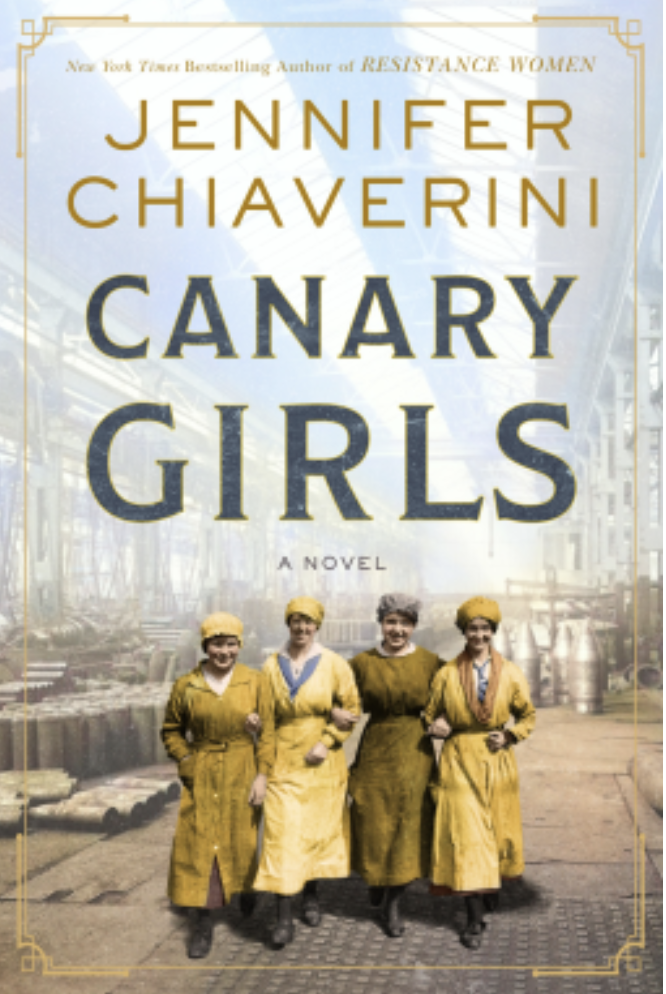
Canary girls by Jennifer Chiaverini (Historical Fiction)

Writing: 4/5 Characters: 4.5/5 Plot: 5/5

A story about Britain’s World War One “munitionettes” — women who answered the call of duty and worked in round-the-clock shifts to produce the much needed munitions for the war arsenal. The label referred to a specific group of munitionettes who worked with the (very poisonous) trinitrotoluene (TNT) which over a short period of time, turned their skin, bleached their hair (green for brunettes and white for blondes), and brought on plenty of health problems, some fatal. The story follows three women from just before war breaks out until it is over: Lucy, married to a professional footballer (that’s soccer to us) and architect; Helen, daughter of an Oxford professor whose husband runs one of the biggest munitions plants; and April, a girl sent into service at 15, who leaves for a better paying, more meaningful job in munitions once the call for women goes out.

Chiaverini’s last book (Switchboard Soldiers) focused on the female Telephone Operators who managed the switchboards in France during WWI (at a time when every single call was connected manually). She brings the same attention to historical detail to this book managing to cover a panoply of issues from the perspective of multiple women who are driving or affected by them . These include women’s suffrage which was put on hold during the war with promises made for after; women’s football, which took off during the war and was brutally shut down by the men’s league until 1971; the massive propaganda techniques used to make men enlist; the pressure on male footballers to enlist when no such pressure was applied to the more elite leagues (golfers, cricketers, and polo players); the impact on British citizens of German heritage, the many fatal accidents at munitions plants; the hunger resulting from German blockades; the posters for “surplus women” to migrate out of country; and the Swiss Medical Mission prisoner exchange (to name just a few!)

I was in awe of her ability to weave in so much about life for these women in that time period in such a meaningful, genuine, and never heavy handed way. Could not put it down. If you haven’t read Switchboard Soldiers, go back and read that one, too.

Great bibliography!

Thank you to William Morrow and NetGalley for providing an advance copy of this book in exchange for my honest review. The book will be published on August 8th, 2023.

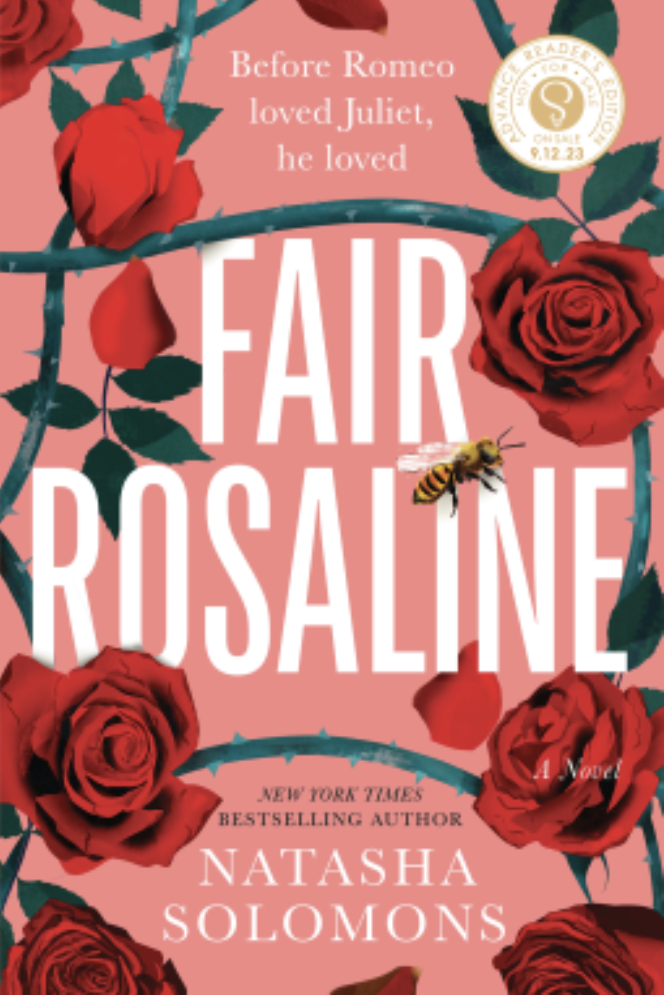
Fair Rosaline by Natasha Solomons (Historical Fiction)

Writing: 4/5 Plot: 3.5/5 Characters: 4/5

A retelling of Romeo and Juliet that cleverly keeps every element of the plot of Shakespeare’s opus while completely shifting the meaning of each scene. This is achieved by making one, rather gigantic change — Romeo is a bad guy. A really bad guy.

The story is told from the perspective of Rosaline — the character with whom Romeo is besotted at the start of the play. In the play neither the audience nor Romeo ever gets to meet her, but she serves as a reference point for Romeo’s unrequited affections and is the reason he shows up at the party where he first sees Juliet. In Solomons’ book, that is all changed because as I said — Romeo is a really bad guy.

The book is very well written. The characters are well drawn, the setting is evoked vibrantly, the plot is gripping, and we get exposed to the hard truths of being a woman in the time period — exposed to all the usual plagues and pestilence while simultaneously having literally no say in any aspect of her life (lots of discussion about nunneries with some interesting surprises). However, I really can’t forgive Solomons for making Romeo into the character she does, and her claims (in the appendix) that her Romeo is more realistic than Shakespeare’s are frankly bizarre. By attributing rapacious intent and a complete disinterest in resulting traumas and hurt to a character who was written to be noble, honorable, idealistic, and passionate — it feels like libel. I don’t honestly understand why she felt the need to do this. The story would have been much more enjoyable (to me) if it weren’t obsessed with rewriting a classic into something that wanted to point the finger to the inherent evil of men. Not to mention the fact that I still had to read through all the tragic events that I knew were coming! So overall, a well-written book, but one that left me unhappy, rather than cheered by the clever way Rosaline “makes everything OK.” Really struggling to not provide spoilers here!

Thank you to Sourcebooks Landmark and NetGalley for providing an advance copy of this book in exchange for my honest review. The book will be published on September 12th, 2023.

At the Edge of the Orchard by Tracy Chevalier (Historical Fiction — Audio Book)

Writing: 5/5 Characters: 5/5 Plot: 4.5/5

This is historical fiction at its best. Not a recounting of precipitous events, but the every day details and inner drives of a family — in this case a family trying to eke a living from an orchard / farm in the Black Swamp of Ohio. The narrative spans the late 1830s to 1856 bouncing around between times and four perspectives: James — with a love of apples and his orchard that borders on obsession; his wife Sadie — overwhelmed by the swamp, stubborn as a mule, and a mean drunk; their youngest son (of 10 children) Robert who is somewhat different from the rest; and their daughter Martha, timid, obedient, and fragile.

I listened to this as an audio book and the four voices were astonishingly good. I took a look at a physical book and think I would have loved reading the book just as much, but the audio definitely added a lot to the experience.

I loved the depictions of real people and events. There is just enough description of apple growing (told from James’ perspective) to be engrossing, but never tedious. Real historical characters pop up with intriguing detail: John Chapman (aka Johnny Appleseed) visits the farm regularly to supply apple seedlings and God Talk; William Lobb (a collector for Veitch Nurseries of Exeter who was rapidly importing all of the “new” plant life found in North America) introduces Robert to the art of plant collecting. Settings from Sacramento gold mining to Ohio camp meetings to new tourist attractions in the newly discovered Sequoia grove populate the story. I was most impressed by the array of survival tactics needed in this hugely different world. No modern sensibilities poked their noses into the narrative, and it occurred to me multiple times how hard a real hard life for some people was. It was survival in a time with little stability and absolutely no backup. Instead there was just mud, swamp fever, real hunger, and ever present danger. Not sure how many of us today would make it past our 20s.

I loved the interior worlds of the four “voices.” They made sense, even when they did things that I thought were wrong, or stupid. Their worldview was coherent and their actions made absolute sense within those worldviews. This is an extremely hard trick to pull off. Stellar writing all around — just the right amount of description — distilling thoughts / actions / scenery into their essence without a lot of extraneous verbiage — great dialog, and fully cohesive characters that are a product of the place and time.
One of my top reads of the year.

Hello Beautiful by Ann Napolitano (Literary Fiction)

Writing: 4.5/5 Characters: 5/5 Plot: 4.5/5

This is a portrait of a dynamically happy, multigenerational family with some serious dysfunctional fractures. As the four incredibly close Padavano sisters grow from childhood to late middle age, we are privy to the interactions, traumas, and healing experienced by everyone in the extended family. Napolitano allows her characters to learn and take risks in relationships and not be stuck doing the wrong thing out of fear or miscommunication. Themes of mental health as well as finding and being true to one’s self permeate the story which explores the impact of death, divorce, and disappointment along with success, love, and belonging on family structures and health. There is a fair amount of drama — it wouldn’t be an Oprah book selection without that — but I was happy to find this was a book about people with problems who actively try to address their own responsibilities in terms of their problems; they are not life long victims or people who continually keep making the same mistakes.

The writing is rich and full of reflection, interaction, and experience. It contains a well structured narrative arc that allows readers to enjoy their intimate time with the family while progressing steadily towards a denouement that works perfectly (although it was both upsetting and surprising to me). I loved the fact that the men in the story had such close friendships and such concern for kindness — nice to see that in male as well as female characters. I really enjoyed the small point made by one character who forgave someone immediately for doing something that was somewhat cruel because she wanted to be able to love that person and couldn’t do so if she felt angry and vindictive. The story includes a nice positive view of therapy and mental health and some great articulation of each individual’s personal discoveries and progress. I found myself thinking that some “solutions” were overly simplistic, but then I really couldn’t defend my own premise. Perhaps they really were core truths rather than sound bites. It was a good feeling.

The Sweet Spot by Amy Poeppel (Literary Fiction)

Writing: 5/5 Characters: 5/5 Plot: 4/5

I enjoyed every minute reading this book. It’s one of those books that you’d turn to rather than most other activities on offer. On the surface (ie the cover) it just looks like a light hearted romantic comedy — which it sort of is — but largely due to the stellar writing it is also a set of lovable and realistic characters, great dialog, and a variety of relationship styles that bear further study.

The stated plot focuses on a baby who lands in the laps of three women — Lauren, a ceramic artist who just got her big break; Melinda, recently dumped after 30 years of marriage and raging for revenge — unfortunately applying said revenge in all the wrong places; and Olivia, the daughter of the bar owner who rents the basement of Lauren’s Greenwich Village brownstone for a song. It’s funny, full of characters who are deeply interesting rather than quirky on the surface, and steeped in New York city culture and habitats. Lots of fun — I can’t remember where I heard about it, but I’ll certainly go back and read some of her other books.

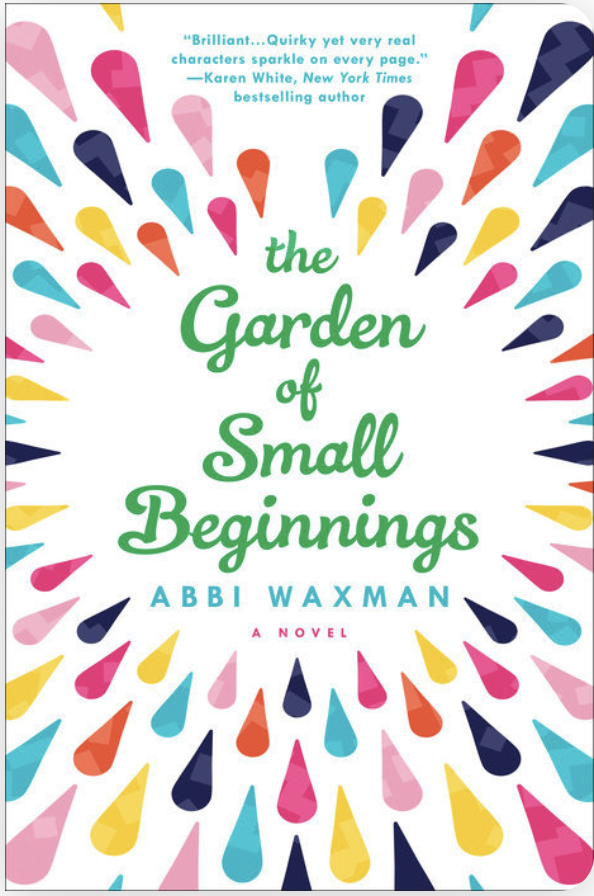
The Garden of Small Beginnings by Abbi Waxman (Audio Book)

Writing: 4.5/5 Characters: 5/5 Plot: 4/5

Four years later, Lily is just barely getting her life together and keeping the grief to a simmer after her husband is killed in a car accident mere feet from the family home. But this is honestly not a sad book (although the author does a good job of exploring how Lily does claw her way back up out of the grief trough). Instead it’s uplifting, humorous, and meaningful all at once.

An illustrator for children’s textbooks, Lily is sent off to a gardening class at the L.A. Botanical Garden to become one with the vegetables she will need to illustrate for a brand new client. She takes her two children (5 and 7) and her sister Rachael with her, and to say the class is populated with some wonderful characters is an huge understatement. The book is clever, literary, and linguistic — I love that Waxman is both a fantastic writer and chooses to write a world where bad things happen, but the individuals involved can make good things happen too. Her characters have agency. I also like the way she works with stereotypes and diversity issues — tackling the assumptions people make about each other and the surprise and follow up understanding when their assumptions are challenged. Very skillfully done.

I listened to this on audio book and the reader was fantastic. I probably would have preferred to read it in book form, though, because I like to savor Waxman’s writing and that is hard to do when you’re listening (and driving, hiking, or otherwise too busy to stop and do some kind of audio underlining). I did manage to capture a couple of lines though: “Just turn the handbag of your soul inside out, and shake it“ and “She has people skills like lions have gazelle skills.” As a bonus, there was a lot of actively good gardening instructions, given in small, digestible, pockets. Take note!

They May Not Mean To, But They Do by Cathleen Schine (Audio Book – Literary Fiction)

Writing: 5+/5 Story: 4.5/5 Characters: 5/5

I love Schine’s books. She is better able to get into the head of wildly different people than almost anyone I can think of. This book is a story about aging and the multiple familial pressures and experiences that are inextricably linked to the process. Joy is the octagenarian matriarch of a New York Jewish family whose husband is ever more rapidly sinking into dementia. When he dies about half way through the book, her children are anxious to solve her loneliness and despair but she is equally anxious to mourn in the way she chooses and to maintain her own life, rather than be absorbed into one of theirs (or, God forbid, be stuffed into an assisted living facility).

I loved so much about this book which was brought to life magnificently by the narrator who has the NY Jewish grandma voice down cold. The ongoing reflection about her own aging; her deep mourning for her far-less-than-perfect husband who she had nevertheless loved completely; her equally deep love for her children coupled with an outrageously growing irritation at their increasing need to boss her around and intrude on her own life plans; the search for belonging when a long term spouse dies — it’s all there and wrapped beautifully in the every day experiences of herself, her children, and her grandchildren. Joy has a wicked sense of humor, a realistic handle on what is happening, and an old flame perking up the picture, so this is by no means a depressing book. Just completely insightful. While the other characters — her two children, her daughter’s wife, all three grandchildren — were fleshed out fully, it was clearly Joy that I resonated with (despite her annoying lack of organizational skills and the fact that I am almost 30 years younger!)

I listened to this on audio so I don’t have captured quotes, but here are some of the concepts I just loved reading about: Joy thinks of her own mother and how she (Joy) could not understand her (the mother) the way she had needed to be understood when she (the mother) was aging. Joy begins to feel there is another person in the apartment and it was she. She had to constantly watch “it” to make sure it took its pills and didn’t fall etc. She doesn’t want to be a burden, but if she is one, she wishes others could carry her with more grace.

One more note — the title comes from the Philip Larkin poem “This Be The Verse.” It’s quite apt.

August Blue by Deborah Levy (Literary Fiction – Audio Book)

Writing: 5/5 Characters: 4.5/5 Plot: 4/5

A beautiful book about self-discovery, identity (in the classic sense), and a search for “home” amidst the angst and displacement of Covid. The music and musical themes that lay at the absolute center of the story had wonderful depth and were enlightening, inspiring, and real. I listened to this as an audio book. It was narrated by Alix Dunmore who was so good that I’m seeking out her other narrations because she put a voice to the prose so very well.

Elsa M. Anderson — a former child prodigy — was at the height of her career as a pianist when she walked off the stage in Vienna in the middle of a performance of Rachmaninoff’s second piano concerto. Now there is a pandemic on, her teacher (who adopted her at age six) is dying far away in Sardinia, and Elsa is roaming Europe, teaching a few lessons, playing very little, and allowing herself to go wherever currents take her. She sees a woman in Athens who she feels is her double, and sees her repeatedly throughout the story, serving as a kind of foil that both drives Elsa and causes her to reflect.

The writing is beautiful — poetic, but not to the point of losing content. I would have many quotes if I weren’t listening to it without an opportunity to write them down. I loved the other characters and the interactions that allowed Elsa to learn more about herself with every engagement. I loved the role of music and how it informed the very way she thought. I loved the way she taught music sensitivity to a young and brilliant student with an overbearing parent. I love the interplay between music, life, and emotions that comprises the mind of a true musician. I loved the fact that the ending didn’t really tell you what would happen in the future, but I was left with a sense of where she was going simply from “living her life” with her. In case you can’t tell, I loved this book!

Lastly, while I don’t have an exact quote, I very much liked Elsa’s answer when her friend mocked her (Elsa’s) interest in Isadora Duncan, who he said was “ridiculous.” Elsa retorted that she (Isadora) had to be ridiculous because she was making something new. That made me think.

Thank you to Macmillan Audio and NetGalley for providing an advance copy of this book in exchange for my honest review. The book will be published on June 6th, 2023

Orchid Child by Victoria Costello (Literary Fiction)

Writing: 3/5 plot: 4.5/5 characters 3.5/5

Kate is a neuroscientist, on her way to a new position in Ballymore, Ireland having been fired from her prestigious New York City based position after an ill-advised affair with her married boss. Ballymore has an historically high rate of schizophrenia, and she has been hired to work on a new followup study on the descendants of the original 1970 work. She brings along her newly adopted nephew, Teague, who is suffering from schizophrenic symptoms and whose therapeutic care is part of the new job package.

What ensues is a tangled, multi generational story (the narrative follows two timelines — Kate’s story in 2002 and the history of her family from 1920 through 1974). Between the two, we are exposed to Irish folklore, long term feuds based in the Irish “Troubles,” druids, and (most interesting to me) multiple approaches to treating and supporting schizophrenics. These approaches include support from therapists following real (I checked) research results, recommendations from “Mad Pride” activists who avoid medical intervention for mental illness, and the consideration that those who claim to hear the voices of their dead ancestors, really can.

There were enough interesting (and new to me) concepts to keep me reading to the end — I really wanted to know what happened. I thought the writing could use some editing — it was messy with a lot of rambling details and I found the dialog a bit stilted. I liked some of the characters more than others and definitely found the different attitudes towards schizophrenia fascinating. I didn’t personally like the main character, although I know I’m supposed to! Of course, I’ve never walked in her shoes (and the author’s bio suggests that she has), so I can’t really judge. My favorite part was reading about treatment modalities based on new (around the 2002 timeframe) research in neuro-epigenetics and the Orchid Child hypothesis (google it). The focus was primarily on the help people need and mostly avoided any discussion of the very real danger some mentally ill people could be to others when not adequately supervised / managed — I always wish reports and stories could be more balanced in this regard.

Some quotes, which reflect more of the plot than the writing style:

Quotes:
“In the parlance of researchers, they were the orchids, prone to dysfunction. When faced with the stressful choice of which lever to push to get their next drink of syrupy water, orchids sat and trembled with indecision. Their luckier peers, her control group, born with a longer form of the same gene, were hardy like dandelions — a group with which she wholly identified.”

“The Celts called it second sight. In our profession, we throw it all under the label of psychosis. Or we assigned patients different positions on a spectrum of abnormality.”

“You all suffer from the same wound, which festers as each generation fails to face it head on.”

“Let’s say you re-enter your body with the intention of telling the story of what happened to you today in whatever medium you choose. You can be sure that one of your ancestors is seeing and feeling that story in his on time as a powerful premonition.”

Thank you to Between the Lines Publishing and NetGalley for providing an advance copy of this book in exchange for my honest review. The book will be publlished on June 13th, 2023

Dreams of Arcadia by Brian Porter (Literary Fiction)

Writing: 4/4 Characters: 5/5 Plot: 4/4

A gentle book about an East Texas veterinarian who leaves Houston (and the end of a disappointing marriage) for the rural lands of his father’s youth. The main character is very human and very relatable — he is supported by a whole array of well depicted and quite real people from the individuals in the small town to his many relatives, most of whom he hasn’t seen in years (or has never actually met). There is quite a bit of description of the landscape, the real (and brand new to me) day to day big (and small) animal vet cases and procedures, and his own internal thought processes. As he works to solve the little (but critical) every day mysteries that populate his profession and interpersonal engagements, he is able to find a place for himself that feels (finally) like home. I particularly liked the solution to the issue of one family’s ailing cows when no diagnostic test could turn up any problems. I won’t give it away here!

Thank you to Legacy Book Press LLC and NetGalley for providing an advance copy of this book in exchange for my honest review. The book will be published on June 27th, 2023