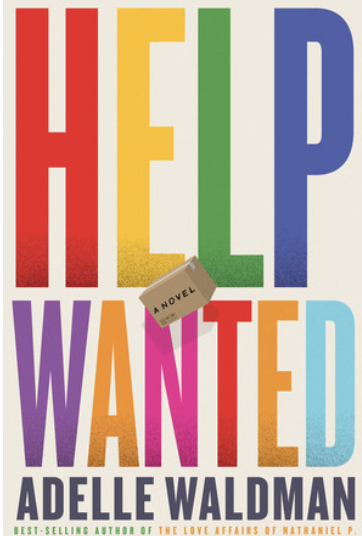
Help Wanted by Adelle Waldman (Literary Fiction)

Writing: 5/5 Plot: 3.5/5 Characters: 5/5

A surprisingly engaging book about a set of bottom of the ladder retail workers and their hopes for more hours and some hope of upward mobility. They have a lot working against them — their hours are minimized to avoid having to pay benefits; each character faces his or her own limitations — a learning disability; a thick accent; trying to go straight when drug dealing is SO much more lucrative; false arrests; mental illness; single parenthood; transportation issues; and even lack of generational wealth. The characters have a lot of depth — none of the above is dealt with in any kind of stereotyped way.

But the book doesn’t take the easy way out — there is no blaming of corporate policies or resentment of management. Instead we get a pretty in-depth view of the situation through the eyes of different workers — each with his or her own thoughts, skills, goals, regrets, and fears. And — again through the voice of individual characters — some pretty interesting (and varied) analyses of the how things got to be the way they are.

The book description calls it “incisive and very funny” — I agree with the incisive part but although the story resisted the slide into depressing territory, I wouldn’t exactly call it funny. However, it is very well written and boasts excellent characterization, and after an initial irritation at what promised to be a stupid (IMHO) plot (but then wasn’t), I ended up enjoying it a lot.

The Edge of the Crazies by Jamie Harrison (Mystery)

I quite enjoyed this new (to me) mystery series taking place in small town Blue Deer, Montana. This is book one of what is currently a set of five books, but I believe it is a recent release of the audio book (I liked the narrator, Justin Price, a lot — had a real Montana sound to him).

The independently minded characters gave off a real Montana vibe, without straying too far into stereotype (and not terribly accurate) portrayal of the Montana resident.

Jules Clement was born and raised in Blue Deer, escaped to the East Coast for education and adventure, and then in a surprising move (even to himself) went back to Blue Deer to take up the usually straightforward position of Sheriff. Not so straightforward during this story, though. What starts as someone taking a potshot at a local screenwriter, turns into something else completely as the bodies start piling up and seem to connect in some way to a 20-year old accident.

While I would not say that many of the characters were likeable, they were all interesting and had their own kind of depth. The story was slow paced, but not overwhelmed by filler, and I never got bored (which is saying a lot). I loved the character of Jules, whose personality contained many contradictory elements. I’ll definitely be pursuing books 2-5.

Thank you to Highbridge Audio and NetGalley for providing an advance copy of this book in exchange for my honest review. The book was published on November 5th, 2024.

Who Will Remember by C. S. Harris (Historical Mystery)

Number 20 in the historical mystery series featuring Sebastian St. Cyr, Lord Devlin. Throughout the series, Harris has successfully embedded each volume in an historically accurate period — this one is no exception. It is set in London in August, 1816, the year that “had no summer.” Later historians promoted the cause as a large volcano explosion that blocked the sun causing weather abnormalities, floods, and massive crop failures leading inevitably to riots, strikes, apocalyptic fears, and the potential for revolution.

In this milieu, the body of a Lord is found in an abandoned chapel, hanging upside down with legs posed as depicted on a rare set of tarot cards (Le Pendu — the Fool). From here connections are made to French assassins, the Prince of Wales, friends made during the 1808-9 British retreat across Northern Spain (Battle of Corunna), and a particular (nasty) society called the Society for the Suppression of Vice.

I always like the characters in these books — representing multiple walks of life and varied ideas of morality. I particularly like the depiction of the members of the “ton” — a term for the fashionable members of upper class English society during the Regency period. As one might expect, those characters run the gamut from utterly selfish, corrupt, and “above the law” to considerate, moral, and obsessed with a fair justice. Always fun to guess which is which upon the first “meeting.”

Thank you to Berkley and NetGalley for providing an advance copy of this book in exchange for my honest review. The book will be published on April 25th, 2025.

Esperance by Adam Oyebanji (SF / Mystery)

Writing: 5/5 Characters: 4/5 Story: 4/5

Part (very weird) murder mystery, part speculative fiction and a wow ending — Esperance is an evolving surprise from start to finish.
Ethan Karol is the Chicago PD detective trying to solve the seemingly inexplicable murder of a father and son, found drowned in seawater next to a large (also dead) fish on the 20th floor of a fashionable apartment building. Meanwhile, Abidemi Eniola is roaming the streets of Bristol (England), dressed in 30s attire, speaking in a weird accent, and full of technological trickery that is beyond anything her accidental sidekick, Hollie, has even considered possible. And both Karol and Eniola appear to be trying to track down a very specific, long ago sea captain…

All the characters are fun to read and slowly learn about. Character insight comes through action and behavior more than any kind of introspection. Themes of racism, justice, and intergenerational trauma are core to the story, but (IMHO) serve primarily as background motivation for what is an intense, action filled set of pages. In truth, a little more action than I usually care for, but so well-written and full of surprising twists I didn’t even have time to complain (to myself).

I’ve read all four of Oyebanji’s books in the last four months and they have all been written (or at least published) in the last three years. This is promising! Two books are straight up mysteries (not cozies, but also not too thrilling for me) and two are SciFi Crime / Mystery. Author has exactly the kind of interesting bio that leads to creative plots and unusual characters. I’ll be keeping an eye out for all his new, apparently rapidly produced(!), works.

Thank you to DAW and NetGalley for providing an advance copy of this book in exchange for my honest review. The book will be published on May 25th, 2025.

The Grey Wolf by Louise Penny (Mystery / Thriller)

Writing: 4/5 Characters: 3/5 Plot: 3/5

If you have liked every Louise Penny book so far, you will probably like this one, too. Gamache gets pulled into a mystery that smacks of domestic terrorism and calls into question everything (and almost everyone) he thought he could trust.

Penny writes taut, suspense-filled crime fiction with very accessible prose — this was an easy read for me — but I did not find myself enjoying it, and I’m not sure I will keep reading the series (despite the fact that I’ve read them all and pre-ordered this book in my enthusiasm!).

As the series has progressed (this is book 19), the stakes have gotten higher — too high. I preferred the highly psychological, small-scale, surprisingly twisted murder mysteries to these large-scale, conspiracy oriented, thrillers. At the same time, this book had a lot of filler. I love Three Pines (the town) and the many interesting characters we have come to love over the past two decades, but there were far too many filler scenes emphasizing the bounty of their lives: Many (too, too, many) food and wine descriptions, children bouncing around doing cute things, the love between our aging inspector and his (too) saintly wife. Somehow in this book this filler simply became too repetitive and too content-free to keep my interest during the many pages they occupied. Lastly, I honestly had a hard time believing that there could be a conspiracy to do something as deadly as planned, without any motive other than (apparently) power, that managed to attract so many previously decent people.

So in summary — second half a good crime thriller, characters had far less depth than they had in the earlier works; writing a little less polished — but an entertaining enough read.

Back After This by Linda Holmes (Rom-com)

Writing: 5/5 Characters: 4/5 Story: 5/5

I really enjoyed this (very) funny, well-written, and actually insightful rom-com written by the author of Evvie Drake Starts Over. I like rom-coms when they are clever, witty, and most of all — NOT STUPID. I can’t stress that last quality enough. This was a perfect, read-in-one-sitting exemplar of exactly what I love in a rom-com and perfect for this stressful season.

Cecily is a podcast producer who agrees (think forced, bribed, coerced) to star in a podcast about modern dating with the help of a dating guru / popular Influencer. An introverted audio nerd by nature, this takes her so far out of her comfort zone that she feels impending implosion looming everywhere. Plenty of (well-paced, well-written) comedy follows, but I was impressed that she gained some real insight into aspects of her own personality that were getting in the way of her getting more of what she wanted from life. While I can’t bear to read about physical makeovers, psychological makeovers — are fascinating.

As an aside, I learned interesting components of podcast production (and marketing) which were new to me and described with a depth that showed true understanding on the part of the author (pet peeve: I hate when characters have a huge passion for something but then never do or think about it in any meaningful way).

A cross between Lori Gottlieb and Curtis Sittenfeld — the best of them both!

Some great quotes:
“I wondered exactly where that research had been done. Presumably the University of Unsupported Hunches, where I was guessing she was a tenured professor.”

“He took me to an ax-throwing bar on our first date, and he was very good at ax-throwing, which I suppose impressed me, because you never know when you might need a guy who can kill a monster in a cartoon dungeon.”

“But we finally agreed on a loose top that fell off one of my shoulders and a pair of pants that had just enough stretch to accommodate my newly emphasized hips without making me look and feel like a vacuum-sealed pork shoulder, ready for a sous vide bath.”

“He had the facial symmetry and the perfectly shaped dark hair of a Lego prince.”

“I tried to dig my smile out of the recesses of my personality.”

“It made for a long dinner, learning quite that much about Andrew’s gym routine.”

Thank you to Ballantine Books and NetGalley for providing an advance copy of this book in exchange for my honest review. The book will be published on February 25th, 2025.

Death of the Author by Nnedi Okorafor (Literary / spectulative fiction)

A captivating book about Zelu — a disabled Nigerian American author (unpublished) and teacher who gets cancelled (and fired) due to her insensitivity (really deeply provoked impatience!) with her more irritating students. It’s also about the new book she writes — Rusted Robots — which becomes an overnight sensation. A post-apocalyptic story where robots and AI are at war over the tattered remains of human civilization, Rusted Robots brings her fame, fortune, some wild, tech-based opportunities, and a whole lot of people who suddenly feel entitled to tell her exactly what to do.

There are so many intellectually interesting and intersecting threads in this story — AI and automation, family, gender roles, African culture, authorial creativity and control, fame, freedom vs safety, disabilities, and the balance between individual and society — but the overarching theme is one of my favorites: the place of narrative and story in human culture. After all, I read fiction because I seek understanding, not just information.

Okorafor manages to blend multiple genres brilliantly, and since I am a fan of both literary and speculative fiction, I was riveted from start to finish. The characters were drawn so deeply — like all of my favorite people, they seemed to be compelling, annoying, loud, supportive, controlling, and caring all at once. I appreciated the fact that while most of the characters were Black (with the exception of the “wealthy white dudes” who keep finding her), there was no antipathy towards white people, just more of a lack of interest.

The big twist at the end absolutely blew me away. And a last little make-me-happy tidbit? She included a call out to one of my favorite (and fairly obscure for the U.S.) books — So Long A Letter by Mariamba Ba.

In my Top Reads of the Year list.

Quotes:
“The rusted robots in the story were a metaphor for wisdom, patina, acceptance, embracing that which was you, scars, pain, malfunctions, needed replacements, mistakes. What you were given. The finite. Rusted robots did not die in the way that humans did, but they celebrated mortality. Oh, she loved this story and how true it felt.”

“The capitalism machine had used her book, her attempt at shouting into the void, to make visual comfort food for drowsy minds.”

“She thought about Rusted Robots and the main character, who understood deep in her circuits that true power was in the harnessing of it, not the possessing of it. And when you were aware of the moment you harnessed power, that was when it was most difficult to navigate.“

“Narrative is one of the key ways automation defines the world. We Humes have always been clear about this fact. Stories are what holds all things together. They make things matter, they make all things be, exist. Our codes are written in a linear fashion. Our protocols are meant to be carried out with beginnings, middles, ends. Look at how I have been built. My operating system is Ankara themed, my body etched with geometric Ankara designs. I’m the embodiment of a human story. But true storytelling has always been one of the few great things humanity could produce that no automation could. Stories were prizes to be collected, shared, protected, and experienced”

Thank you to William Morrow and NetGalley for providing an advance copy of this book in exchange for my honest review. The book will be published on January 14th, 2025.

The World’s Fair Quilt by Jennifer Chiaverini (Women’s / Historical Fiction)

Another installment in Chiaverini’s feel good Elm Creek quilts series. While appearing like basic Women’s Fiction (not really my thing), I like this series for two reasons: I like the characters and the way of life they represent, and I love the “every person history” stories of the featured piece of the past.

This book recalled the 1933 nationwide quilting contest sponsored by Sears Roebuck. With a grand prize take of $1,200 in prizes (remember — this was depression era) and the best quilts to be displayed at the Chicago World’s Fair, it garnered over 25,000 entries. In our time, when you can see / experience anything with a tap on the screen, I enjoyed the excitement and wonder the book made me feel along with a couple of expert (but teenaged) quilters entering the contest. Their thoughts (and designs) on the contest’s theme (“A Century of Progress”) was excellent history and told completely within the context of the time period.

I also like the way the characters in these books tackle life — with strength and fortitude, a network of supporters, and a focus on doing the right thing. There is plenty of adversity (this isn’t a fairy tale) but little complaining, little blaming on past events, and little neuroticism. Kind of refreshing 😉

Thank you to William Morrow and NetGalley for providing an advance copy of this book in exchange for my honest review. The book will be published on April 1st, 2025.

Where Serpents Sleep by C. S. Harris (Historical Mystery — Audio Book)

This is the fourth book in the Sebastian St. Cyr mystery series. I listen to them on audio book because the reader — Davina Porter — is the absolute best, with convincing “voices” for characters of all backgrounds, genders, professions, and place of origin accents. I highly recommend listening to, rather than reading, this series, despite the fact that I am primarily a book reader. The series starts in 1811; this fourth book starts in 1812. The Napoleonic Wars are in full swing and the upstart Americans are giving the British trouble (think “the War of 1812”). This book concerns itself with the killing of eight prostitutes who were sheltering in a Quaker house of refuge.

So why do I love this series so much? The characters — even those who appear in only one book — are fully fleshed out with time and place appropriate personalities. They run the gamut from nobility (both the utterly self obsessed and the more humane) to street urchins, with each novel bringing to light the experiences and behaviors of those in professions we don’t often hear about: for example, the chimney sweep boys or young prostitutes. The historical setting comprises all manner of detail from political power struggles, foreign policy and entanglements, the class system, and quite often the roles allowed or foisted upon women. Some wonderful strong female characters, along with those portraying more negative female stereotypes of the time. And always convoluted plot lines that introduce the reader to more of the time period — (often ridiculous) laws, the constabulary, power machinations, diplomacy, etc.

The main character is Sebastian St. Cyr — heir to an Earl and with a piercing intelligence. At 29, he has already seen quite a bit of military service and is a very impressive fighter as demonstrated through many action oriented scenes, none of which last longer than my low tolerance for extended action scenes allows. While one description called him an anti-hero (I’m guessing because he has no trouble dispatching people who are in the process of trying to kill him), I think he makes the perfect hero, with his strong regard for justice for all people (not just those with a title), and the ability to correct injustices with the combination of rank, privilege, physical prowess, courage, intelligence, and an unbreakable moral code.

While I started reading this series somewhere in the middle, and bounced about for a while, I’m now going back to the beginning and stepping through all the installments that I missed.

Show Don’t Tell by Curtis Sittenfeld (Literary Stories)

A set of short stories with such thorough character development and such clear, succinct, and essence depicting prose that I read the whole set without once wishing I were reading a novel instead (I tend to get bored with short stories about 1/3 of the way through the collection).

The stories run the gamut of professions, relationship statuses, races, and problematic situations. Just about all of them got me thinking about some little aspect of life that I hadn’t necessarily considered before. While the characters are all different, they do seem to all share an earnestness, a tendency toward reflection, a (shared with us) path to insight, and a focus on whether or not they are, indeed, good people. A few over thinkers (unfortunately, I do identify with this). I loved the exploration of human fitness and honesty within relationships. There is plenty of dramatic tension, but of the “it could happen to me” variety and not the melodrama that so many people seem to crave.

I liked all of the stories but here are a few that tickled my thinking bone: a VP of film production heading to Alabama to convince the religious author of a popular marriage book to allow a gay couple in the movie; a babysitter for a future internet billionaire; a woman researching the “Billy Graham rule” that “if you’re a married man, you don’t spend time alone with another woman;” a covid story that unearths strange behavior patterns in a long time couple.

Quotes:
“He’s the kind of writer, I trust, about whom current students in the program have heated opinions; I’m the kind of writer their mothers read while recovering from knee surgery. To be clear, I’m mocking neither my readers nor myself – it took a long time, but eventually, I stopped seeing women as inherently ridiculous.”

“Even if it takes a month to get through a novel, the ritual still anchors me, the access to lives I’ll never live.”

“Among the gifts Alison had given me years before when she said ‘only white women are afraid of getting old’ was the reminder, at a time when I’d needed it, of just how many cultural narratives were optional rather than compulsory.”

“I hadn’t thought adulation was something I wanted or needed; I had thought companionship sufficed. But I’d failed to anticipate how calamitous the standard erosion of affection over time could be when you started with a modicum as opposed to an abundance.”

“Not for the first time, it occurs to her that perhaps, rather than exploring the customs of married, heterosexual socializing, she is inadvertently demonstrating the isolation of modern life.”

“I’d noticed over time that neither she nor Cheryl insulted themselves in the reflexive, somewhat disingenuous way my white friends did; Allison and Cheryl didn’t use self-criticism as a bid for either praise or bonding.”

Thank you to Random House and NetGalley for providing an advance copy of this book in exchange for my honest review. The book will be published on February 25th, 2025.