
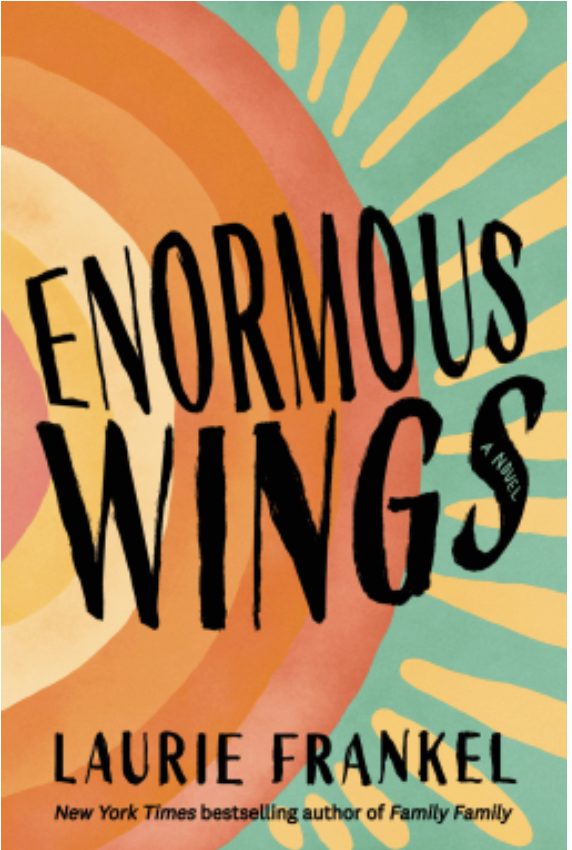
Enormous Wings by Laurie Frankel (Literary Fiction)

I wanted to like this book — Laurie Frankel is a fun and sharp writer and I loved Family, Family. She excels at writing families who are faced with every permutation of reproductive drama — unwanted pregnancies, adoptions, abortions, you name it — and who deal with them in an abundance of creative ways. This book’s discombobulating surprise? Pepper Mills — a 77-year old woman recently shunted to an old age home by her well-meaning but (in her opinion) overly controlling children — finds herself … pregnant! A bizarre situation by any standard but in this case, she also happens to live in Texas — home of some of the most “innovative” no-abortions-allowed legislation. (To be fair, we do get an explanation later in the book that does make this pregnancy more plausible than it first appears).

I loved the humor which is wry, supported by a fair amount of carefully launched sarcasm, and reminiscent of the Jewish family I always wished I lived in. I also loved the discussions, the ethical (and bizarre) questions, and every single one of the primary characters including a great set of “oldies” at the Home, and the myriad children and grandchildren who all add their personal (and multi-generational) slant to the events. I really loved the many one liners that had me laughing out loud — this woman can write! And how can you not love Pepper? Her thoughts, irritations, and love for each individual she connected with are coupled with her absolute insistence on good grammar! I’m not actually very good with grammar myself, but I really appreciate those who are.

My only complaint — and it was big enough to warrant my dropping the rating a point — is that the book was too long and spent much of that excess length on a long pro-choice / anti-Texan rant lecture. I am, and always have been, pro-choice, and I think the recent anti-abortion laws in Texas are wrong in so many ways — but I still resent the incredibly heavy handed depiction of people in Texas (including doctors) who are two-dimensionally mean and manipulative with their only goal appearing to be keeping women under control. It’s a long-standing technique in the world of fiction to make the bad guys really, obviously, Bad. It makes it easier to hate them and side with the author’s idea of the “good” people. But in our era of extreme polarization and encouraged hate, I’m pretty sick of it. I’m sure I’m overreacting here, but it really spoiled the book for me. Too much pounding of the message, even though the message was well-established from the first pages and anyone who was reading this probably already in agreement.

So — fun to read if you can ignore the stereotyped baddies and skim a bit at the end…

Thank you to Henry Holt & Co. and NetGalley for providing an advance copy of this book in exchange for my honest review. The book will be published on May 5th, 2025.

Behind You Is the Sea by Susan Muaddi Darraj (Literary Fiction)

Writing: 5/5 Characters: 5/5 Plot: 4.5/5

This is a beautifully written novel composed of interlinking stories about characters in a Palestinian-American community in Baltimore. Most are members of three families: the Baladis, Salamehs, and Ammars. The stories move linearly forward in time, while bouncing between different individuals and their points of view. This means that the narrative slowly moves from first generation immigrants to younger family members born in the U.S. Influences from their ethnic heritage and the American culture surrounding them drift downward through the generations, melding uniquely in each individual making for nuanced, discrete characters. This creates a kind of narrative arc through the stories so that it did feel novelistic despite the clear boundaries of the stories.

I enjoyed the diversity of the characters — more akin to the everyday “diversity” of different human beings than to the diversity of skin color or ethnicity since (almost) all the characters were Christian Palestinian-Americans. Some wealthier, some poorer, some professionals, some working class, from real estate moguls to housekeepers. Many stories dealt with some aspect of being a woman within this culture, ranging from pregnancies to divorce to education — basically different ways that women might make decisions that did not align as well with family expectations as some families might expect. However, family reactions were not all the same — sometimes the father would be unhappy (to various extents), sometimes the mother (or the aunt, siblings, etc). Sometimes things escalated badly, and in others acceptance and adaptation was the name of the game. Real people — all in the same “place,” all with different stories. Topics run the gamut include generation conflicts, teenage afflictions, racism (in multiple directions), domestic abuse, cultural misrepresentation, etc. From minor issues to major. Some sweet and uplifting, and some not, but all moving towards understanding and growth.

Beautifully written, wonderful characters, little or no political statements — see some quotes below.

Quotes:
“The day he dies, Baba looks skinny and surprised. When he sucks in the last breath, his mouth opens in an O, like America has shocked him at last, and freezes there. It’s like he finally understood he was never meant to win here.”

“Americans like to talk about everything, I know. They like to share their feelings, like purging old clothing, or dumping clutter. But when you’re like us, you purge nothing. You recycle or repurpose every damn thing. Nothing is clutter.”

“Arabs are ridiculous; even if they live a dream life, they want to star in some tragedy. If there is no tragedy, they imagine one.”

”Sometimes I think that is why I like science. Science doesn’t mind when you make a mistake. Instead, science gets kind of excited.”

“No, with the baby, with Baba fading, with ever-present work stress, now is a time to lie in the weak surface of water, to trust that its fragility could nevertheless keep her afloat. It could even, despite its transparency, carry her great distances.”

“Marcus realized then that, while some people talked about growing up poor, his parents had been a whole different level of poor. Barefoot poor. Starving poor. Babies dying from diarrhea poor, like Mama’s little sister, Amal, who had died before she was a year old. Sleep on rooftops in the summer poor. Go to mass at two different times so your siblings can share the good shoes poor. Boil weeds to make tea poor.”

“Americans like to talk about everything, I know. They like to share their feelings, like purging old clothing, or dumping clutter. But when you’re like us, you purge nothing. You recycle or repurpose every damn thing. Nothing is clutter.”

“Arabs are ridiculous; even if they live a dream life, they want to star in some tragedy. If there is no tragedy, they imagine one.”

”Sometimes I think that is why I like science. Science doesn’t mind when you make a mistake. Instead, science gets kind of excited.”

“No, with the baby, with Baba fading, with ever-present work stress, now is a time to lie in the weak surface of water, to trust that its fragility could nevertheless keep her afloat. It could even, despite its transparency, carry her great distances.”

“Marcus realized then that, while some people talked about growing up poor, his parents had been a whole different level of poor. Barefoot poor. Starving poor. Babies dying from diarrhea poor, like Mama’s little sister, Amal, who had died before she was a year old. Sleep on rooftops in the summer poor. Go to mass at two different times so your siblings can share the good shoes poor. Boil weeds to make tea poor.”