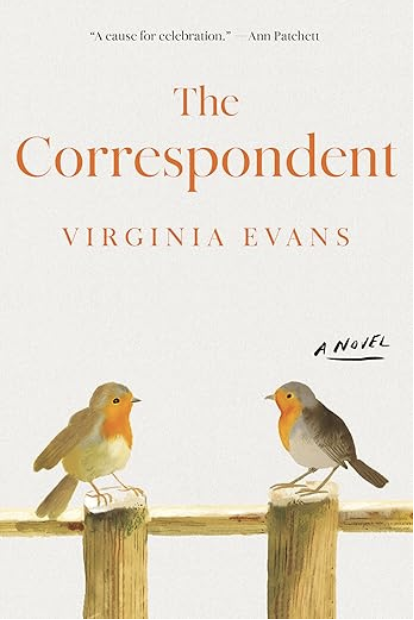
The Correspondent by Virginia Evans (Literary Fiction)

This book is so beautiful, so elegant, and so full of depth I’m finding it almost impossible to write a meaningful review. Sybil Van Antwerp — a woman in her 70s — has lived a full life as a distinguished lawyer, wife, mother, and friend but over the five years of this epistolary novel, she has cause to reflect on her choices, her options, and her very real regrets. Through letters to (and from) friends, relatives, neighbors, stubborn academic deans, a precocious (and somewhat troubled) child of a colleague, a disgruntled (with reason) person from her past, and yes, the tech support person who helps her with the DNA test kit gifted her by her son — we are able to know Sybil with a depth difficult to reach even with those we are closest to.

Sybil (and Evans obviously) turns letter writing into an art form — these letters were simultaneously beautiful to read (clear, to the point, brimming with essentialness) and a piece of a puzzle as the archivist in me sought to piece it all together. I found myself in a constant state of intellectually stimulation while simultaneously moved to wonder or tears. I loved her letters to authors — Joan Didion, Larry McMurtry, and Ann Patchett to name a few — and their letters in return (I’m quite curious about how the author did that). I loved her taste in books as depicted by the exchanges with her sister-in-law — Ishiguro, Verghese, Patchett, Sue Miller, Stegner — so many of my favorites.

The writing, pacing, closure — all incredibly well-done. I wish I could remember how I even found this book — it wasn’t through my regular channels. For me, this was one of my top reads — I’m having trouble thinking of a book I liked more.

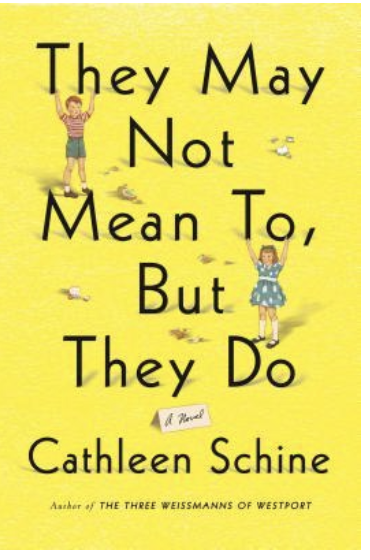
They May Not Mean To, But They Do by Cathleen Schine (Audio Book – Literary Fiction)

Writing: 5+/5 Story: 4.5/5 Characters: 5/5

I love Schine’s books. She is better able to get into the head of wildly different people than almost anyone I can think of. This book is a story about aging and the multiple familial pressures and experiences that are inextricably linked to the process. Joy is the octagenarian matriarch of a New York Jewish family whose husband is ever more rapidly sinking into dementia. When he dies about half way through the book, her children are anxious to solve her loneliness and despair but she is equally anxious to mourn in the way she chooses and to maintain her own life, rather than be absorbed into one of theirs (or, God forbid, be stuffed into an assisted living facility).

I loved so much about this book which was brought to life magnificently by the narrator who has the NY Jewish grandma voice down cold. The ongoing reflection about her own aging; her deep mourning for her far-less-than-perfect husband who she had nevertheless loved completely; her equally deep love for her children coupled with an outrageously growing irritation at their increasing need to boss her around and intrude on her own life plans; the search for belonging when a long term spouse dies — it’s all there and wrapped beautifully in the every day experiences of herself, her children, and her grandchildren. Joy has a wicked sense of humor, a realistic handle on what is happening, and an old flame perking up the picture, so this is by no means a depressing book. Just completely insightful. While the other characters — her two children, her daughter’s wife, all three grandchildren — were fleshed out fully, it was clearly Joy that I resonated with (despite her annoying lack of organizational skills and the fact that I am almost 30 years younger!)

I listened to this on audio so I don’t have captured quotes, but here are some of the concepts I just loved reading about: Joy thinks of her own mother and how she (Joy) could not understand her (the mother) the way she had needed to be understood when she (the mother) was aging. Joy begins to feel there is another person in the apartment and it was she. She had to constantly watch “it” to make sure it took its pills and didn’t fall etc. She doesn’t want to be a burden, but if she is one, she wishes others could carry her with more grace.

One more note — the title comes from the Philip Larkin poem “This Be The Verse.” It’s quite apt.

Olive, Again by Elizabeth Strout (Literary Fiction)

Writing:  4.5 /5 Plot: 4/5 Characters: 4.5 /5

Olive Kitteridge — gruff, direct, honest and with absolutely no patience for pretense or pretentiousness. Some people love Olive for just this reason — many others consider her a rude “old bag”.  I love the fact that Olive — in her late seventies now — continues to have epiphanies about herself and her life.

The book is a collection of snapshots of life in the coastal town of Crosby, Maine. Some are centered on Olive herself, but in others she plays only a peripheral, though impactful, role. Ranging in age from middle school to elderly and incorporating contextual situations such as drug use, sexual harassment, suicide, Somali immigration, and even the value provided by a dominatrix (!) — the stories are full of introspection and reflection. They are more about how people absorb experiences into their own perspective, rather than the experiences themselves.

Strout is the master of the imperfect relationship — no closure, no solutions — just the reality of evolving relationships with ups and downs and fresh interior “ahas” rather than the drama of abrupt discovery via loud confrontation.

For those who loved Strout’s 2008 work Olive Kitteridge, Olive,Again takes up where the latter leaves off, covering the next decade of Olive’s life (it’s not necessary to read the first book, this one stands up well on its own). It’s a fascinating look at life from the perspective of old age, and while there is loss and plenty of “old age indignities,” there is also a great sense of hope, understanding, and wisdom.
Great Quotes:
“It seemed to her she had never before completely understood how far apart human experience was.”

“And then he thought: how does one live an honest life?”

“It’s just the way it was, that’s all. People either didn’t know how they felt about something or they chose never to say how they really felt about something”

“…and during the night they would shift, but always they were holding each other, and Jack thought of their large old bodies, shipwrecked, thrown up upon the shore — and how they hold on for dear life!”

“What frightened him was how much of his life he had lived without knowing who he was or what he was doing. It caused him to feel an inner trembling, and he could not quite find the words — for himself — to even put it exactly as he sensed it. But he sensed that he had lived his life in a way that he had not known.”

“But it was almost over, after all, her life. It swelled behind her like a sardine fishing net, all sorts of useless seaweed and broken bits of shells and the tiny, shining fish — all those hundreds of students she had taught, the girls and boys in high school she had passed in the corridor when she was a high school girl herself, the billion streaks of emotion she’d had as she’d looked at sunrises sunsets, the different hands of waitresses who had place before her cups of coffee — All of it gone, or about to go.”

“Because as her heart became more constricted, Henry’s heart became needier, and when he walked up behind her in the house sometimes to slip his arms around her, it was all she could do to not visibly shudder.”

“Cindy Coombs, there’s not one goddamn person in this world who doesn’t have a bad memory or two to take with them through life.”

Thank you to Random House and NetGalley for providing an advance copy of this book in exchange for my honest review. The book will be published on October 15th, 2019.