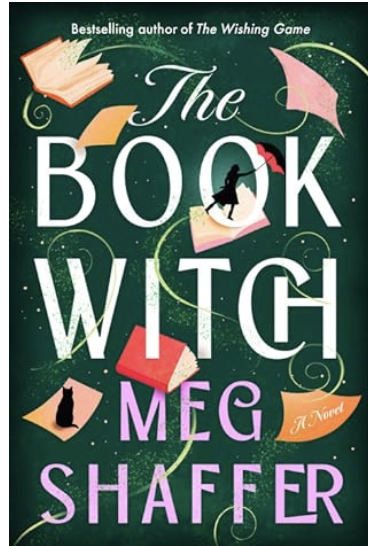
The Book Witch by Meg Shaffer (Literary / Mystery / Romance Fiction)

This is an unusual book. What starts as an adventure story that blurs the lines between reality and fiction via a coven of magic infused “Book Witches,” veers off into a more meaningful, touching, existential, and incredibly meta story about the importance of literature within our lives and the incredible love and connection between authors, characters, and readers. I laughed through most of the book, but was brought to tears (of the poignant, meaningful variety) multiple times in the last half.

Rainy March is a Book Witch — “sworn to defend works of fiction from all foes real and imaginary.” She has a magic umbrella, a feline familiar (Koshka the non-Russian, Russian Blue), and a few mysteries of her own past to consider. Her adventures are humorous and quite literary (if you’re a reader you will enjoy traipsing through many of your favorite books as Rainy works to fix breaks and prevent the “Burners” from having their incendiary way). Rainy falls for the dashing (and fictional) Duke of Chicago during one of her rescues. This goes against the rules, but does make the story more interesting (and a lot more complicated). The seven section headings of the book are genres — Romance, Mystery, Fantasy, Non-fiction, YA and Horror, Thriller, and Science Fiction — and the plot does a good job of navigating through the sections in an eponymous fashion.

Clever, funny, and often poignant writing that takes an intricate worldview and serpentine plot and makes them accessible, fun, and intriguing. Some beautiful lines which I can’t include without giving too much away — except this non-plot centric funny one: “Two more !s? Something needed to be done about this punctuation abuse.“ I’m quite guilty of this abuse myself, sadly, hence my appreciation for the line. Some interesting historical tidbits on works of literature — my favorite about Nancy Drew: Apparently Nancy Drew was rewritten in the 60s to make her less feisty, a little older and better behaved. Not only did I have no idea, but all my copies are the rewrites! Grrr. Lastly, I loved the dedication: “Dedicated to librarians book, sellers and teachers fighting the good fight to save our stories and to all the world’s bedtime story readers.”

Inspired by a spate of actual book burnings in the 70s — fun, educational, and moving.

Thank you to Ballantine Books and NetGalley for providing an advance copy of this book in exchange for my honest review. The book will be published on April 7th, 2025.

The Editor by Steven Rowley (Literary Fiction)

An incredibly touching novel about motherhood, life, and forgiveness. Masterfully crafted, the plot weaves together author James Smale’s effort to publish his first novel and his own personal growth through the process. The surprise yoda-like catalyst for this — wait for it — is his editor: Jacqueline Kennedy Onassis. I admit to fearing the book would be a fictionalized history of Jackie and her glamorous life; however it was anything but. This book celebrates Jackie’s work as an editor, and while James is the main character, Jackie provides the stimulus, advice, and motivation to make his work great.

As The Editor winds through the editing process of James’ Ithaka — a loosely fictionalized story about James and his mother — the interplay between author and editor, fiction and life is brilliantly done. With clear, concise, and humorous writing, carefully crafted sentences, and excellent, in-depth characters, it was a real pleasure to read.

As an interesting aside in these virus-infested times — while we don’t get treated to any excerpts from Ithaka, we do know that the action occurs during a 40-day quarantine (!) that forces mother and son to confront all of their issues. So perhaps we can look forward to some valuable personal and relationship insights from our own shelter-in-place experiences 🙂

Some Quotes:
“To me, typing was akin to publishing. I lived for that typewriter, and I would agonize when the ribbon became twisted, or the keys stuck, and I needed my mother’s assistance. She didn’t prioritize typewriter repair the same way I did.”

“When we exhausted all possible topics of conversation, I dropped my news like I was carpet-bombing Baghdad in Desert Storm.”

“Is the mark of adulthood putting others first? Or is it standing behind your own vision, your own work, your own view of the world? Beads of sweat form on my forehead and I have to wipe my brow.”

“To find something in a manuscript that you recognize as familiar truth, but also as wisdom you’re hearing voiced in a new and articulate way.”

About sausade: “It’s like a nostalgia or melancholy, but more than that. With a recognition that the something we’re longing for hasn’t happened, or isn’t returning. Or maybe never was.”

“Women like your mother and me, from our generation, we were duty bound. Things were expected of us, marriage and motherhood. But we were girls once, with dreams and aspirations of our own. When we see our children succeed, of course part of their accomplishments are our own. But it also reminds us that life doesn’t turn out for everyone the way they dreamed.”

“Jackie has lived most of her adult life in the long romantic shadow cast by history. What must it be like to have a whole nation idealize a past that you know firsthand was painfully imperfect?”

Thank you to Penguin Group Putnam and NetGalley for providing an advance copy of this book in exchange for my honest review. The book will be published on June 30th, 2020.

Old Lovegood Girls by Gail Godwin

Writing: 3/5 Plot: 3/5 Characters: 4/5

Thank you to Bloomsbury Publishing and NetGalley for providing an advance copy of this book in exchange for my honest review. The book will be published on May 5th, 2020.

The story of a lifelong friendship between two women who first meet at Lovegood College in 1958. Feron comes from a terrible, dark, background and has trouble connecting with people in any meaningful way; complacent and composed, Merry comes from a happy background and yet suffers a tragedy that forces her to withdraw from school after only one semester. Both develop literary interests and talents which feature in the story.

It’s an odd (to me) friendship and an odder narrative. After bonding immediately as freshman roommates, their next contact isn’t for ten years and remains sporadic after that. The narrative plays off this strange relationship by leaping from contact to contact and filling in the (event rich) intervening years via memories and asides. Thus whole marriages are relegated to a sad memory summarized in a couple of lines.

In some ways the book is written well — the language is good, the characters interesting, the dialog decent. However, it was difficult to get invested in the characters and this central relationship when there was so little to it. The author does convey the closeness each feels to the other, in spite of the fact that neither seems to make much effort to connect more often. It’s possible that these are just not people or modes of interaction that would work for me — I didn’t particularly like either of the main characters. I could not manage to find empathy for Feron, despite knowing her background and being privy to her inner thoughts. Merry was less well developed and while likable, she was far too passive for my taste. I feel like a real friendship would have brought out more in the other — the fact that these two felt close, despite rarely seeing or talking to each other, wasn’t much of a story.

While there was a lot in the book I liked — the (very different) literary aspirations, motivations, and processes for the two; the full depictions of Merry’s tobacco farm, Feron’s New York City life, Lovegood college, and the other characters — overall I found it rather depressing. Nobody in the book has a particularly happy life, and while the tone is not overly dramatic (the action is removed since it’s all in history), I felt dragged into an emotional pall. While each character seemed to have found some happiness or sense of accomplishment in their life, we don’t get to experience that directly. Overall I found the book mildly interesting from an intellectual perspective and mildly depressing from the emotional.