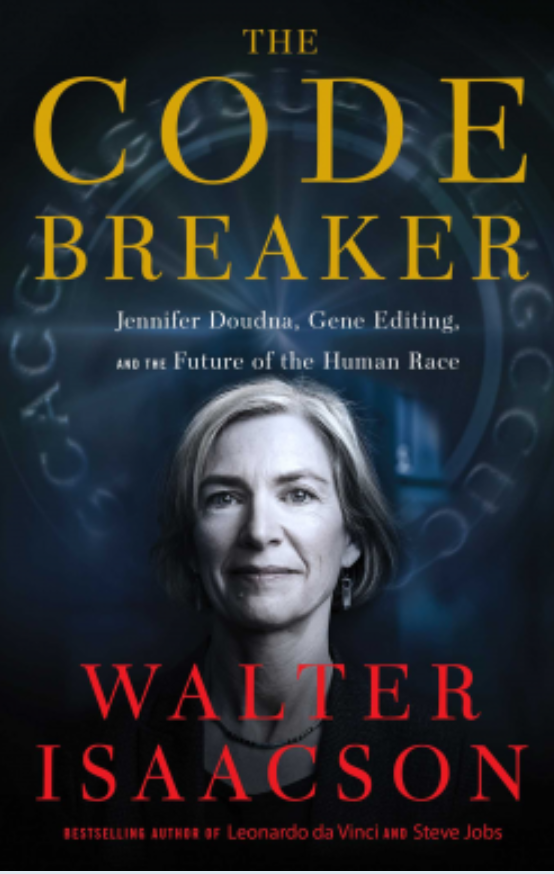
The Code Breaker: Jennifer Doudna, Gene Editing, and the Future of the Human Race by Walter Isaacson (Non-fiction)

A fascinating and timely story about the life sciences revolution (specifically gene editing) and the Covid bomb that ignited a community already poised at the brink of discovery — all told through the biographical lens of recent Nobel winner Jennifer Doudna.

Isaacson is a skilled biographer and synthesizer. He has an unsurpassed ability to explain very complex concepts in accessible terms. I’ve read four of his books and have been impressed by his ability to explain well things I already know (Steve Jobs and computers) and things in which I have little background and zero aptitude (Leonardo Da Vinci and 15th century art). His descriptions of CRISPR (DNA sequences that enable the gene editing at the heart of the book) and the myriad ways it was discovered, applied, and deployed do not disappoint. What I liked best? You actually feel the zing of scientific discovery as he describes the evolution of gene editing tools and techniques and the researchers who made it happen.

Getting to know the researchers was almost as interesting as learning the science — to the point where Jennifer Doudna — while thoroughly admirable — did not have a personality that eclipsed the other players, making it feel less like a biography and more like a community portrait. Every one of the key contributors was profiled in a succinct but insightful way: James Watson of DNA discovery fame (more on him later); Harvard Medical School geneticist George Church (who felt trapped in the present when he should be in the future); Doudna’s co-Nobelist and co-discoverer of the CRISPR/Cas9 “genetic scissors” the peripatetic Emmanuelle Charpentier who likes to keep herself on edge and not get too comfy; Feng Zhang — credited (but bitterly contested) with applying CRISPR to the human genome; and the many, many additional researchers pursuing careers in the field.

In addition to the science and the scientists, Isaacson spends a fair amount of time on the aspects of commercialization including the competition between academics resulting in sometimes bitter patent battles on rights regarding various facets of the technology and its applications. In contrast, he also gives plenty of air play to the wealth of technologies born of necessity during the COVID-19 pandemic covering how the community was poised to act and the incredible bureaucracy and what strings had to be pulled to get through it (and who had the clout to pull those strings). Also included is a pretty comprehensive description of the requirements and applied innovations to virus detection, vaccination, and treatment. I actually feel much calmer about covid having read the book.

Lastly, Isaacson devoted a lot of time and discussion to the question of ethics — a topic I always enjoy. Ethical questions such as safety and unintended consequences, the tradeoff between individual needs and the needs of society, the potential widening of the privilege gap, and the potential impact on human diversity if we allow people free choice on gene selection for offspring. Isaacson inserted a lot of his own ideas into this section and I can’t say I agreed with everything he said, though he did fairly include multiple viewpoints. He appeared to conflate (as people often do) genius with debilitating problems — pointing to Van Gogh (mental illness) and Miles Davis (sickle cell anemia) as examples where a change to their genetic structure might alleviate their suffering but hamper their creative output — a loss to society as a whole. He (again, as most people do) also firmly yoked diversity to physical characteristics instead of a wide range of personality, opinion, intelligences etc. There appears to a strong fear that if left to their own devices, everyone would choose to have blonde haired, blue eyed children. Also — nobody ever seems to bring up the ethical question of parents making decisions for their as-yet-unborn children! I have more strong opinions on this chapter but I encourage you to read it yourself!

I have a few other issues with the book — Isaacson seems to insert himself into the action more often than I thought necessary and spent a little longer than I liked on a somewhat sensationalized version of the patent wars. He also loudly supported our new “cancel culture” with his full chapter treatise on James Watson’s fall from grace due to unpopular racial remarks. I’m a big believer in a free electorate who must be trusted to think for themselves and not in favor of shutting down people who have beliefs different from my own (no matter how distasteful). Controlling people’s freedom of expression is really a bad move for a free society, regardless of how much we each wish we could get the other side to shut up!

Still — small annoyances aside — this is a fully engaging book about a fascinating topic told in an accessible manner and covering one of the key turning points of human civilization — so go buy it today and read it!

Early Morning Riser by Katherine Heiny (Literary Fiction)

Jane is a second grade school teacher in Boyne City, Michigan. In chapter one she falls in love with Duncan — the town playboy — and spends the rest of the book following an unexpected path through her own life. Each chapter (carefully labeled with the year — thank you!) is a mini-story that captures the essence of Jane’s personal story in that time frame. Story and personal evolution proceed apace with humor, insight, and poignancy as she becomes deeply involved with a set of characters she might not have voluntarily sought out: Jimmy, Duncan’s sweet and intellectually slow colleague; Aggie, Duncan’s bossy ex-wife; and Aggie’s flat out strange husband Gary.

I love Heiny’s writing style — her precise language perfectly captures internal thoughts and external behaviors. Jane possesses a biting interior commentary and the descriptions of second grade classroom life are pointed and hysterical. The characters are real — some times you love them and sometimes they irritate you completely. Good for fans of Anne Lamott.

Some random quotes:

“In fact, she had not only stopped being the maid of honor, she nearly stopped being human and became just a help desk in a giant green dress. She had to tell the caterers to start serving, and direct the florist on where to put the arrangements and the staff which table to designate for gifts.”

“It all reminded Jane that having a baby was not that miraculous. Any two fools could do it.”

“Worst of all were the mood swings. Although, actually, could it be considered a mood swing if it only swung one direction? Maybe it was more like a mood acceleration. Like the needle on a speedometer that whipped straight from ZERO to ANNOYED and stayed there. Because it seemed like the world was in an unkindly conspiracy to irritate Jane.”

“Endless rolling nausea without vomiting, nausea that spun out before Jane like a curving country lane meandering through a hilly green landscape, the end always just out of sight.”

“Jimmy was always there. He lived with them, and sometimes Jane thought that spontaneous adult conversation had fled her life forever.”

“Little insights into the murky liquid that sloshed around in the fishbowl of Gary’s mind.”

“She felt a sort of cellular-level sorrow and wondered if she loved more deeply than other people. Or was everyone else just more mature, more rational? More realistic?”

Thank you to Knopf Doubleday and NetGalley for providing an advance copy of this book in exchange for my honest review. The book will be published on April 13th, 2021.

All the Little Hopes by Leah Weiss (Literary Fiction / YA)

Writing: 3.5/5 Plot: 4/5 Characters: 4/5

All the Little Hopes is a double coming-of-age story set in a North Carolina tobacco farming community from 1943 until the end of the war in 1945. Thirteen-year old Lucy Brown lives with her family on a tobacco and honey producing farm when she meets Allie Bert Tucker (Bert) who was shipped away from her Asheville mountain home when her mother died. The story alternates between their voices as they rapidly move from strangers to best friends to family. Lucy worships Nancy Drew and wants to be a detective; Bert wants more than the “puny life” she was headed towards back home. They both get what they want when a German POW camp provides labor nearby and men — not the nicest of men — start disappearing.

The story is firmly embedded in factual events and surroundings — WWII on the home front with a beeswax contract with the government; cheap labor from a nearby POW camp and community misgivings; an entire world of German glass marbles and the ubiquity of earned marble skills; purple honey with potentially healing properties; and Shape Note Singing (look it up — it’s cool) as examples. Racial and ethnic stereotypes, segregation, and attitudes are matter-of-factly included without being the focus on the story.

I thoroughly enjoyed this book which is billed as Literary Fiction but could easily serve as YA. It’s a small and local story painted on a big and global canvas that gives insight into young lives maturing under the auspices of war, propaganda, and local culture. Great characters and an intriguing plot as told from the perspective of youngsters who were forced to gather information piecemeal and fit it into their own emerging mesh of internal knowledge.

Some good quotes:

“I don’t tell Bert that sometimes I wonder if Irene’s heart is too small. She isn’t very amiable, and she’s stingy with kind words, like she’s scared she’s going to run out. It must be tiresome being Irene.”

“It’s got bits and pieces that glue me together when I’m coming apart.”

“It ain’t nice to shine a light on the ugly, but the ugly came home with Whiz and sits in our front yard.”

“We’ve crossed some invisible line into the land of beguile, and I feel a power I never knew before.”

Thank you to Sourcebooks Landmark and NetGalley for providing an advance copy of this book in exchange for my honest review. The book will be published on July 27th, 2021.

Vera by Carol Edgarian (Historical Fiction)

Writing: 4/5 Plot: 5/5 Characters: 4/5

A wild coming-of-age story — Vera is the daughter of the Barbary Coast’s most successful (and infamous) Madam (Rose) and is raised by a “proper” Swedish widow (Morie) who lives on that income. At 15 Vera is a “scrawny and sharp-tongued girl” seething with a fervent desire for more: more time with her real mother, more options, more life. And then the 1906 San Francisco quake hits.

With a cast of unforgettable characters deployed across unforgettable scenes, we follow Vera through adventures during and after the quake and resulting fire (which burned 28,000 buildings and 500 city blocks). From Rose’s “gold house” on Lafayette Square to Chinatown to the many encampments for the suddenly homeless (400,000 people), the novel depicts the new mixtures of uppercrusters, corrupt politicians, wandering orphans, and the military with their overrun field hospitals — all adhering to their own sense of morality, loyalty, and their survival instinct.

Real life personalities Alma Spreckles, Abe Ruef, Caruso, and Mayor Eugene Schmitz (the quake occurring on the eve of his arrest on corruption charges) all play parts. The writing is full of details such as the ingredients in Dills cough medicine (chloroform and a heroin derivative). Completely brings to life the time and the place for a variety of characters with different backgrounds. Could not put it down.

Thank you to Scribner and NetGalley for providing an advance copy of this book in exchange for my honest review. The book will be published on March 2nd, 2021.

China by Edward Rutherfurd (Historical Fiction)

Writing: 5/5 Plot: 5/5 Characters: 5/5

A sweeping novel of China from 1839 – 1900, from the Opium Wars through China’s Century of Humiliation to the suppression of the Boxer rebellion. It’s the story of the conflicts surrounding the forced opening of China to Western trade, customs, and religion. The story is told through a variety of characters who span cultures, classes, backgrounds, and professions (including plenty of women characters with different roles, abilities and agendas). Multiple generations of characters such as a young English merchant trying to make his fortune (through opium), an upright Mandarin charged with enforcing the emperor’s ban of opium, a palace eunuch, a peasant girl, a mercenary pirate, a missionary, a Manchu bannerman, the emperor and various concubines and princes, and some craftsmen. The characters have depth, too. They reflect on what is happening, how they feel about their own role, and how to achieve their goals while maintaining their values (or how to shift their values to attain their goals).

I love that history itself is the protagonist in this novel, rather than the background setting for individual stories. Everything is told through the personal stories of the characters — either through participation in the action or through conversations between neighbors, colleagues, and family members. Even past history is exemplified in ritual and description of the origin of individual morality. This approach brings to the fore what it was like to live through these times with only direct observations and rumors as sources of information. And how very different that information was depending on your location, background, profession, culture and connections. Additionally, there were so many fascinating descriptions of various ways of life — all told in a style that was interesting because someone was learning it (e.g. a craft) or going through it — so always real and never dry. This was a long book, and I literally had trouble putting it down. (As a warning, one of these “fascinating” descriptions was about foot binding, and I skimmed through trying not to read that at all. Of all the atrocities visited upon humans, this is the one I find most horrific and barbaric (yes, even more than female circumcision which comes in a close second).

This is my first Rutherfurd and I’m now going back to read more. Meticulously researched, personal and accurate — a kind of modern day Michener for those old enough to remember classics like Tales of the South Pacific, Hawaii, The Source, or Caravans. After reading this, I have a far more in-depth understanding about the relationship between China and the West and of life in the 19th century.

Thank you to Doubleday Books and NetGalley for providing an advance copy of this book in exchange for my honest review. The book will be published on May 11th, 2021.

The Poet X by Elizabeth Alcevedo (Young adult)

Spectacular book — possibly one of the best I’ve read this last year. Made me really “get” some concepts that I knew only peripherally.

This is a coming-of-age story about Xiomara — an Afro-Latina teenager with an intensely religious immigrant mother and a father who is absent even in his presence. She is “unhideable” with “too much body for such a young girl.” And she is a secret poet who puts her thoughts about family, religion, boys, and the place for girls into her poetry.

The story is a novel-in-verse — told in poetry with an overall narrative arc. I was hesitant because I don’t typically enjoy poetry but this was utterly engrossing. The author was able to consistently distill complex thoughts, feelings, and narrative into a concise set of stanzas of great profundity. Told from Xiomara’s point of view, we see depth in the characters — her mami, papi, twin brother, best friend, potential boyfriend, priest, and the teacher who convinced her to join Poetry Club — through their relationship with her. Incredibly engaging and incredibly well-executed. No stereotypes in this book — Xiomara is anything but — she is always “working to be the warrior she wanted to be.” I was surprised to find that I really liked the character of the priest who was culturally bilingual (able to deal simultaneously with Mami’s deeply religious life and Xiomara’s search for her own way) and thus was able to help Xiomara and her mother come to terms with their different priorities and goals.

I’ve put some of my favorite quotes below — additionally, I absolutely loved the whole of the “Church Mass” poem on page 58-59.

“The world is almost peaceful
when you stop trying
to understand it.”

“But everyone else just wants me to do:
Mami wants me to be her proper young lady.
Papi wants me to be ignorable and silent.
Twin and Caridad want me to be good so I don’t attract attention.
God just wants me to behave so I can earn being alive.”

“How your lips are staples that pierce me quick and hard.”

Metropolitan Stories by Christine Coulson

Writing: 3.5/5 Plot: 3/5 Characters: 3/5

A collection of (somewhat) interconnected short stories that revolve around life in the Metropolitan Museum of Art, based on the 25-year employment experience of the author (and her very active imagination). The stories range from the surreal (art coming alive, ghosts swirling about, people slowly disappearing) to the real (experiences of interns, neurotic but talented curators, donors, Lampers, and night guards). Coulson experiments with different POVs — first person “chair,” plural first person, third person omniscient, etc.

From the description I really should have liked this book but I didn’t. For me, the writing got in the way — I found it overwrought and pretentious. Lots of obviously carefully crafted metaphors and similes (LOTS) that felt more self-indulgent than communicative to me. I love writing that can distill insight into a few carefully chosen words — this felt like the opposite — more stream of consciousness chock full of impressions and feelings but (to me) utterly lacking in insight. I can see that many people would really enjoy this open, imaginative gush of sentences but it’s not a style that works for me. My favorite stories were those focussed on real people told in a 3rd person style — the characters had more depth, the writing was more spare. I should point out that I’m a huge speculative fiction fan; my issue with the more fantastical stories here was the writing, not the subject matter.

I did like this particular line: “He shoves his anxiety into every second of every minute, like jamming extra socks into an overstuffed suitcase.”

Almost Human by HC Denham (Speculative Fiction)

Writing: 3/5 Plot: 3/5 Characters: 2/5
A cautionary tale of a future where AI based humanoid robots may be slowly taking over the planet while the human population they are intended to serve remains blissfully unaware. All but one — the utterly competent, perfectly empathic, friendly humanoid robots just give Stella Mayfield the creeps.

While the plot had potential, I really didn’t enjoy this book. The characters were extremely stereotyped (and really, although Stella was a Biologist with a PhD, she behaved like the stereotypical neurotic woman while the men behaved like stereotypical men — completely out of touch with their feelings blah blah blah. The techie robot engineer was the biggest stereotype of all (and spoke some weird dialect that didn’t match anything I’m familiar with and I live and work in Silicon Valley!). There is very little science and very little plot — instead it includes lots of filler encompassing a lot of clichéd relationship stuff that had little to do with the plot. Writing is decent enough that I finished the book, but nothing special, and the end was completely predictable. Could have made a decent short story with better characters and more philosophic depth.

The Night Hawks by Elly Griffiths (Mystery)

Keep writing, Elly! I always look forward to a new Ruth Galloway book and it never disappoints. I’m so glad Ms. Griffiths is making good use of her pandemic time to up her (already high) prolificity (I may have made that word up — not sure).

These books are a great mix of mystery and novel — full of Norfolk folk lore and history with plenty of archeology — with no repeats so far. In this novel we also get a group of Detectorists (defined as a person whose hobby is using a metal detector); an interesting (fictional but plausible) theory about the Beaker people who came to Britain about 4400 years ago and left only 10% of the native population after 200 years; and a timely plot line around dangerous and illegal vaccine trials. A high body count, some progression in the Nelson / Ruth saga, and a variety of eccentric and interconnected characters make this a real page-turner. Enjoy!

Thank you to Houghton Mifflin Harcourt and NetGalley for providing an advance copy of this book in exchange for my honest review. The book will be published on June 29th, 2021.

The Half-Orphan’s Handbook by Joan F Smith (Young Adult)

A well-written book about a young girl going through the grief of her father’s recent suicide. Lila is 16 and has been reluctantly cajoled into attending a grief camp for the summer. This is the story of her slow journey towards healing, including a healthy amount of new friends, a budding love interest, and that irreverent teen style that helps makes the unbearable, bearable.

The author, who went through a similar experience, does an excellent job at describing the confusion of competing feelings, the different ways grief hits you at different times, and the eventual return to the three Ls: laughing, loving, and living without guilt. I really liked all the characters, and I want to emphasize that this was not at all a depressing book — there was a lot of honest reflection, observation, and fun. Plenty of racial and sexual diversity as well as discussions of addiction, suicide, and first love.

Thank you to Children’s Publishing Group and NetGalley for providing an advance copy of this book in exchange for my honest review. The book will be published on April 6th, 2021.