

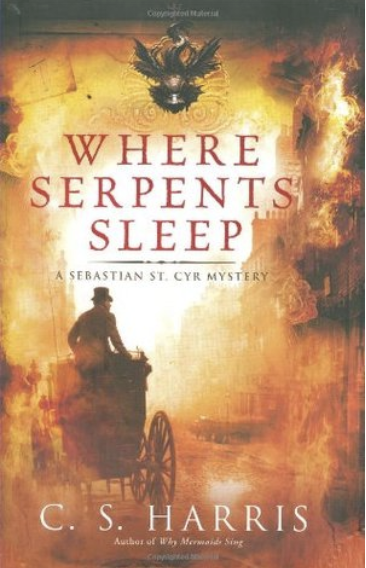
Number 21 in the Sebastian St. Cyr historical mystery series. Regency period — 1816 — London and environs. This was the “year without a summer” due to the eruption of Mount Tambora in 1815.
Sebastian — son and heir to an Earl — has a habit of involving himself in bringing justice to murder victims, regardless of their class. In this episode, first one and then another of a group of high born friends is murdered — one found in the river and the other burned to death. One of the group is Sebastian’s nephew Bayard. The entire group — Bayard definitely included — is what are known as “bad ton” where “ton” refers to the state of being fashionable and high society. The men in this group feel they are above any law or sense of human decency.
In solving the evolving mystery (more bodies turn up) there is reference to the American wars, the slave trade, ancient Celtic practices including human sacrifice, and potential Druid revivals. I always thought of Celts as ancient Britons but learned recently that in fact Celtic tribes were roaming around Central Europe as early as 1200 BCE. and as for Druids, I found this note in the book interesting: “Actually as far as we can tell, the Druids were more like what we might call the intellectual class of the ancient celts. The poets, historians, musicians, physicians, and astronomers of their day and advisors to Kings.”
The writing is decent, the characters (from the high to the medium and low) have evolved over time and have depth, and the mystery was quite convoluted, but completely consistent and engaging. The historical setting is excellent.
As an aside, the author’s note at the end of these books is always illuminating as she clearly delineates the fact from the fiction. I was particularly interested in a “real” character — German chemist Friedrich Accum who, among his other many accomplishments, was one of the first to draw attention to the danger of food additives and was involved in gaining acceptance for beet sugar, which was notable for not being derived from slave-driven sugar production from cane.
Thank you to Berkley House and NetGalley for providing an advance copy of this book in exchange for my honest review. The book will be published on April 14th, 2026.


 Books to look forward to ...