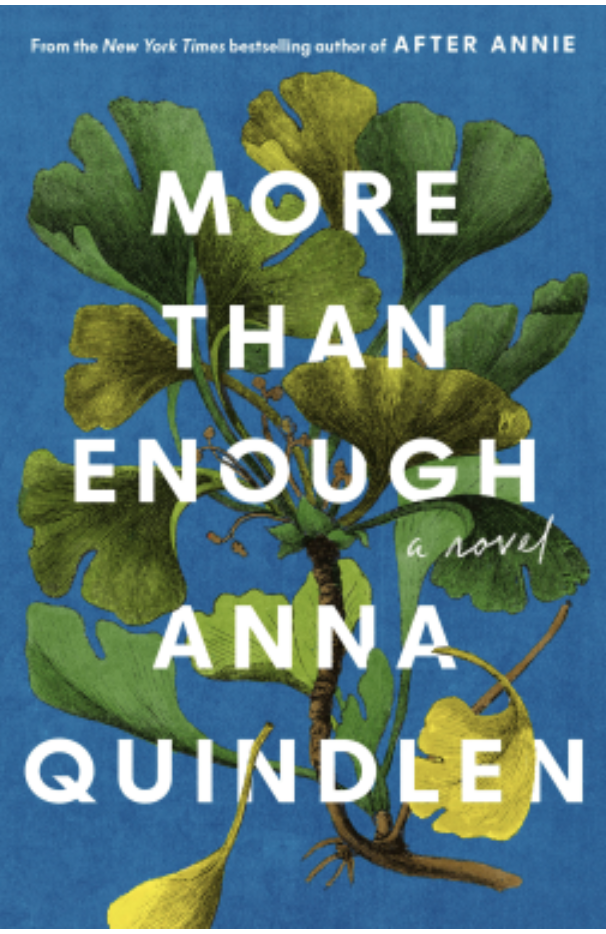
More than Enough by Anna Quindlen (Literary Fiction)


One of my favorite books of the year — thoughtful, relatable, and delightful, even, in an odd way, the sad parts. This is in large part due to the characters who are all good and wise people in their way, but always with more to learn. I’d like to say there was a jackass or two in the pages, but there really weren’t.

Polly is a high school English teacher at a private Manhattan school where the kids are (mostly) wealthy and privileged but also driven, smart, and with problems of their own. As an aside, I like the fact that people who are not poor, not downtrodden, and not necessarily members of a minority class are allowed to have problems and drives and desires like anyone else. Her appealingly well-adjusted husband is a big animal vet at the Bronx zoo — possibly my favorite character occupation of all time! And she is part of a perfectly balanced four member book club — unique in that its members must buy, but not actually read, the chosen book every month. At the same time, however, her beloved father is losing his mind to dementia, she is struggling with infertility, she is in a perpetually low-grade state of anger with her mother, and a “joke” DNA test gift has resulted in a surprising and uncomfortable disclosure.

The book is a “tag along” to a thoroughly examined life as it progresses, as all lives do, completely out of the control of the one who lives it. All we can do is adjust, appreciate, understand, and settle in for the ride. Beautifully written with a slew of insightful comments (and many apt literary references and quotations — she teaches advanced Literary Honors courses after all!). Full of myriad families and friend groupings, each with their own distinctive cultures and implicit behavior patterns. I loved that the story was a study in non-dysfunctional ways of handling both life’s vicissitudes and pleasures. I found myself disagreeing with Tolstoy — not all “happy families” are alike, because every family, even the happy ones, find their own way of handling all that life throws at them. And lastly, some truly fun and informative scenes with alpacas.

Some quotes both directly from the author and as referenced in the book:

I am out with lanterns looking for myself — Emily Dickinson.

Marriage. Like calculus without the answers.

There’s a kind of equipoise to our group, so that we’ll veer here and there and somehow always come back to center, and peace.

Sometimes I think the human brain is a house, and the lights only come on in mine one room at a time.

Life is a tragedy for those who feel and a comedy for those who think — Moliere

“Daddy Daddy Daddy is running through my head like a piece of music with only two notes, like Philip Glass. I hate Philip Glass.”

“I’d like to disabuse you of the notion that you are the only woman in the world who doesn’t like her mother,” my therapist had said three years before.

The thing about living in New York City is that you feel either perpetually untethered or unwaveringly embedded.

You girls need to allow me my petty grievances.

Beauty is whatever gives joy — Edna St Vincent Millay.

I’m afraid families are a funnel, and ours is running out.

Thank you to Random House and NetGalley for providing an advance copy of this book in exchange for my honest review. The book will be published on February 24th, 2026.
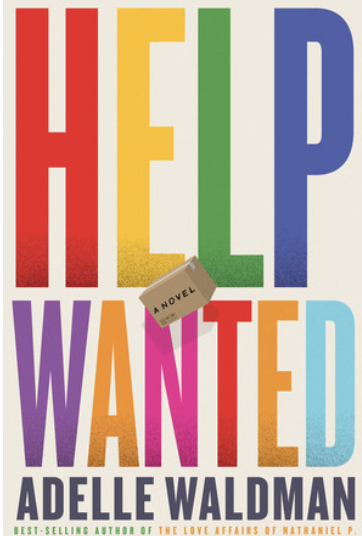
Help Wanted by Adelle Waldman (Literary Fiction)

Writing: 5/5 Plot: 3.5/5 Characters: 5/5

A surprisingly engaging book about a set of bottom of the ladder retail workers and their hopes for more hours and some hope of upward mobility. They have a lot working against them — their hours are minimized to avoid having to pay benefits; each character faces his or her own limitations — a learning disability; a thick accent; trying to go straight when drug dealing is SO much more lucrative; false arrests; mental illness; single parenthood; transportation issues; and even lack of generational wealth. The characters have a lot of depth — none of the above is dealt with in any kind of stereotyped way.

But the book doesn’t take the easy way out — there is no blaming of corporate policies or resentment of management. Instead we get a pretty in-depth view of the situation through the eyes of different workers — each with his or her own thoughts, skills, goals, regrets, and fears. And — again through the voice of individual characters — some pretty interesting (and varied) analyses of the how things got to be the way they are.

The book description calls it “incisive and very funny” — I agree with the incisive part but although the story resisted the slide into depressing territory, I wouldn’t exactly call it funny. However, it is very well written and boasts excellent characterization, and after an initial irritation at what promised to be a stupid (IMHO) plot (but then wasn’t), I ended up enjoying it a lot.

Firekeeper’s Daughter by Angeline Boulley (YA / Mystery / Thriller / Romance)

Writing: 4/5 Characters: 5/5 Plot: 4/5

I loved this book! Daunis Fontaine is 18 years old, 6 feet tall, an ice hockey ace, and a science whiz. While she grows up in Sault Ste Marie, Michigan with her white mother and grandparents she is also deeply ingrained in the local Ojibwa community of her father. What starts off looking like an upbeat teen romance takes a sharp left turn and becomes mystery, intrigue, and thriller (romance takes a back seat — pun intended). The plot keeps swerving — surprise after surprise after surprise — with Daunis giving us an intelligent and fiercely community oriented view of the ride. I couldn’t put it down. I’ll give you a hint — Daunis ends up being a Confidential Informer (she calls it being a Secret Squirrel) for law enforcement.

One of the things I loved about this book is the way the many characters in the Ojibwa community are portrayed. While references to past injustices are present and individual incidents of prejudice occur (Daunis and her friend like to play Bigotry Bingo — see quote below), they are not front and center. This is a novel of today — various members of the community are successful (by personal definitions of the word) while others are not; some are greedy and conniving while others are supportive and helpful; some have drug and alcohol problems while others have steered clear. In other words, no group stereotypes and no group victimhood. An array of well-drawn individual characters.

Daunis is a great character — I love her scientific approach to life, her fearless and unconcerned approach to typically male endeavors, and her deep involvement with the tribal culture and people. Great themes, great unfolding of the many mysteries past and present, and an absorbing view into a culture unlike my own. Ojibwa is a matriarchal society, and the story includes many strong women characters of all ages. I enjoyed the embedded language and cultural practice tutorials.

A couple of quotes:
“When Lily and I were on Tribal Youth Council, we all played a game called Bigotry Bingo. When we heard a comment that fed into stereotypes, we’d call it out. Dream catchers were the free space. Too easy. There are so many others though. ‘You don’t look Native.’ ‘Must be nice to get free college.’ ‘Can you give me an Indian name for my dog?’ ”

“My mother’s superpower is turning my ordinary worries into monsters so huge and pervasive that her distress and heartache become almost debilitating.”

“When you love someone, but don’t like parts of them, it complicates your memories of them when they’re gone.”

Thank you to Henry Hold & Co and NetGalley for providing an advance copy of this book in exchange for my honest review. The book will be published on March 2nd, 2021.

The Vanishing Half by Brit Bennett (Literary Fiction)

Plot: 4/5 Characters: 5/5 Writing: 4.5/5

Brit Bennett’s second novel is just as good, if not better than, her first (which I already loved).

Identical twin sisters grow up in the 1950s in Mallard: a small Southern town that doesn’t even make it onto a map. Mallard is “colorstruck” — a town inhabited by colored people, all obsessed with lightness.

The twins leave Mallard, each for her own reasons. One disappears overnight — “passing” into the white world; the other rebels, marrying a well-educated, sweet-talking, and very dark man . From these beginnings emerge a narrative that spans the 50s through the 80s, extends across the U.S., and incorporates expanding family and friends. It’s an exploration of characters who aren’t completely comfortable in their own skin: a colored woman passing as white; a transgender man in a time predating legal surgical options; a dark child shunned in a negro community valuing lightness above all else.

What I loved about this book was that any dramatic events (e.g. domestic abuse, lynching, cruelty in many forms) were tied to individual characters — how they felt, how they reacted, how their personality was modified — shifting how they made decisions, protected themselves, and made the most of their lives. The point was not the drama of the acts themselves, but how they impacted the characters. The author also embedded the impact of societal trends of the time as well — feminism, civil rights, and many blunt and subtle inequities. I so appreciated that each character was a true individual — no stereotypes — and that no single group was demonized. Each character was both interesting and likable (to me) and I loved watching them develop, learning about their own strengths, disappointments, and fears. The ending was quite realistic — no pat finish artificially tying up all the loose ends — but lives continuing with some aspects resolved and some ongoing.

Incredibly skilled writing — the stories emerge and twine together as each character develops and builds / evolves relationships with others. I didn’t find a lot of quotable sentences in this book as I did with the first — but it’s quite possible this is because I was devouring the book too quickly.

Highly recommended.

Thank you to Penguin Group and NetGalley for providing an advance copy of this book in exchange for my honest review. The book will be published on June 2nd, 2020.


Barker House by David Moloney (Fiction)

Writing: 4/5 Plot: 4/5 Characters: 5/5

A set of interconnected stories as told by prison guards in New Hampshire’s Barker County Correctional Facility or “The House.” Each unfolds specific events, though the import of the story comes not from the events themselves but from what they uncover about the life of the person telling the story: a sexual attraction, a fellow officer’s suicide, a softball game between law enforcement branches, the attempted suicide of an inmate, the processing of an accused child killer, etc.

This is way outside of my comfort zone — everything I’ve ever learned about prison comes from documentaries, bad TV shows, and sensationalized news stories. I liked this book because it didn’t appear to come with any specific political agenda — the focus was far more on individual lives. And there were no real stereotypes — each guard is a distinct human being with his/her own motivations, coping mechanisms, and personal context. Some are withdrawn, some mean, some afraid. Many are dealing with their own personal issues while trying to maintain an acceptable demeanor. Not your typical adventure story, it’s all character. It also includes detailed descriptions of typical days in a correctional facility from the perspective of those who run it: the tiers, transportation, property management, and booking. I have no idea how accurate it is, but I found it fascinating and full of depth. Couldn’t put it down.

Thank you to Bloomsbury and NetGalley for providing an advance copy of this book in exchange for my honest review. The book will be published on April 7th, 2020.

Peace Like a River by Leif Enger (Fiction)

Writing: 4 Plot: 3.5 Characters: 5

11 year-old Reuben was born to witness. Coming into the world with troublesome lungs, his father called him to life after the doctors had long given him up for dead. In this book, he bears witness to the events in Roofing, Minnesota that cause his elder brother, Davy, to shoot two boys dead; Davy’s subsequent escape from prison; and the long search that Reuben, his father, Jeremiah, and younger sister, Swede, take looking for him.

Beautiful descriptions of a harsh landscape that yet evokes “home” to our characters and a moral undertone that is never preachy and yet fully covers each individual’s worried contemplation of the situation. Well-drawn and intimate characters — Jeremiah has a special relationship with God and performs miracles that only Reuben seems to see; Swede has an off-the-charts imagination and bangs away at her typewriter working her ideas into narratives and poetry; Roxanna Crawley runs a gas station in a remote town and is big, warm, and has possession of an astonishingly large vocabulary; and Andreesen — the “putrid fed” — chases Davy, but is slowly revealed to be honorable and compassionate.

I had some trouble getting started with this book. The first third — taking us through Davy’s escape — was slow, stressful, and full of (what felt to me as) injustice. I didn’t like it at all but kept plugging away as I was reading it for a book club. Then it simply took off into something wonderful. It’s rare that I read a book with that kind of composition (probably because I give up too soon) but I recommend skimming if necessary to get to the good part.

Good for fans of Ivan Doig or Markus Zusak.

Chronicles of a Radical Hag by Lorna Landvik (Fiction)

Writing: 4 Plot: 3 Characters: 4.5

When 81 year old columnist Haze Evans (the titular “Radical Hag”) slips into a coma, the local paper in Granite Creek, Minnesota decides to reprint selected columns from the last 50 years until she can start again. Always uncensored, these columns range in size and topic and bring history (both local and global) back to life in a personal way. The entire community relives events such as the Kennedy assassination, the Oklahoma bombing, the Exxon Valdez spill as well as the meeting of her lifelong best friend, her short but loving marriage, the birth of local quadruplets, etc.

The characters in the novel are wonderful and run the gamut from newspaper publisher to RV salesman to nurse with assorted retirees and high school students thrown in. Each handling his/her own concerns while working towards his/her own definition of a good and decent life.

I loved the way the characters spent time *thinking* about what they were reading in the columns and engaged with those with differing opinions. One high school teacher instituted “Radical Hag Wednesdays” where students discussed column-instigated topics. In other conversations, the impact of #metoo style accusations on young boys, or love, divorce, and adultery were discussed — all with depth and a desire for understanding rather than condemnation. An artfully done blending of “homespun wisdom” with open minds.

I’ve been a fan of Lorna Landvik since her 1995 Patty Jane’s House of Curl. Her writing is simultaneously humorous and heartfelt, thought provoking and tolerant, touching on real people dealing with life in a real way.

Nine Perfect Strangers by Liane Moriarty (Fiction)

Writing: 4 Characters: 5 Plot: 3

A gripping, character driven, novel — classic Moriarty. A fairly simple plot — nine “perfect strangers” sign up for a ten-day retreat at a high-end health resort promising a “transformational” experience. Each is there for wildly different reasons and none really expects to be “a different person” at the end but … it’s possible they will be.

Moriarty draws interesting, intricate, and believable characters. Each character — across a wide range of backgrounds, ages, and motivations — is completely developed in the story. Each chapter is told from a specific character’s point of view, giving rise to some fascinating contrasts between what a character is saying, is thinking, and is assuming about the others. I was most interested in these assumptions and the way those perceptions of each other shifted over time with more exposure and information. It’s rare that we get so much insightful detail about how our assumptions play into our behavior towards people and vice versa.

The story includes many social issues such as microdosing, lotteries, teen suicide, shaming, and trophy wives. My favorite line and sly message about the “shaming” current authors are susceptible to (as expressed by character Frances Welty, aging romance author: “She dared to look up and the stars were a million darting eyes on the lookout for rule-breaking in her story: sexism, ageism, racism, tokenism, ableism, plagiarism, cultural appropriation, fat-shaming, body-shaming, slut-shaming, vegetarian-shaming, real-estate-shaming. The voice of the Almighty Internet boomed from the sky: Shame on you!”

Great read!