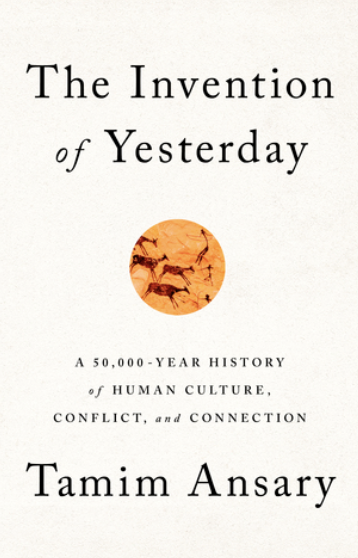
The Invention of Yesterday: A 50,000-Year History of Human Culture, Conflict, and Connection by Tamim Ansary (Non Fiction)

In this ambitious book, Ansary tackles 50,000 years (literally) of history with the thesis that pervasive narrative is the key driver of both cohesion and conflict. Narratives are the glue holding together the social constellations that give rise to culture. From stone age to digital age and beyond the singularity, he traces these narratives through giant hinge points such as the evolution of language, worldviews stemming from religion or ideologies, and methods of conquest and absorption. Why can’t we all get along? Because we are living in different worlds of meaning.

What I gained from reading this book is a much better understanding of the Islamic World, as that, of all the histories, is the one I know least about. Looking through his other books, I now wish I had read “Destiny Disrupted: A history of the world through Islamic Eyes” or “Games Without Rules,” a history of Afghanistan. His primary concept is (to me) not new, and does not really help think of solutions — I think we’ve known for a long time that we need to really understand the other in order to try to find some kind of compromise — and sometimes that is simply impossible. The way he tied global peoples and events across time was pretty interesting, though I found it often very high level.

There were a lot of small surprises (to me). Here are some of them (I have fact-checked some, but not all):
• North Americans didn’t develop the wheel because they had no tamable beasts (I don’t completely understand this since 1) a wheeled cart would be helpful to a person and 2) has anyone tried to tame a buffalo? I really don’t know.)
• Unlike the Western world, the Chinese had no tradition of jealous gods, demanding exclusive worship, so it was easier to absorb multiple narratives.
• Arabs were the (big) slave traders in East Africa, while Europeans became the traders in West Africa. Since Islam forbids enslaving Muslims, many conquered peoples decided to convert.
• Rome never fell, but did kind of get taken over by the conquered who had been given a path to citizenship through battle. More of the German tribes (German meant “barbarians who keep bugging us” — his words) ended up in leadership positions shifting things.
• Persians were OK with Islam but not with Arab superiority and so found an acceptable path by finding a Persian descendant of the Prophet leading to the Shia split.
• History of the development of the Caste system in India and description of why political fragmentation did not lead to cultural fragmentation there.
• The main Arab contribution around 800 CE was to catalog everything done elsewhere, e.g. medical knowledge. Their central project was the documentation of Sharia — the complete manual of how to be a Muslim. Meanwhile, the central project of the Western world was Science.
• Mongols brought bubonic plague to Europe from the Himalayan foot hills via fleas. In 1345 they lay siege to cities by catapulting diseased warrior corpses into the city.
• Movable type could handle the Roman alphabet better than Chinese pictographs. Arab writing also had something about it (he was vague) that made it more difficult.
• When Mongols took over China they tried to be Chinese, but their policies came from a different environment (e.g. water shortage in their home on the Steppes led to policies that discourage bathing in China)
• Systems based on patronage and relationships (Islamic world) vs commerce (western) and what that led to.
• Columbus “discovering” America led to one of the biggest hinges: — some estimates are that 90% (55 million) of people in all the Americas died — mostly of disease — after that “visit.” A catastrophe that dwarfs the Mongol hordes, the Holocaust, the Black Death, and both world wars.
• Tools and machines were as seminal as the acquisitions of language. Western social constellations could incorporate machines into their networks of meaning much more easily than the other large empires of the time.
• The Muslim narrative with its patronage networks and Sharia law did not have a way of turning inventions into products. The Chinese world with its dream of a socially cohesive centralized state operated by an all pervasive bureaucracy didn’t either. New technology had the potential for disrupting existing social arrangements, and in much of the world preserving existing social arrangements took precedence over building better stuff.
• Societies shaped by the progress narrative (ie the West) had an advantage not because of the tools, but because of the improvements and variations they kept building on the first.
• The invention explosion was the busy energy of all the entrepreneurial companies and corporations that got excited about making things happen

In summary — it was a long book and the ratio (for my personal background) of new ideas or information to number of pages was lower than I would like. However, the writing was accessible — it didn’t tend to get dragged into too much tedium — and I did learn a lot about the Muslim World. However, at this point I’m more interested in going back and reading the two books I mentioned at this beginning of this review. I did read (in 2007 so I unfortunately do not recall the details) his memoir of growing up in Afghanistan and then coming to the U.S. in high school. That was excellent!
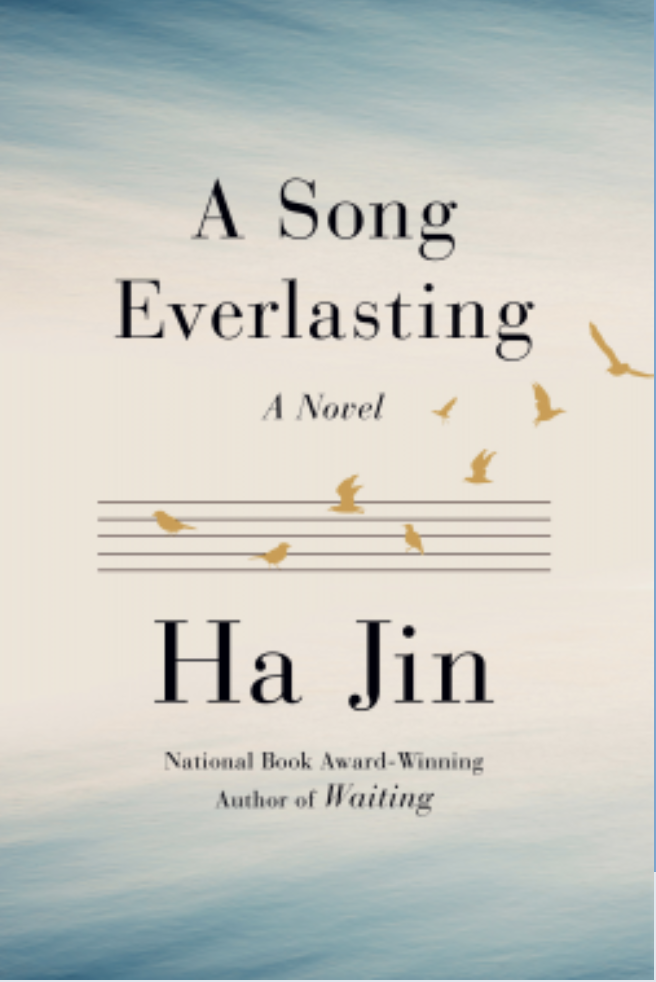
A Song Everlasting by Ha Jin (Multi cultural / Literary Fiction)

Writing: 5/5 Plot: 4/5 Characters: 4/5

A beautifully understated and surprisingly engaging book about a Chinese tenor struggling to make it on his own in the US after finding himself on the wrong side of the Chinese party. I appreciated the picture of modern China and an individual Chinese artist through Tian’s experiences with the Chinese government, friends, and family as he is bribed, blacklisted, and receives appeals to his love of and duty towards his country. Where some of the government techniques were things I had heard of, many were not, and I was surprised at the insidious nature of government manipulations outside of China through local operatives, foreign newspapers, etc. Tender and reflective, this is the story of Tian’s life, not a political treatise or call to arms. Tian in some ways is a bit of an innocent — decidedly apolitical and consistently working to maintain artistic integrity and personal principles. I learned a lot and was surprised that the book kept pulling at me as it isn’t my typical fare. Definitely worth reading.

A few quotes:

“This new understanding threw him into a peculiar kind of excitement, because it indicated that the citizens and the country were equal partners in an agreement. Tian gathered that this equality must be the basis of democracy. Now he could see why the Constitution meant so much to the United States. It was the foundation of the nation. With such a realization he became willing to defend the Constitution, even to bear arms if he was called upon, simply because he believed in noble ideas and was willing to sacrifice …”

“He realized many immigrants were in varying degrees of the same situation: They were attempting to break loose from the grip of the past and to start over in a faraway place, but few of them could foresee the price for that new beginning, or the pain and the hardship that came after.”

“In the context of the Tiananmen massacre, China seemed to him more like an old hag, so senile and so ailing that she had to eat the flesh and blood of her children to sustain herself. In the back of his mind lingered a question to which he didn’t yet know the answer: If a country has betrayed a citizen, isn’t the citizen entitled to betray the country?”

Thank you to Knopf Doubleday Pantheon and NetGalley for providing an advance copy of this book in exchange for my honest review. The book will be published on July 27th, 2021.

China by Edward Rutherfurd (Historical Fiction)

Writing: 5/5 Plot: 5/5 Characters: 5/5

A sweeping novel of China from 1839 – 1900, from the Opium Wars through China’s Century of Humiliation to the suppression of the Boxer rebellion. It’s the story of the conflicts surrounding the forced opening of China to Western trade, customs, and religion. The story is told through a variety of characters who span cultures, classes, backgrounds, and professions (including plenty of women characters with different roles, abilities and agendas). Multiple generations of characters such as a young English merchant trying to make his fortune (through opium), an upright Mandarin charged with enforcing the emperor’s ban of opium, a palace eunuch, a peasant girl, a mercenary pirate, a missionary, a Manchu bannerman, the emperor and various concubines and princes, and some craftsmen. The characters have depth, too. They reflect on what is happening, how they feel about their own role, and how to achieve their goals while maintaining their values (or how to shift their values to attain their goals).

I love that history itself is the protagonist in this novel, rather than the background setting for individual stories. Everything is told through the personal stories of the characters — either through participation in the action or through conversations between neighbors, colleagues, and family members. Even past history is exemplified in ritual and description of the origin of individual morality. This approach brings to the fore what it was like to live through these times with only direct observations and rumors as sources of information. And how very different that information was depending on your location, background, profession, culture and connections. Additionally, there were so many fascinating descriptions of various ways of life — all told in a style that was interesting because someone was learning it (e.g. a craft) or going through it — so always real and never dry. This was a long book, and I literally had trouble putting it down. (As a warning, one of these “fascinating” descriptions was about foot binding, and I skimmed through trying not to read that at all. Of all the atrocities visited upon humans, this is the one I find most horrific and barbaric (yes, even more than female circumcision which comes in a close second).

This is my first Rutherfurd and I’m now going back to read more. Meticulously researched, personal and accurate — a kind of modern day Michener for those old enough to remember classics like Tales of the South Pacific, Hawaii, The Source, or Caravans. After reading this, I have a far more in-depth understanding about the relationship between China and the West and of life in the 19th century.

Thank you to Doubleday Books and NetGalley for providing an advance copy of this book in exchange for my honest review. The book will be published on May 11th, 2021.

The White Mirror by Elsa Hart (Mystery/Historical Fiction)

The second book in the series and (sadly) the last one for me to read. Another exquisitely written mystery fully evoking the rhythms, culture, and political machinations of early 18th century China (1708 to be exact). In this book, our scholar and prior Imperial librarian Li Du, has stopped in a small valley on the way to Lhasa where his caravan discovers the dead body of a monk with a small white mirror painted on his chest. Thus begins a journey into artistry, beautiful descriptions of relationships of all kinds, and Tulkus — reincarnated lineages, the most powerful of which is the Dalai Lama.

I’m going to miss this series and I hope the author’s latest book (which takes place in London in 1703) does not mean that she has given up on Li Du forever!

The Tea Girl of Hummingbird Lane by Lisa See

Writing: 4 Plot: 5 Characters: 4

The sweeping, emotionally intense story of an Akha village girl in the Yunnan Province. Spanning 1988 through 2016, Li-Yan (commonly known as “Girl”), goes from tea picker in Yunnan to Guangzhou Tea Master to global businesswoman.

While the characters are well developed and the plot riveting, my favorite aspect of the book is the way the author brought recent Chinese history, American adoption of Chinese children (usually girls), and the tea trade to life.  Especially the extensively researched tea trade — a fascinating discussion of pu’er tea — from the resurrection of the old methods of production (which were discouraged during Mao’s reign) to the history, economy, and medicinal applications going back centuries. Supporting this thread was the impact of various Chinese policies, and slogans on regular people — from the Cultural Revolution to Deng Xiaoping’s slogan “ To get rich is glorious” to The Thirty Years No Change Policy, the One Child Policy, and the Great Leap Forward. and the recognition of the 55 ethnic minorities (even though there were actually many more).

Another thread follows the experiences of Li-Yan’s baby girl, adopted by Caucasian parents in California with only an ancient tea cake to connect her to her birth parents. While happy with her parents and life, Haley and other Chinese adoptees face the issue of not fitting in — with either the Caucasians or the other Asians. Interestingly, while the bulk of the book is in Li-Yan’s voice, all information about Haley comes through letters, school reports, and other external forms of documentation.

Lisa Yee is a master at sweeping you into a story that you can’t help but care about. Warning — I found the events of the second chapter so disturbing that I almost stopped reading the book but I’m very glad I kept going. I found the descriptions of China fascinating — it was constantly surprising to me to be reminded that some of the things that sounded so “primitive” had been a way of life only 30 years ago. Intriguing plot, well-developed characters, and a rich and historically accurate background environment.

I’m looking forward to reading Lisa See’s upcoming book “The Island of Sea Women.”

A River of Stars by Vanessa Hua

Thank you to Random House and NetGalley for an early review copy of A River of Stars by Vanessa Hua, which will publish August 14, 2018.  All thoughts are my own.

Writing: 4 Plot: 4 Characters: 3.5

Heavily pregnant, Scarlett and Daisy, meet at Perfume Bay — the exclusive maternity home in Los Angeles for Chinese women who want to have their “anchor” babies in the U.S. for automatic citizenship. Neither wants to be there — teen-age Daisy has been placed there by parents anxious to separate her from an “unsuitable” boyfriend; Scarlett has been placed there by the baby’s father — also her married boss — who wants the son he believes she is carrying.

After an opportunistic escape, they make their way to San Francisco’s Chinatown where they learn about motherhood while trying to bulldoze their way to legal status and financial stability (Scarlett) and find the boyfriend (Daisy).

Woven throughout the modern day narrative are the historical stories of Scarlett’s China — highlighting the contrasts between the traditional and modern, the city and the country, and China and the U.S. There are a lot of interesting details included: Scarlett’s estranged mother was the village “family planner” — the woman charged with upholding the unpopular “one child” law (only recalled in 2013, this novel takes while the law was still in effect). Historical immigration policies in the U.S. had banned Chinese women from immigrating as families “weren’t supposed to take root here.” The backstories of other characters reveal even more detail of life in China under Communist rule.

While the end is tied up perhaps too neatly, the story is unpredictable and engaging, the characters are appealing, and I appreciated the inclusion of historical and cultural detail. It is simultaneously a novel about China and San Francisco, quirks and all. It shirks from neither!