The Listeners by Maggie Stiefvater (Literary Historical Fiction)

Writing: 5/5 Characters: 5/5 Pure story: 5+/5

I loved this book — the exquisite and content rich writing, the elaborate storytelling with deep and resonant themes, the faint whisper of otherworldliness. I probably won’t do it justice in this review, but I will try.

It’s just after Pearl Harbor and the world is falling apart — recklessly, rapidly, relentlessly. The Avallon Hotel — known for Extreme Luxury — has been offered to the State Department as a holding area for hundreds of foreign Axis diplomats until they can be exchanged for similarly trapped Americans in Axis countries. The hotel is held together through sheer force of will by the new manager — June Hudson — a local mountain girl with an untamed native twang, who possesses an innate talent for “listening” to the mountain sweetwater — the mineral springs that give the Avallon its luxury reputation. But the new residents bring with them foul sentiment, angry expressions, and bitter fear and stimulate the same in others. And it threatens to turn the sweetwater into something much darker. You can read it as metaphor or as a hint of fantasy. I chose both.

The many and varied characters — from diplomats to families to hotel staff to FBI and State Department agents — were deep, real, unusual, and individual. Despite a large cast of characters, I never mixed anyone up — they were each unique. And each struggled with their own challenges — the complexities of justice, deeply held principles challenged by the realities of a world at war, threatened loyalties, the definition of bravery, the scale of protection, and the pull of love. The story wound itself into knots while the broader plot moved inexorably forward. There was no filler. I never had a moment to contemplate whether or not I might be bored. I really loved the “character” of the sweetwater, a powerful metaphor but also reified in a compelling and illuminating way. The resolution was complex, perfect, and satisfying. The (short) authors note at the end brought out some of the more dramatic events that were based on reality. The diplomat housing and eventual swap was real, as were some of the (ridiculous) tantrums, pressures, and demands of individuals.

Highly, highly, recommended.

The Eights by Joanna Miller (Historical Fiction)

Historical fiction at its best! Four women are part of the historic 1920 matriculation of women to Oxford — the first in over 1,000 years. Roomed together in “corridor eight,” this is the story of their first year, with several flashbacks to flesh out their personal context. Beatrice Sparks — almost 6 feet tall, daughter of a famous (and vigorous!) suffragette, with an appetite for politics; Marianne Gray — the motherless daughter of an English vicar; Dora Greenwood — beautiful and still grieving for the brother and fiancee who died in the war; and Ottoline Wallace-Kerr — wealthy and at odds with her family’s expectations, who keeps herself calm with mathematics. There are some secrets and some surprises — all quite realistic and perfectly embedded in the well-drawn context of the time. And for the girls, a discovery of unexpected, but deeply felt, friendship.

I say this is historical fiction at its best because it finds the right balance between the extremes of dull, historic, facts and overly sensationalized (and manipulatively emotional) story telling with a minimum of historic accuracy. There are no modern sensibilities sneaking in — but plenty of individual reactions and experiences nestled in the very real context of the day. The country had just emerged from WWI, (some) women had just gotten the vote, and now — Oxford was open to women who wanted to pursue a more intellectual path through life. I loved the many small details that peppered the prose: a new mystery author — Agatha Christie — who was set the challenge to write a novel where it was impossible to guess who did it — and succeeded; the introduction of ouija boards; stories of the Bodlein library and how the rare books were protected during the war; the second wave of influenza; the origin of Chequers (home to Britain’s prime ministers); practice trenches in the countryside; suffragette pennies, etc. A pretty interesting Oxford-style debate on whether or not women should be at Oxford at all. I loved the bits of discussions on various studied subjects. The secondary impact of the war on various people after the war was over was equally interesting — more personal, individualized, and detailed. Philosophical and ethical issues pervaded the experiences because how could they not?

I like historical fiction because, when done well, you learn about what history might have meant to the people who lived through it. The author’s note delineates fact from fiction as well as describes inspirations — with a nice bibliography on relevant sources. Also — there is a glossary at the end that I really wish I had known about before I finished! Plenty of period specific slang was used that I had to constantly look up or guess at. Now you know!

Thank you to G. P. Putnam’s Sons and NetGalley for providing an advance copy of this book in exchange for my honest review. The book will be published on April 15th, 2025.

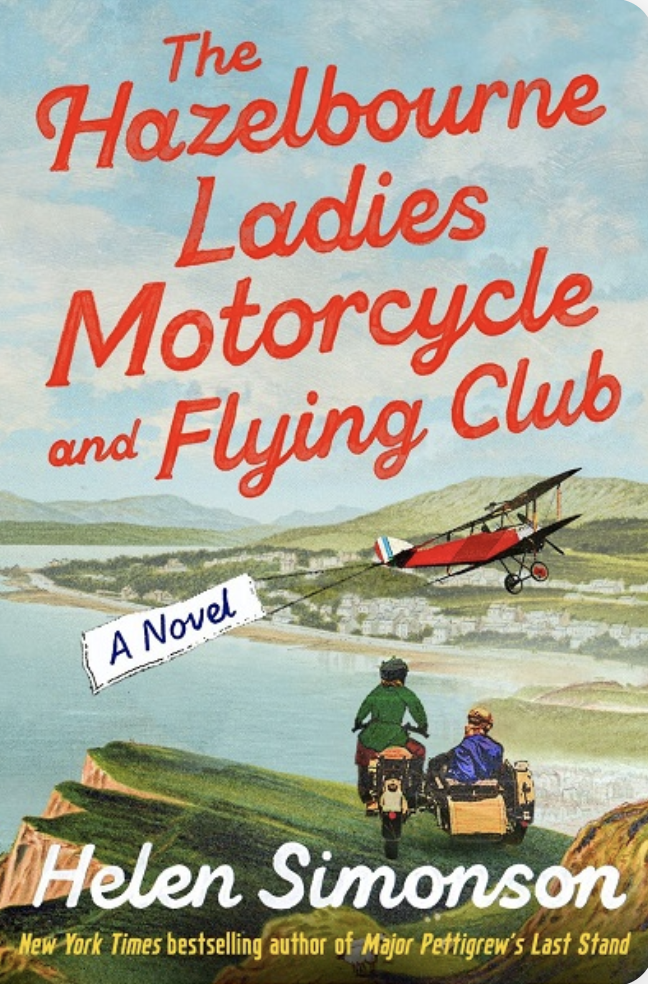
The Hazelbourne Ladies Motorcycle and Flying Club by Helen Simonson (Historical Fiction)

Writing: 4.5/5 Characters: 5/5 Plot: 4/5

Constance Haverhill is a girl with few prospects. 1919 finds her spending a summer as companion to an elderly lady at a posh hotel at the seaside with an unpleasant future looming before her. The Pre-War Practices Act of 1919 gave returning soldiers their pre-war jobs back and forbade women from holding jobs in Covered Occupations. While Constance is pondering her (limited) options, she meets and is befriended by Poppy Wirrall, a local baronet’s daughter and proprietor of the fledgling women’s motorcycle-based taxi service which she hopes to expand to flying lessons for women. Poppy’s primary goal is to keep women employed and progressing while the government and local councils work equally hard to send the women back to homes and domestic service.

The book is beautifully written with a cast of compelling characters set in a very realistic post-war environment. Each person represents a kind of cohort of the day — women facing the loss of their livelihood and an (extremely) limited supply of potential husbands, wounded soldiers returning to a population that doesn’t want to be reminded of the war, those of the wealthy class still scheming for good matches at the expense of ethics and friendship, foreign born naturalized citizens who had been detained during the war and relegated to low status jobs, and even a mysterious Indian national whose character brings to light the treatment of Indians in Britain and the under-appreciated contribution of Indian men in the war. Simonson writes with intricate detail about the inner thoughts and struggles of several characters as well as painting a comprehensive picture of life in that era. It’s an Austen-style novel of manners combined with a feminist look at post-war lives in Britain with a little romance tossed in.

My only complaint might be that certain “types” of people were not given interior lives but were presented as pure negative stereotypes — mostly people of the monied class and one horribly stereotyped American. I’m sure there were plenty of Americans at the time who really were that unpleasant, but being an American myself I would have enjoyed having at least one “decent” American included 🙂

Thank you to The Dial Press and NetGalley for providing an advance copy of this book in exchange for my honest review. The book will be published on May 7th, 2024.

The Samurai’s Garden by Gail Tsukinaya (Historical Literary Fiction)

A quiet, thoughtful, and utterly absorbing book about a young man from Hong Kong sent to a small, Japanese fishing village to recover from tuberculosis on the eve of the second Sino-Japanese war (Fall, 1937). Twenty-year old Stephen is a student and a painter. The year he spends in Tarumi is told through a set of journal entries which are equal parts descriptive and reflective. There is the distant war, with the radio intoning massive Chinese casualties along side propagandist calls for the enemy to “simply surrender to the kindness of the Japanese army, and all will be well.” There is the slow unraveling of his parent’s marriage as his father’s business interests keep him in Japan. And there is the burgeoning friendship with the older Matsu — caretaker and master gardener — and Sachi — whose life was abruptly shattered when leprosy swept the village decades before. Throughout the year, Stephen — feeling deeply but never loudly or dramatically — is slowly developing his own philosophy of living based on the lessons the world is teaching him.

The writing is exquisite — shifting between culture, character, and the natural (and unnatural) world. There is a recurring theme of beauty — sometimes found in the most unlikely places — and yet, once found, inevitable rather than surprising. Throughout all — war, destruction, disease, grief, and the ever tragic profusion of human contradictions — the focus is always on how to move forward — recognizing the fragility of life and finding your own peace and contentment within it. I liked the way the author made it clear that this was not an easy task. And I loved the fact that throughout this story teeming with essential truths, there was neither a cliche nor a saccharine sentiment to be found anywhere in the pages. Some beautiful descriptions of gardens and natural landscapes along with an artist’s way of engaging with the world as well.

Highly recommended.

Quotes:
“ It’s harder than I imagined, to be alone. I suppose I might get used to it, like an empty canvas, you slowly begin to fill.”

“All over Japan they were celebrating the dead, even as more and more Chinese were being slaughtered. There would be no one left to celebrate them. I looked around at all the smiling faces, at Matsu and Fumiko who moved slowly beside me, and wished that one of them could explain to me what was going to happen.”

“Ever since I had come to Tarumi, I’d seen more deaths than in all of my life in Hong Kong. Everything before me was changing. I knew I would never be able to step back into my comfortable past, Ahead of me lurked the violent prospect of war, perhaps bringing the deaths of people I knew and loved, along with the end of my parent’s marriage. These were the terrors I’d somehow escaped until now. And as I sat among the white deutzia blossoms, I felt a strange sensation of growing pains surge through my body, the dull ache of being pulled in other directions.”

“I’ve tried to capture this ghostly beauty on canvas, but like anything too beautiful, it becomes hard to re-create its reality. There’s something about being too perfect, that, even this, which at times appears stiff, almost boring. I finally gave up after several tries.”

“She wasn’t beautiful, not in the way that Tomoko must’ve been, nor did she have the roughness of Matsu. Her attraction wasn’t in the form of perfect features, but from the deep, wrinkles, age spots, and eyes that have seen much of what life has to offer. Fumiko had a face that had been enriched through time.”

“I was old enough to understand everything he said, but as his mouth softly formed the words, I knew the sense of integrity I had long admired in him had died, and then I was already grieving for its loss.”

“He learns how to do art with the stones in her garden: it was a strange feeling, much different from working with the fluidity of brush and paint, or water and earth. The weight of the stones pulled against each stroke and left a distinct feeling of strength and permanence.”

The Stranger Behind You by Carol Goodman (Mystery / Thriller)

Plot: 5/5 Characters: 4/5 Writing: 4/5

Carol Goodman writes the most intriguing, convoluted, surprising novels. She is a master of setting the mood (in this case — creepy, mysterious, righteous, and fearful). The Stranger Behind You is a woman-centric, Gothic-style, mystery-thriller whose plot lines and main characters keep twisting together in unexpected ways. It all comes together beautifully but with constant surprises and a real sense of not ever feeling like you know the characters all the way. The theme might be — you never know who you can trust. Parallel stories weave together police corruption, mobsters from the past, and #metoo style manipulation of women. I’m not generally a reader of books that induce anxiety or stress, and I did have to limit myself to daytime reading for the first third of the book — but it was not the kind of thriller that induces too much anxiety (for me). I’m not a fan of heavy-handed books where all the men are horrible and the women manage to thrive regardless, so let me hasten to say that this is not one of those books. There are some pretty nasty men, and a few nasty women — but there are also plenty good men and women and possibly even a delightfully drawn and mysterious guiding spirit. Enjoy trying to figure out which is which in advance!

Great writing, great storytelling.

Thank you to William Morrow and Custom House and NetGalley for providing an advance copy of this book in exchange for my honest review. The book will be published on July 6th, 2021.

The Book of Longings by Sue Monk Kidd (Historical Fiction)

Characters: 4.5/5 Writing: 4/5 Plot: 4/5

A dramatic and fiercely feminist bit of historical fiction. Sue Monk Kidd inserts a remarkable character into the life of Jesus Christ — a wife named Ana. This is Ana’s story, however, not his. From childhood, the secret longing of this determined and deeply intelligent girl has been to have a Voice. Beginning with writing the stories of the matriarchs of the bible, she continues throughout her life to document the stories of forgotten and neglected women everywhere.

I was completely pulled in to the story. The historical context is rich with detail and insight into both the lives of individuals and the social and political currents of the time. Full sensory descriptions of Ana’s writing — the scrolls, inks and pens; the libraries and codices; the requisite hiding places; and the rare and tenuous gift that she had been allowed, as a woman, to learn to read and write at all. As we go through her life, we experience the inspiration for her writings and read samples as well. I was fascinated to learn that one such sample — Thunder: Perfect Mind — was an actual text unearthed from the 1942 Nag Hammadi excavation and dated to the time of the story.

There is plenty of drama — Ana’s father Matthias is the chief scribe and advisor to Herod Antipas; her adopted brother is Judas; and she meets and marries Jesus — but the actual story was far more political than spiritual … and I appreciated the historical depiction unencumbered by later religious trappings. As an aside, I loved the description of life in Therapeutae — an actual community of Jewish philosophers in Alexandria.

While Sue Monk Kidd’s style is often a little too emotional for me, I was completely drawn into this story of a strong woman insisting on her own voice — in some ways relegating the “greatest story ever told” to a mere influence. This book managed to completely shift my perspective on a period of time I knew little about.

Thank you to Penguin Group Viking and NetGalley for providing an advance copy of this book in exchange for my honest review. The book will be published on April 21st, 2020.


Simon the Fiddler by Paulette Jiles (Historical and Literary Fiction)

Thank you to William Morrow and NetGalley for providing an advance copy of this book in exchange for my honest review. The book will be published on April 14th, 2020.

Plot:  4.5/5  Writing:  5/5  Characters:  5/5

The best kind of historical fiction — a deep, richly painted, description of life in East Texas at the end of the Civil War. It’s an everyday adventure story — not about mythical heroes but about people trying to reclaim their lives in the chaotic aftermath of a devastating war.

Simon Boudlin — the titular fiddler — has simple goals after the war: find a piece of land, marry a woman with similar desires, and make a living with his music. But life after the Civil War is anything but simple. The novel is gritty with detail painting the turmoil of that time with a full sensory experience. While some semblance of government is trying to establish itself and put the country back together again, displaced and ruined people are scrambling to survive and make new lives. From my modern perspective life then was impossibly hard — but in this book it isn’t described in an emotional, complaining way. It just is the way it is. This is the story of people getting on with it — making their way by whatever means necessary, while still not losing their way morally.

Included are beautiful descriptions of music at the time: Simon’s lusting for new sheet music that he can’t afford, the way music draws yearning and memory from the new mash of people from disparate backgrounds, and the business side — how to get gigs, what needs to be played, and how to handle the drunks and disorderlies who insist on disrupting.

If you liked The News of the World, you’ll be just as captivated by Simon the Fiddler (in which Captain Kidd makes a surprise, cameo appearance!)

Beautiful writing that gets to essences. Some quotes:

“His worrying kept him awake. The country was in chaos, there were no rules, law was a matter of speculation, nobody knew how to buy land or put savings in a bank since there were so few banks, how to get a loan, register a title to land, or legalize a marriage, everybody was dubious about the new federal paper money, there was little mail service, and nobody seemed to know where the roads led.”

“So he lived in the bright strains of mountain music and the reflective, running pool of the Irish light airs that brought peace to his mind and to his audiences; peace soon forgotten, always returned to.”

“Every song had a secret inside. When he was away from shouting drunks and bartenders and sergeants and armies, he could think his way into the secret, note by note.”

“He knew that he did not play music so much as walk into it, as if into a palace of great riches, with rooms opening into other rooms, which opened into still other rooms, and in these rooms were courtyards and fountains with passageways to yet more mysterious spaces of melody, peculiar intervals, unheard notes.”

“His first problem was to find a girl who would fall in love with him despite his diminutive stature and his present homelessness.”

“People always tired him, always had, always would.”

“He was ragged, a man of a defeated army and at the dinner he had played his heart out in a borrowed shirt. In short, very like the Irish.”

“So it’s dog eat dog and Devil take the hindmost. So it has been in human memory, wild places where the only law is the strength of your good right arm.” He lifted his arm and made a bony fist. “That’s how it is in all human memory. ‘Vastness and Age! and Memories of Eld!’”

“You expect the government and the diplomatic corps to proceed at some foolish breakneck pace! There are substatutes to argy over and rewrite! And meantime the politicians must be paid their stipends and their travel expenses. Become wise, young man, and cynical, and life will be far more understandable.”

The Dearly Beloved by Cara Wall (Historical Fiction)

A slow-paced, deeply interior book about love, marriage, and faith. It follows a linear progression through the lives of four individuals, two marriages, and a forty-year shared ministry.

The real center of the book is the place of God in people’s lives. Each character has his or her own relationship (or lack thereof) with God: Charles knows absolutely that there is a God and that he has a calling to the ministry; his wife Lily is equally certain that there is no God and has no affinity with the tasks expected of a minister’s wife, preferring an academic life. Nan is a minister’s daughter and has never questioned her faith; James is not religious and has doubts about God, but feels the ministry would be a good platform for his drive towards social justice.

As each character grows into his or her life and faces difficulties both large and small, God is at the center of many thoughts and actions and is present on most pages. This was surprisingly non-repetitious, and the arguments, discussions, reflections, and historical references were balanced and intriguing, even to someone like myself who has no interest in religion.

The characters are all very earnest — even in their doubt and questioning, there is no cynicism (or any humor which I’m now realizing is often predicated on cynicism). It was somewhat refreshing and made me realize how very cynical the world feels today and how it wasn’t always that way.

The prose is beautiful, though at times over wrought. It is a philosophical and reflective look at life and marriage and documents the details of a healthy approach to personal growth — listening, discussing, reflecting, and resolution.

I was initially quite put off by the number of references to God and faith — it really isn’t my thing — but I found myself quite taken by the four individuals and their personal quests for understanding and a fulfilling life. I learned quite a bit more than I expected.

Thank you to Simon & Schuster and NetGalley for providing an advance copy of this book in exchange for my honest review. The book will be published on August 13th, 2019.

A Single Thread by Tracy Chevalier (Historical Fiction)

Writing: 4/5 Characters: 3.5/5 Story: 3.5/5 Historical depiction: 5/5

In 1933, Violet Speedwell is one of the many “surplus” women — women for whom there simply are no men, WWI having depleted the stores. This quiet, slow-paced, and yet utterly engrossing novel follows the 38-year old Violet as she slowly makes an independent life for herself without the availability of traditional options.

Leaving her home in Southampton and her embittered and critical mother, she takes a low-paid typing job and a room in a boarding house in nearby Winchester. It is there that she becomes drawn into the community of Cathedral Broderers who have taken on the task of producing the Cathedral embroideries (360 kneelers, 62 stall cushions and 96 alms bags). I am in no way “crafty,” but I found the description of the entire effort, from overall design, to process, to individual effort to be fascinating. As one of the volunteers (also a Latin teacher) says, “sic parvis magna — from small things, greatness,” commenting that these may be the only mark they are able to make on the world. I liked the fact that the lives described may have been “small” by modern dramatic standards, but were rich and full of meaning to those who lived them.

There is more: early forays into independence; friendships with other women who have not made conventional choices; beautiful descriptions of the natural beauty of the region; and some utterly fascinating descriptions of bell-ringing (did you know that in campanology (bell ringing) a “Peal” is a pattern of bell ringing that goes through 5,000 changes without stopping and can take over three hours? I did not. Don’t forget — each bell is pulled at the precise time by an actual human being.)

Excellent historical fiction based on real events and organizations and beautiful writing that stays true to the mores and habits of the period.

Thank you to Viking and NetGalley for providing an advance copy of this book in exchange for my honest review. The book will be published on September 17th, 2019.

Old Baggage by Lissa Evans (Historical Fiction)

The best thing about this novel is the way it brings the UK Women’s suffrage movement of the early 1900s to life. Historical fiction at its best. Having grown up in the 60s in a family that wouldn’t dream of not encouraging their daughters, I sometimes forget how difficult it was for women to gain something as simple as the vote (as an aside, check out https://www.infoplease.com/us/gender-sexuality/womens-suffrage to see the order in which women got the vote across the globe).

Mattie Simpkin is the larger-than-life, brash heroine who has spent most of her life fighting for Women’s Equality. She was a leader of the Militant Suffragette Movement, and a fair portion of the book covers those experiences along with “where are they now” reunions of those women in the current time (1928, on the cusp of the Act that gave women electoral equality with men). Now Mattie has turned her attention to the young girls who don’t seem to appreciate their newly won rights or understand that the fight for equality isn’t anywhere near complete. She founds a Girls Club with the stated aim of training young girls for lives as “20th Century Women.”

The writing is exquisite — equal skill applied to descriptions of the environment, individuals and their opinions and motivations, and some spectacularly articulate and insightful arguments for women’s equality.  I loved the depth painted in each character — a panoply of realistic people of the time. Although the story is not a comedy, several lines had me laughing out loud (see samples below).

There was an additional plot line overlaid on the broader story that I frankly didn’t care for as much. This focused more on Mattie’s personal development with respect to her feelings towards friends and family and her inability to see clearly into a particular character because of her own history.  However, the bulk of the book is both enjoyable and informative so I am happy to recommend it.

Some great lines:
“People always stared. If one didn’t creep around, if one said what one thought, if one shouted for joy or roared with anger, if one tried to get things done, then seemingly there was no choice but to be noticeable”

“Moodiness had always baffled her — the way that it placed the onus on the other person to gauge which breeze of circumstance was the cause of this particular weathercock twirl. If one were cross about something, then one should simply say so; conversation should not be a guessing game”

“Whereas listening to Mr and Mrs Wimbourne on the topic of their grandchildren is akin to being chlorformed. And servants — do you have any idea of how much the average middle-class woman has to say on the subject of servants? Mrs Wimbourne, Mrs Holyroyd, Mrs Lumb — all ululating on the difficulty of keeping a housemaid.”

“A banshee chorus swelled monstrously and then died away and, for a moment, only the barking of every dog in Hampstead was audible.”

“Churchill had been giving a speech about the miners, his staccato delivery a gift to the astute heckler:”

“It seemed that people like him, people with easy lives, were always assuming things about her: she was stupid because she was a char; she was interesting because she was pretty; she’d be loyal because she was grateful. Nobody except Miss Lee asked her what she really thought.”

“There was a pause, presumably for Mr Wilkes to ensure that any remaining trace of anticipation had been sluiced from the room.”

“If she were a horse, one would advise blinkers”

“Mattie felt as if she were trying to sharpen an India rubber pencil”

“As a method of teaching it lacked variety, but it pummelled my intellect and meant that I dreamed no more during lessons.”

Thank you to Harper Collins and NetGalley for providing an advance copy of this book in exchange for my honest review. The book will be published on April 16th, 2019.