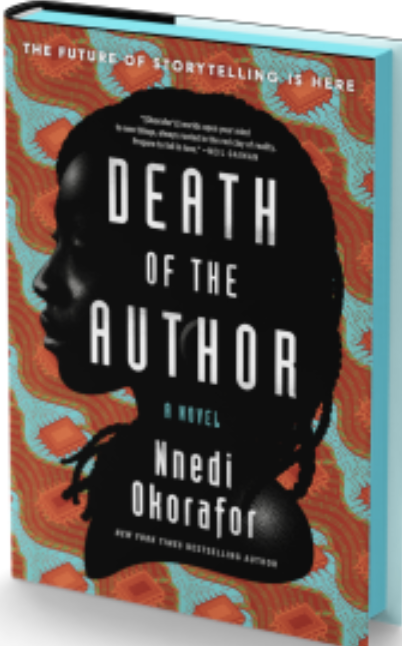
Death of the Author by Nnedi Okorafor (Literary / spectulative fiction)

A captivating book about Zelu — a disabled Nigerian American author (unpublished) and teacher who gets cancelled (and fired) due to her insensitivity (really deeply provoked impatience!) with her more irritating students. It’s also about the new book she writes — Rusted Robots — which becomes an overnight sensation. A post-apocalyptic story where robots and AI are at war over the tattered remains of human civilization, Rusted Robots brings her fame, fortune, some wild, tech-based opportunities, and a whole lot of people who suddenly feel entitled to tell her exactly what to do.

There are so many intellectually interesting and intersecting threads in this story — AI and automation, family, gender roles, African culture, authorial creativity and control, fame, freedom vs safety, disabilities, and the balance between individual and society — but the overarching theme is one of my favorites: the place of narrative and story in human culture. After all, I read fiction because I seek understanding, not just information.

Okorafor manages to blend multiple genres brilliantly, and since I am a fan of both literary and speculative fiction, I was riveted from start to finish. The characters were drawn so deeply — like all of my favorite people, they seemed to be compelling, annoying, loud, supportive, controlling, and caring all at once. I appreciated the fact that while most of the characters were Black (with the exception of the “wealthy white dudes” who keep finding her), there was no antipathy towards white people, just more of a lack of interest.

The big twist at the end absolutely blew me away. And a last little make-me-happy tidbit? She included a call out to one of my favorite (and fairly obscure for the U.S.) books — So Long A Letter by Mariamba Ba.

In my Top Reads of the Year list.

Quotes:
“The rusted robots in the story were a metaphor for wisdom, patina, acceptance, embracing that which was you, scars, pain, malfunctions, needed replacements, mistakes. What you were given. The finite. Rusted robots did not die in the way that humans did, but they celebrated mortality. Oh, she loved this story and how true it felt.”

“The capitalism machine had used her book, her attempt at shouting into the void, to make visual comfort food for drowsy minds.”

“She thought about Rusted Robots and the main character, who understood deep in her circuits that true power was in the harnessing of it, not the possessing of it. And when you were aware of the moment you harnessed power, that was when it was most difficult to navigate.“

“Narrative is one of the key ways automation defines the world. We Humes have always been clear about this fact. Stories are what holds all things together. They make things matter, they make all things be, exist. Our codes are written in a linear fashion. Our protocols are meant to be carried out with beginnings, middles, ends. Look at how I have been built. My operating system is Ankara themed, my body etched with geometric Ankara designs. I’m the embodiment of a human story. But true storytelling has always been one of the few great things humanity could produce that no automation could. Stories were prizes to be collected, shared, protected, and experienced”

Thank you to William Morrow and NetGalley for providing an advance copy of this book in exchange for my honest review. The book will be published on January 14th, 2025.

Irontown Blues by John Varley

Thank you to Berkeley Publishing Group and NetGalley for an early review copy of Irontown Blues by John Varley, which will publish August 28, 2018.  All thoughts are my own.

Writing: 4 Characters: 4 Plot: 4 World Building: 4.5

A nice fast-paced, action-oriented, noir-mystery, in a futuristic setting from Sci-Fi master John Varley.

Chris Bach is a PI wannabe offering his services on Luna many years after the alien invasion of Earth (which basically depopulated the planet — see previous books in the Eight Worlds Universe for more details on this, but it’s not important for this story). He sets off to solve the case of a woman who has been given leprosy against her will (hard to believe anyone would willingly contract leprosy but in this world of acceptable and reversible extreme body modifications, disfiguring diseases can be a source of amusement for some — hmmm). “The Case of the Leprous Dame of Irontown” — trust me when I tell you that the case does not go where you think it will.

Chris is aided by his sidekick, Sherlock. Sherlock is a CEC — a Cybernetically Enhanced Canine. The tale is told through their alternating voices — Sherlock’s via the aid of a canine interpreter named Penelope Cornflower (β-Penny in Sherlock parlance). The book is worth reading for Sherlock’s story alone — if you’re at all a dog person you’ll enjoy (and crack up at) his interpretation of the world and events. Other cool characters include Chris’ not-very-maternal mother (retired police chief and now prehistoric-reptile rancher), and some pretty nasty soldiers from Charon, a once prison-planet turned … not-so-nice but now fully acceptable part of the Eight Worlds.

Great world building and descriptions of future life, both technologically and culturally enhanced. Surprising plot and interesting characters. Plenty of fun references to our favorite detectives both current and past (Elvis Cole and Marlowe are mentioned a lot as is Hildy Johnson. Heinlein gets a whole subculture.) Threads on libertarian ideals, body modification, creative habitats, and slightly insane AIs, run liberally through the story.

Hugo-and-Nebula-Award-Winner John Varley has been writing since shortly after I began reading, and I’ve read most of his work. His short story collection, The Persistence of Vision, is possibly my number one favorite SF short story collection (which is saying quite a lot). I confess I had lost track of him for the past few years and haven’t read his last couple of novels — but I’ll remedy that shortly.

Head On by John Scalzi

Writing: 5 Characters: 3.5 Plot: 4.5

Classic Scalzi — a cool, well-explored, futuristic world with non-stop and non-predictable action and funny banter. This is the second book in his “Lock In” series. It can be read on its own, but “Lock In” was great, too, so why not read it first?

Both books are mysteries in a sci-fi setting. In this world, 1% of the global population has Haden’s syndrome — a condition where the person is “locked in” to his/her own body. A number of technologies have been developed to support this population — implantable neural networks that link their brains directly to the outside world to humanoid personal transport units (called “threeps” after C-3PO) and an online universe called “The Agora.”

In this installment, FBI Agents Chris Shane (himself a Haden) and Leslie Vann (a female version of the crotchety senior detective persona) tackle a difficult case: the physical death of a Hilketa player during a game in which the play is all via threeps and should be no danger whatsoever to the human player. Hilketa is a (very weird to me) game played by decapitating a targeted player and carrying his / her head across the goal line.

I’m happy to say that Scalzi is back in top form. This is only the second book published after he signed a huge multi-million dollar, multi-year, multi-book deal with Tor. The first book published after the contract was Collapsing Empire — the only Scalzi book I have ever disliked (and I’ve read them all) — so I’m quite relieved that he is back on track.

Great writing and pacing, plenty of plot twists, and generally difficult to put down. I started in the morning and finished as I went to bed (only put it down briefly when I was grudgingly dragged outside to help shovel dirt into the new tomato planter). This is accessible to all readers — similar to Andy Weir’s books (The Martian; Artemis) but funnier, more inventive, and offers more exploration of the cultural and political impact of the technologies in addition to the scientific-technical angles.