There are Rivers in the Sky by Elif Shafak (Literary Fiction)

Writing: 4.5/5 Characters: 5/5 Plot: 4/5

A long and highly complex book following three elaborate storylines, all influenced in some way by the Epic of Gilgamesh — the epic Babylonian poem from about 2000 BC. Arthur Smythe — also known as King Arthur of the Sewers and Slum — is born into abject poverty but has an extraordinarily keen mind, an eidetic memory, and an absorbing passion for the artifacts in the British Museum. His story runs from his birth in 1840 to his death 36 years later in Iraq. Zaleekhah is a passionate researcher who focusses on the study and conservation of the Earth’s water in 2018 — focused on theories that would earn her derision were she to try to publish. She is also is pulled in to a fascination with the region through her own Iraqi heritage and feels a despair at the state of the Earth, both politically and environmentally. Narin is a nine-year old Yazidi girl whose village is to be subsumed from flood waters once a new, large dam is completed. A trip to Iraq in 2014 before they must leave the area exposes her to the cruelty of ISIS. Woven throughout the story are themes and entangled details about Mesopotamian history, antiquity looting, modern ISIS, grand scale pollution, language processing and the underpinnings of water throughout.

Shafak’s brain is many orders of magnitude more erudite and complex than mine. The way she can pull together an apparently disjointed collection of data points, commentary, and occurrences and create an interconnected narrative of great scope is inspiring. Her facility with language is impressive — she has a lyrical style that nevertheless manages to convey real content. An example of a one sentence physical description that manages to combine visual depiction, origin, and impact: “… neither grey nor white, the air is a soupy ochre that glows green in places. Particles of soot and ash float above, as domestic coal fires and factory chimneys belch sulfur-laden smoke, clogging the lungs of Londoners, breath by breath.”

I have mixed feelings about how much I enjoyed reading this book. I loved all the detail — giving great depth to so many aspects of the world and bringing so many pieces of information — that could have easily remained hidden — to the surface. These days it feels like we have access to so much information, we are forced to have strong opinions based on a very shallow understanding of the topic, so I appreciated the deep dives on … everything. I loved all the unusual minutiae that came into the story — underground lost rivers, Ashurbanipal’s lost library, a tattooist who works only in cuneiform. However, a real sense of impending doom suffused the pages, and that only got worse at the story went on. It’s hard not to feel as though the world were hopelessly hurtling towards a bad end, with genocidal maniacs (real ones, not Israel, and if you don’t know the difference do some research), environmental disasters, and a generous helping of greed, power-hunger, cruelty, cynicism, and general disregard pervading the text. I freely acknowledge that the world has many, many, problems, but I prefer to read about the many ways we continue to try to improve the many problems and not to succumb to melancholy and hand wringing. I also had a real problem with the ethical dilemma presented at the end. I felt the character’s resolution (clearly representing the author’s opinion) was surprisingly poorly thought out given the depths of her big picture thinking through the rest of the book.

So — if you can read for the history, the beautiful prose, the increased awareness of the interconnectedness of the Earth and the people running mad upon it, you will probably love this book. If your mood is one that is highly influenced by what you’re reading, you might want to pop a Prozac or two before diving in.

Thank you to Knopf and NetGalley for providing an advance copy of this book in exchange for my honest review. The book will be published on August 20th, 2024.

Red Side Story by Jasper Fforde (Speculative Fiction — Audio Book)

I had such a good time listening to this fast paced, humorous, always surprising, adventure rich speculative fiction story by the master of Weird, Jasper Fforde. I highly recommend listening to the audio book as the reader is fantastic and really adds a depth to the events through his voicing of the characters.

In this fully fleshed out imagined world, a person’s role in society is strictly proscribed by the percentage of the color spectrum s/he can see. Two individuals — Eddie, a relatively well-endowed seer of Red, and Jane, a Grey with no color vision at all — set out to bring justice to this world of strict rules and sudden “mildew” events (mildew is always fatal and there is some strong suspicion that exposure is not the accident it is made out to be). We learn more about the mechanics, extent, and population of the world at the same time as our heroes, the onion peeling back layer by layer through a bizarre set of events that I personally could never have imagined. It’s quite fun to read (or listen to — my recommendation!). Composed of precise language and the most thoroughly imagined political and scientific composition, it’s full of British snark and wit. I tend to be bored by pure adventure books — people getting out of one scrape only to enter another — but with the added stimulation of a wildly imaginative world tossing out screwball dangers that each teach us something brand new (and startling) about the world itself, I’m all in.

Enjoyed every minute of it.

By the way, this book is a sequel to the 2011 Shades of Grey which I have not read. Fforde did a great job explaining just enough that there was no confusion, without retelling the entire (previous) story.

Thank you to Recorded Books and NetGalley for providing an advance copy of this book in exchange for my honest review. The book was published on May 7th, 2024.

The Radcliffe Ladies Reading Club by Julia Bryan Thomas (Literary Fiction)

I loved this quiet, but powerful, novel about a group of four Radcliffe students who join a book club devoted to discussing the classics — particularly those focused on the roles, experiences, and opportunities for women. Set in 1955, the discussions of historical classics such as Jane Eyre, The Age of Innocence, A Room of One’s Own, Anna Karenina, and others are superimposed on each girl’s individual background, goals, and experiences. This leads to some well written dialog, reflection (always my favorite), and action, all revolving around the evolution and personal impact of social norms for women. I’m not introducing the four girls here, as I like the way author introduced each. I’m also not describing some of the events that took place — they are important, but best left unintroduced IMHO.

The writing is straightforward, but never simplistic. For me personally, being only one generation behind the students in the book, the stark contrast between the lives and opportunities for the women in the book club selections, the 1955 Radcliffe students, and myself was illuminating. Social norms are embedded in us at an early age, and it is sometimes difficult to have an awareness of how our thoughts and beliefs are forged before we aware of the process. As an aside, I was impressed by how the various male characters were portrayed. The narrative was never strident, and the men ran the gamut from pretty awful to quite decent. It became clear to me that the men, too, were a product of the expectations of the time — not as an excuse for any behavior, but as an understanding of how it might have evolved. The whole thing was fascinating and (for me) never dipped into cliche or melodrama. It simply focussed on the life each girl chose, why she chose it, and how she made it happen.
For the younger among you, Radcliffe was a woman’s liberal arts college in Cambridge founded in 1879 and absorbed into Harvard in 1999.

Some great quotes — some from the classics the girls read:

From the discussion of Anna Karenina: “She had more temptations than an ordinary girl would have had. A handsome count was never going to fall in love with someone less beautiful and exciting than Anna. Which makes me think it wasn’t her fault as much as some might think.” I never thought about it that way.

From Virginia Woolf’s Orlando: ”As long as she thinks of a man, nobody objects to a woman thinking.” Ha!
“Jane Eyre was meant to be read at all stages of life, and each reader must glean what she could from her own study of the book.“

“Ah, but you see, there are no right or wrong answers in book club. It’s all about how a book affects you and how it makes you feel.”

From Virginia Woolf’s Orlando: ”As long as she thinks of a man, nobody objects to a woman thinking.” Ha!
“Jane Eyre was meant to be read at all stages of life, and each reader must glean what she could from her own study of the book.“

“Ah, but you see, there are no right or wrong answers in book club. It’s all about how a book affects you and how it makes you feel.”

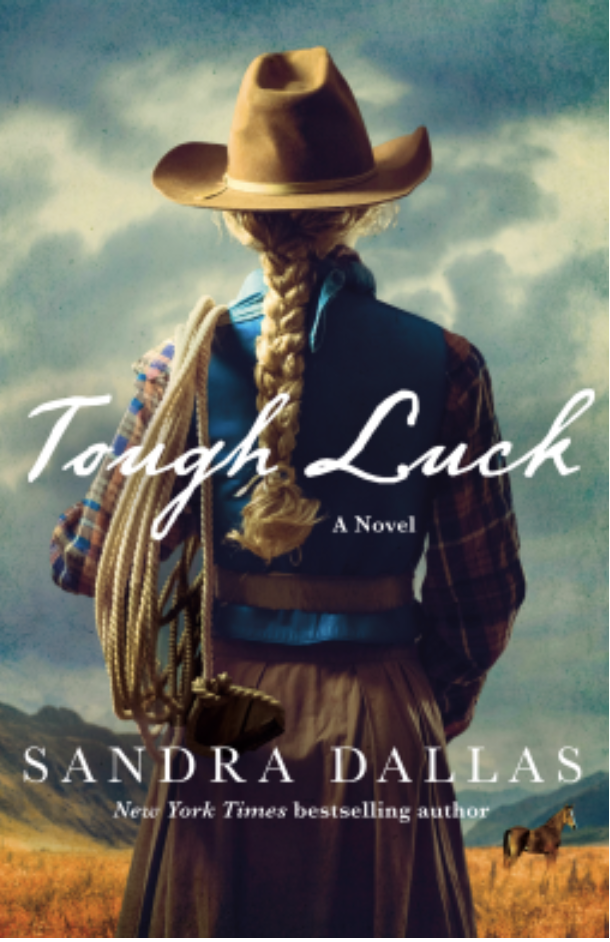
Tough Luck by Sandra Dallas (Historical Fiction)

Writing: 4/5 Characters: 5/5 Plot: 4.5/5

I’ve been reading Sandra Dallas’ books since 1998 and have read (and loved!) all of them. This one is already one of my favorites — captivating characters, wild adventures, and a full sense of the time (1863) and place (Western territories).

Dumped in an orphanage by their elder brother once their mother died, Haidie (14) and Boots (10) Richards manage to escape, taking one of the more reluctant caretaker nuns with them. They head West in search of their long missing father whose last reported location was a mining town past Denver.

Diving into some fantastic storytelling, we join them on an adventure laden trip, sharing the camaraderie of a slew of characters who are as realistic as they are individualistic, intriguing, and somewhat morally curvaceous. The feel of the time and place is intensely real, with the focus on how these people are making their way through the harsh realities of the time. It’s the characters who make it for me — card sharks, con men, mule packers, members of the clergy, and (my favorite) a pair of “old maid” sisters (at the ancient ages of 27 and 29!). I love the way they are each making his or her own way in a harsh world following individual definitions of what it takes to survive in an acceptable fashion. I love the way Dallas’ books tend to include people aggregating into tight knit groups bonded by their experiences. It’s a part of human nature that I genuinely enjoy.

Gobbled this up in one session. Hope the author’s book tour lands in my town because I would dearly like to meet her.

Good for fans of Paulette Giles (though Dallas has been at it longer!)

Thank you to St. Martin’s Press and NetGalley for providing an advance copy of this book in exchange for my honest review. The book will be published on April 29th, 2025.

What Time the Sexton’s Spade Doth Rust by Alan Bradley (Mystery)

Flavia De Luce is back! Joined (against her wishes) by her obnoxious (but very similar IMHO) cousin Undine and the always welcome, long-time family retainer Dogger, Flavia sets out to defend the family’s cook against a murder charge. Major Grayleigh — a genial but private man — was found dead after eating the mushrooms picked and cooked by Mrs. Mullet. Obviously nothing is what it seems on the surface, and there are some big surprises that unfold with the mystery. All told in Bradley’s irreverent style and populated with arcane bits of history that I can’t believe are real. The Neck Verse and clergy indemnity? Timycha, a pregnant Pythagorean philosopher, who bit off her own tongue to prevent her disclosing secret information during torture? Look them up!

I always like the characters — some new, some old. Max — a retired concert pianist of “diminished verticality” (his words) — is a favorite of mine. In all, plenty of fun. I had wondered if Bradley had stopped writing as it’s been five years since the last volume, and they had been coming annually so I’m happy to see that it’s not over yet! I’m not actually sure how old Flavia is any more — she was 11 at the start of the series but that was nine books ago …

Thank you to Bantam and NetGalley for providing an advance copy of this book in exchange for my honest review. The book will be published on Sept. 3rd, 2024.

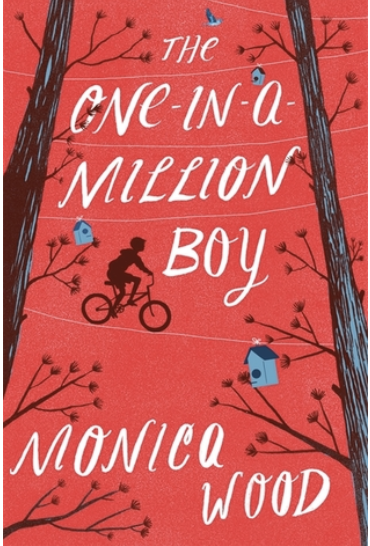
The One-in-a-Million Boy by Monica Wood (Literary Fiction)

Writing: 5+/5 Characters; 5/5 Plot: 5/5

This woman can write! The eponymous “one in a million” boy is dead (at the age of eleven) before the story starts. In fact, we never even know his name — he is always “the boy.” But we learn about him extensively — his (odd) mannerisms, his fascinations, his earnestness — through the effect he has had on a number of characters: his grief-stricken mother Belle; his father Quinn, twice-divorced from his mother, and a complicated presence (or absence) in the boy’s life; and his new friend Ona, the 104-year old woman who is a service target of his boy scout troop. The boy is the only scout Ona has ever allowed to help her for long. He is different. She trusts him and he has managed to extract from her stories, thoughts, and even some fluency in the language of her birth (Lithuanian) — a language she has never knowingly spoken. Most importantly, he has elicited some enthusiasm on her part for a goal for her remaining (!) years. Well versed in the Guinness World Records and utterly enthralled with the possibilities, he believes she has a shot — with his help — at attaining more than one age-related record for the Guinness record keepers.

The book moves on — exploring the characters, their memories, their confusion, sadness, remorse, and regrets, and ultimately their ability to patch the holes in their souls and move forward. The narrative is so real — full of thoughtful characters reflecting on life intelligently with the latent understanding that comes with time; relationships that grow; and characters whose ability to have good relationships keep growing. It’s a bit of a celebration of the utter uniqueness of individual people. I just read David Brooks’ book “How to Know a Person,” but honestly I learn more about how to know a person by reading books like this. Good fiction always feels more truthful to me than the best non-fiction when it comes to people.


At the moment, Monica Wood is my (newly discovered) favorite author. So many possible quotes on this one — I’m probably including too many but I already pruned the list so much! FYI, I absolutely loved the end. I would love to include the whole section but that would just be cheating:

“To Quinn, for whom alcohol was a touchy simile, the truth was this: playing guitar was the single occasion in his slight and baffling life when he had the power to deliver exactly the thing another human being wanted.”

“They stood together in the dripping world, sizing each other up, the boy appearing to marvel at the weight of a century-plus, Ona wondering how in hell she’d unearthed two unrelated words in a tongue she couldn’t remember ever speaking.”

“He enunciated beautifully, though his diction contained barely perceptible pauses in the wrong places, as if he were a foreigner, or short of breath.”

“Normally, Scouts bored her, with their Game Boy stats and soccer scores and lazy, shortcutting ways. This one, though, brought a literal sense of second childhood: she felt as if she were speaking to a child she might have known when she herself was eleven. How easily she placed him at McGovern’s, installed at the white marble soda fountain, sipping a chocolate phosphate. She could see him amid the white-shirted boys playing stickball on Wald Street, tagging the door of Jose Preble’s black REO. There was something vaguely wrong with him that made him seem like a visitor from another time and place.”

“He reminded her that she’d once found people fascinating. That she’d lived more than one life.”

“Ona loved English from the get-go and paid strict attention, noting the cause-effect of language: her parents’ syntactical shipwrecks, the tin peddler’s casual profanity, Maud-Lucy’s pristine enunciations. Style could move listeners to pity, to reverence, to the purchase of a stewpot they didn’t need. Maud-Lucy taught Ona to compose a sentence with intention, and eventually she chose for herself a high-low hybrid that matched her ambivalence toward humankind.”

“Belle managed something like a laugh despite her sorrow, for the boy’s syntactical oddities had always pleased her. He’d read obsessively — instruction manuals, record books, novels far too old for him — picking up linguistic baubles like a crow mining a roadside.”

“I’m good at secrets,” the boy said, studying her so intently now that she began to feel stripped after all — in a good way, stripped of decrepitude and shame.”

“He did wait, observing in silence as Amy padded back and forth with an array of cleaning supplies. From their mother, the Cosgrove girls had learned to scrub their way out of despair. There was no detergent in existence for what ailed them now, but Amy heaved into the old standby nonetheless, with an alacrity bordering on violence, much sloshing and clanging coming from the adjoining rooms. He listened to these sounds — like an animal crying hard, he thought — until she appeared again, hands red and raw.”

“As she opened the menu, Ona felt momentarily unborn, as if her long life had been a warm-up for the real show, on which the curtain was about to rise. She ordered a grilled cheese and a strawberry shortcake, expecting to eat it all.”

“How could it be that Ona Vitkus after so many years alone, had been netted by the maneuverings of lovers and interlopers, tangled into their grief and envy and clumsy efforts at peace? And oh, weren’t they a show: their puzzling wants, their cross-purposes, their own mundane, ticking-down minutes.”

“She looked small and translucent, like a baby turtle from a nature documentary. He fought an impulse to pick her up and carry her to safer ground, As she stood there, fading before his eyes, he extracted the details as if through an old telegraph, dots and dashes that he gathered into a story.”

“He loved that they loved him. He loved the hollow he filled. It was the boy who’d understood this. The boy, whose lists and lists filled his own hollow, the one his father had left behind. A loosening in his chest, like sliding rocks, took him so abruptly that he doubled over, trying to hold it in.”

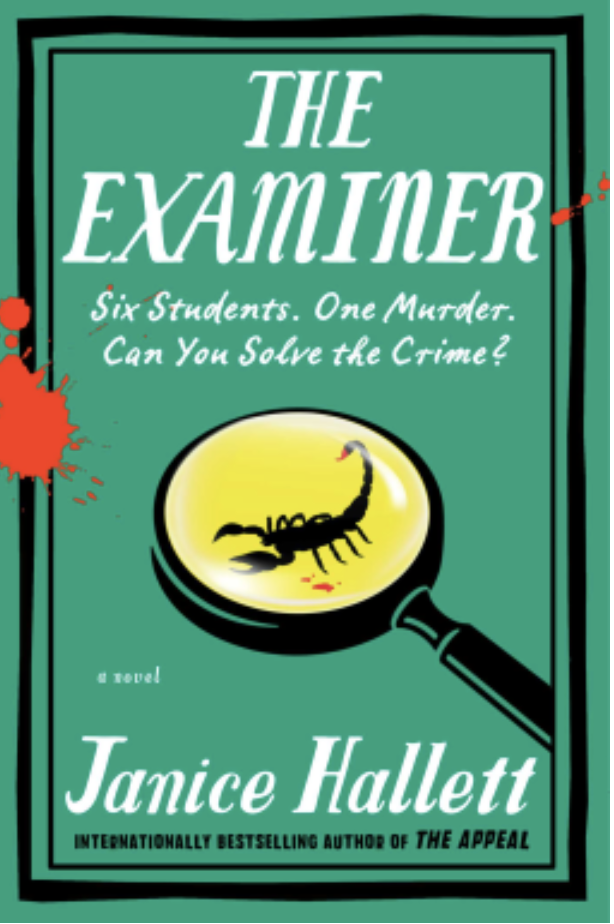
The Examiner by Janice Halett (Mystery)

A kind of a cozy thriller, if that makes sense. Six diverse students are part of a new art master’s program but things go weirdly wrong amidst the standard types of exercises mixed with a “real world” final project installation at a local tech company. The entire book is composed of emails, text messages, online assignments, essays, and assessments, giving the book a kind of forensic feel as events (and the ensuing panic) are slowly revealed. No dialog, no internal ponderings, no real time action.

Unfortunately, this is not my kind of book. It’s very slow paced and is largely composed of “filler” with way too much detail on the arts program (not the art) and interacting with the tech company. It was repetitive, full of bureaucracy, and that particularly irritating mode of interacting with others which is false in every possible way. By the second half of the book there were some big twists and surprises, but honestly they didn’t pass my “not stupid” test. I can deal with “stupid” in my plots if the book is very funny or the characters so interesting that I get to think about how they would react in these improbable situations, but this book is not funny and the characters are not depicted in depth. They aren’t even likable. Perhaps I’m lucky in that I never had a work environment (or school environment) that was populated by such unpleasant and incompetent people! Most of them seemed like absolute prats (British slang for someone who is foolish or stupid, or has little ability — this is a British book, after all!).

There was one good line: “That’s something they don’t tell you about teamwork. It can normalize the horrific.” Never thought about teamwork that way but I get it.

This is my first Janice Hallett book and I know she is popular. I can see that some people would enjoy the text based story, the crazy activists, the shallow and negative depiction of corporations and academic institutions that we can all rally around and groan about but … not for me.

Thank you to Atria Books and NetGalley for providing an advance copy of this book in exchange for my honest review. The book will be published on Sept. 10th, 2024.

Last House by Jessica Shattuck (Literary Fiction)

Writing: 5/5 Plot: 5/5 Characters: 5/5

This is a brilliant epic of a book. It spans a period of 90 years (~1950 to 2040) via the trajectories of a single family — each member ensconced in his or her own cultural context while engaging with the others who are firmly planted in their own contemporaneous but often dissonant contexts. The story begins with Nick and Bet Taylor — he a junior lawyer attached to an American oil team negotiating deals in the Middle East and she a WWII cryptographer who gave up her dreams of a PhD to become a wife and mother (as women did in the 50s). From this stability and cultural conformity came two children — Katherine and Harry — who grow up in a clash between the middle class values of their parents and the anger and rhetoric of the 60s, complete with Marxist hyperbole and anger-fueled violence in the name of peace and justice. Decades later, by the time the third generation comes of age, their social cohort is beset by the overwhelming angst from the imminent collapse of society from climate change, war, and shifting values.

What impresses me about this book is how well Shattuck captures the feelings of the time(s) from so many different perspectives. Anger, fear, bewilderment, passion. Sometimes it was hard to read because she captured it so well; other times it was chilling to read because the activism of the 60s (the good, the bad, and the ugly) is blatantly mirrored in what is happening today. She must have finished writing this book before the Israel / Hamas war began and yet she captured the mix of intentions, propaganda and stupidity of the current situation perfectly.

I loved that the multiple viewpoints were captured via highly reflective characters — their feelings of joy, frustration, rage, and angst appearing in response to a rapidly shifting cultural landscape. I love that they pondered, each in his or her own way, the responsibilities that are incurred simply by being alive. The pages are full of insight with regard to parenting, political attitudes, alliances, friendship, and familial support.

I was (pleasantly) surprised by the lack of cliche and manipulation in the narrative. If the author has a strong opinion on climate change, greed, politics, democracy, or activism, I couldn’t tell you what it was. She covered several competing thoughts on how a person chooses to live in the world as it is. One of my favorite parts (towards the end) was a 2-3 page summary of an optimistic and pessimistic view of the same world. Perfectly crystalized (IMHO) into personal attitudes and interpretations. This book could have been depressing but came off to me as more wistful — the wistfulness that always accompanies the passage of time, regardless of how sweet that passing is.

Some good quotes:

“That’s what civilization is,” Brent said. “Living with people outside your tribe. All those rules and norms and structures that allow you to coexist. Right? Without those, we’re just – cave dwellers, protecting our own turf. You escape civilization, you escape back into your tribe. “

“The Weather Underground had gone off the deep end. They had aligned themselves with history’s most violent killers, people who thought the righteousness of their cause gave them the right to make decisions about life and death: Hitler, Stalin, Charles Manson. In the name of justice, how could you choose that?”

“Still, Katherine‘s knee jerk cynicism, annoyed him. She had never even been to the Middle East. She knew nothing about Iran. She knew nothing about the oil industry or the complicated politics of resource distribution. She had never even taken an economics class. She did not grasp that she was on the top floor of a great complicated structure with her lofty ideals while he was in the basement, stoking the boiler, making sure she would not freeze to death. Her generation took so much for granted! All the peace and plenty they had grown up with wasn’t given — it was protected by a sheath of young men’s bones strewn across Europe and the Pacific“

“How will it work when everyone is exactly equal?” my mother wanted to know. “Is there enough, really, to go around?” I was appalled by this sentiment, so chauvinist, racist, survivalist. I railed at her about the capitalist racket, the smallness of her Depression-era mindset (“But I don’t have a mindset,” she protested. “I have questions”). She was a good sport about it, really, mild-mannered in the face of my patronizing. But she persisted: Wouldn’t there always be some way people sorted themselves? If it wasn’t race or gender or class, would it be intelligence? Physical strength? Blood type? Weren’t there always bound to be haves and have-nots on account of finite resources? The constraints of weather and geography, for instance? Who got the high ground with fertile soil versus who got the desert?”

“My father wanted calm and safety, not emotion. Everything in their life was set. That was her generation, I guess. Their households clean, tidy, and immobile, built to last. So, too, was their concept of the relationships of the people who populated it: mother, daughter, neighbor, housecleaner — these were static entities. I can see now that for my father, this was vital, the best protection he knew against all that was ugly, tangled, and difficult. My mother, though, longed for something different. She was forty-seven years old, and she’d been living the same life since she was twenty-three.”

“Conflict avoidance is a luxury of the bourgeoisie,” I said as if this were a well-known quote. Maybe it was. My head was awash in edict and directives and liberal platitudes.

“The idea disturbed him. They were raising a daughter who felt free to be unpleasant when she was unhappy? He would have been caned by his father if he’d ever been ‘unpleasant.’ ”

Thank you to William Morrow and NetGalley for providing an advance copy of this book in exchange for my honest review. The book will be published on May 14th, 2024.

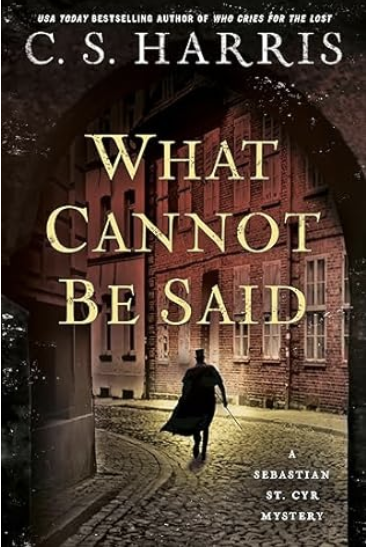
What Cannot Be Said by C.S. Harris (Historical Mystery — audio book)

The latest (number 19!) of the early 19th century series centered around Sebastian St. Cyr, Viscount Devlin, who has a calling to help Bow Street untangle tricky murder cases, particularly when the upper classes are involved.

This episode takes place in July, 1815 — just as Napoleon is captured for the second time, his fate left to the British to determine (exile was chosen because nobody wanted to create a precedent for murdering heads of state, regardless of their crimes). Sebastian is brought in to investigate the brutal murder of a Baronet’s wife and her 16 year old daughter, their bodies posed in the exact same positions as those in a prior crime fourteen years earlier. Through an investigation tangled with possibilities, we are led to a dark conclusion that I admit I never would have suspected (though all the clues were there).

Harris excels at the successive unfolding of layer after layer of intrigue, suspects, and background stories. From lunatic asylums to the work houses to neglectful baby fostering to Dickensian apprenticeships and cruel taskmasters for the unfortunate orphans to soldiers returning from war along with the ever present sniping, posturing, and opportunities for outrage of the upper classes, the story gets richer and richer as it progresses.

The audio book reader was new for me — the first 16 books were narrated by Davina Porter who is one of my absolute favorites. I have no complaints at all about Amy Scanlon but I do miss Ms Porter’s voice.

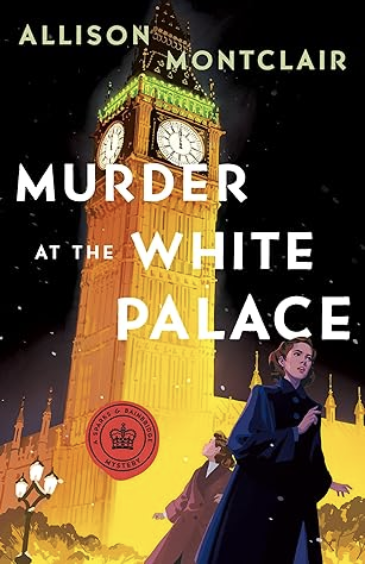
Murder at the White Palace by Allison Montclair (Mystery)

Writing: 3/5 Plot: 4/5 Characters: 4/5

Book six of the Sparks and Bainbridge historical mystery series. These books are just fun — a combination of novel, historical interest, and always an interesting body or two that unravel into quirks and twists and plenty of opportunity for the two women to evolve personally. Set in post-WWII London, the two have started the Right Sort Marriage Bureau. Iris Sparks, with a mysterious past in British Intelligence, and Gwendolyn Bainbridge, a genteel war widow who has recently been pronounced “sane” after an extensive engagement with the lunacy courts. I’ve only read book five so I’ll have to go back and start from the beginning to get all the details, but the author does a decent job of giving you enough background to make sense of the present.
In this episode, Gwen has fun with some bad boys and turns out to be a snooker shark (I’m afraid I skimmed over the snooker scenes — all I got was that it is played on a table with some balls) and has the uncanny ability to tell when someone is lying. Iris is dating a charming man whom we love instantly along with her, though he has ties to the underworld that should be unattractive. A body is found that ties back to history and an old bank robbery, and both women take some pretty interesting twists in their love life. They don’t actually match anyone in this story so (as a fellow reviewer pointed out) we have to hope that they manage to stay in business and nobody is paying them to solve mysteries!

Very entertaining and just the right amount of “cozy” for me.

Thank you to Minotaur Books and NetGalley for providing an advance copy of this book in exchange for my honest review. The book will be published on July 30th, 2024.