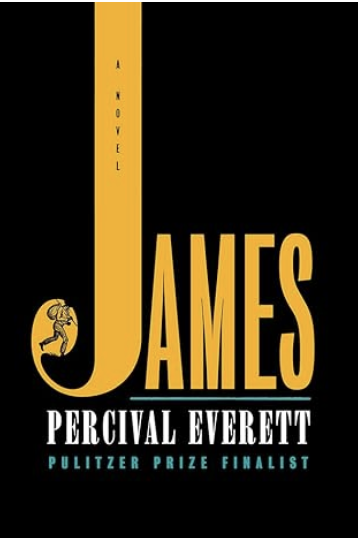
James by Perceval Everett

Writing: 5/5 Characters: 5/5 Plot: 4/5

A beautifully written reimagining of Twain’s Huckleberry Finn, told from the perspective of “Big Jim,” the slave with whom Huckleberry Finn escapes down the river. While Finn is escaping an abusive father, Jim is running from the rumor that he will be sold away from his family. This aligns with the original work. However, in this version of the story, Jim is presented as an intelligent, educated, and feeling man with a rich interior life and a strong sense of responsibility. He is the narrator of the tale and we hear the story from his perspective — drastically different than that of the Twain’s narrator Huckleberry Finn.
The key mechanism of the storytelling (for me) is the code-switching that all the slaves use when in the presence of white people — adopting an unsophisticated patois along with ignorant and superstitious behaviors. Among themselves they speak with good grammar and have a rational (if somewhat resigned) outlook. It’s fascinating what (often inaccurate) signals we receive simply by the way someone talks and behaves.

I enjoyed the writing, the deep characterization, and the (somewhat uplifting) end, although I didn’t particularly enjoy the “adventures.” Starting with the same plot lines as Huck Finn, the book expanded to include plot elements that supported Jim’s drive to free himself and his family. The story was full of realistically depicted attitudes and behaviors towards slaves. While I had read many fictionalized accounts of slavery, I thought this was one of the best for highlighting the varying attitudes of whites, as well as adding depth to the experiences of the slave himself. White characters ranged from cruel men who took pleasure in their cruelty, to those who didn’t believe in slavery but didn’t take any steps to stop it, to those who were actually kind and yet still considered Black people to be subhuman. Everett managed to convey the intense tension present in every moment for a person who is enslaved — the constant worry and lack of any kind of control, the constant tamping down of anger, the constant need for vigilance lest anyone notice anything about you that doesn’t jive with the “dumb animal” they expect. But the real stroke of mastery in the writing is how everything shifts for the reader simply by making it clear that the characters are fully recognizable as human being simply by speaking in a way that we recognize as intelligent.

While I don’t think this was the primary point of the book, it also got me thinking about when violence is justified. Without giving too much away, Jim intentionally kills two other (white) characters even though his own life was not at risk at the time. I was completely happy with his actions which left me feeling vicariously satisfied at the death of two absolutely horrible people. And yet, those people had done nothing that was illegal — instead they were cruel, violent, and behaved immorally according to my own ethical standards. Most of us today are horrified by the idea of slavery and the specific cruelty of many of those who practiced it; however, there are people today who are celebrating the murders committed by Luigi Mangione (United Healthcare CEO Brian Thompson), Tyler Robinson (Charlie Kirk), and the Hamas attack on Israel (1200 murders, rapes and 250 people kidnapped — all non combatants). In their minds, the victims were “guilty” and merited murder. The line between these situations feels clear to me, but is it?

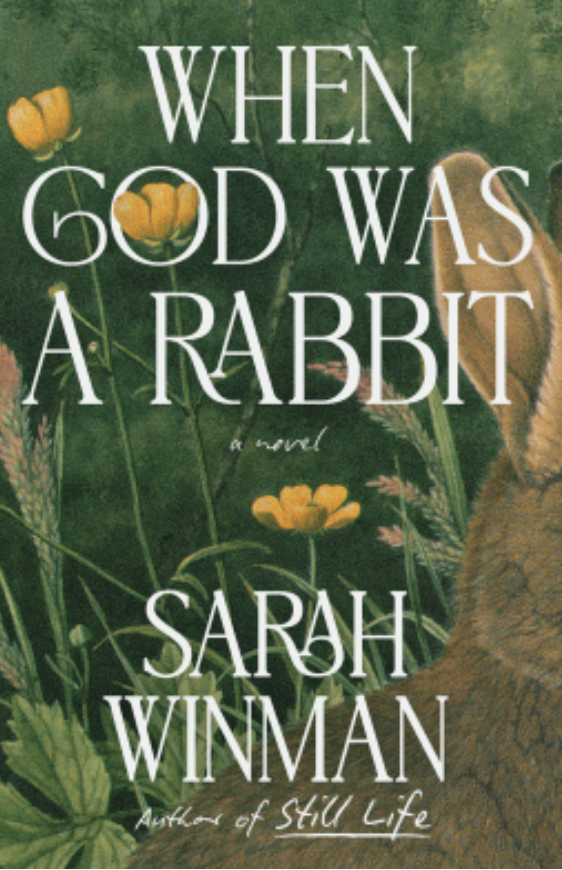
When God was a Rabbit by Sarah Winman (Literary Fiction)

Writing: 5+/5 Plot: 4/5 Characters: 5/5

Charming, deep, and full of insight. A coming of age and beyond novel with clear flows from life experiences to the development of a personality, a worldview, and a moral core.

Eleanor Maud is a bit of a loner, with an adored older brother, a best friend from the “other” side of the tracks, an odd collection of adults who provide her with myriad perspectives and experiences, and a pet rabbit she has named God. Introverted and introspective from an early age, we see her develop a sense of self and a unique brand of faith by continually modifying her worldview and her self-understanding in reaction to events both personal and societal (e.g. a suicide, a scary lump, lost memory; 9/11, the massacre at Dunblane, John Lennon getting shot).

I thoroughly enjoyed reading this, being immersed in another’s quirky and slanted, but also rational and considering, mind. Ellie was an easy character for me to “travel with” in this way. I loved the cast of supporting characters who were each unconventional in his or her own way, always through eccentricities well-supported by their outlook and exploits. This is a reprint of the book — it was originally published in 2011 and was the author’s debut. She has since written three additional books.

Some beautiful quotes:

“He had skirted the periphery of my early life like an orbiting moon, held between the alternate pull of curiosity and indifference, and probably would have remained that way, had Destiny not collided with a Tyrolean coach that tragic, pivotal afternoon.”

“He presented a colorful alternative to our mapped-out lives. And every day as I awaited his return from school, my longing became taut, became physical. I never felt complete without him. In truth I never would.”

My father had never met a lesbian before, and it was unfortunate that K. H. should be his first, because his liberal cloak was pulled away to reveal an armory of caricatured prejudice. He could never understand what Nancy saw in her, and all she ever said was that K. H. had amazing inner beauty, which my father said must be extremely hidden, since an archeological dig working round the clock would probably have found it hard to discover.

“I just want my friend back,” I said, tears burning behind my eyes. ‘I’ve become forgettable”

Do I believe in a mystery, the unexplained phenomenon that is life itself? The greater something that illuminates inconsequence in our lives; that gives us something to strive for as well as the humility to brush ourselves down and start all over again? Then yes, I do. It is the source of art, of beauty, of love, and proffers the ultimate goodness to mankind. That to me is God. That to me is life. That is what I believe in.

And she had left nature alone, opting instead to banish vanity like the meddlesome, suffocating weed it was.

His strange presence had uncovered a loneliness of such devouring longing, one that reached cruelly back into the past, and I knew I could no longer be around him.”

And he uncovered in us a curious need: that we each secretly wanted him to remember us the most. It was strange, both vital and flawed, until I realized that maybe the need to be remembered is stronger than the need to remember.

Thank you to G. P. Putnam’s Sons and NetGalley for providing an advance copy of this book in exchange for my honest review. The book will be published on February 24th, 2026.