
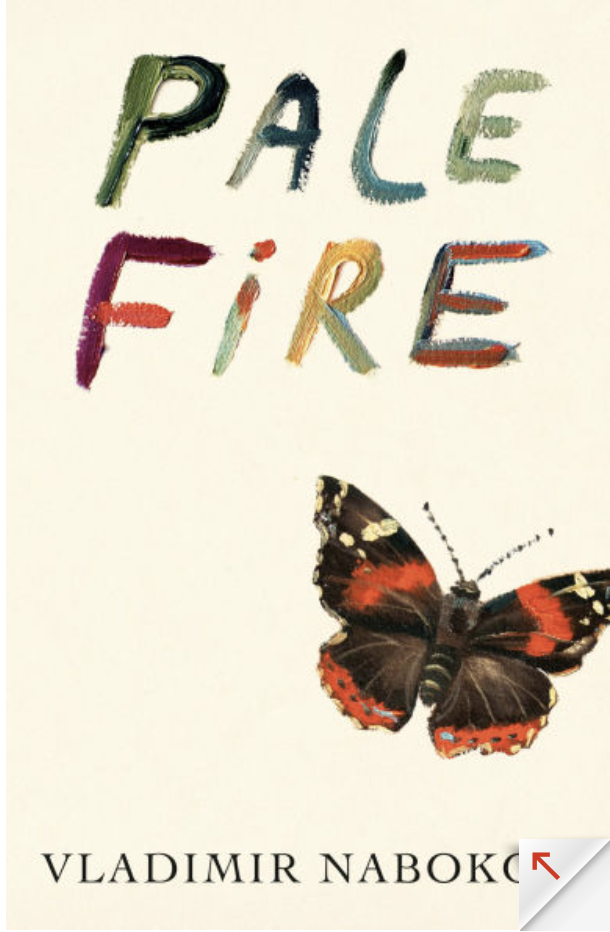
After plowing through this book, reading some online explanations, and having a discussion with other literary fans, I can honestly say that I think this is a masterpiece of literature but not terribly fun to read. The book comprises an introduction, a 999 line poem, and a (very) lengthy, almost line-by-line commentary about the poem.
The poem is written by John Shade, while the introduction and commentary is written by the character Kinbote. Kinbote is the epitome of an unreliable narrator, but that’s OK because what narrative there is is buried in fits and starts within the commentary. While it may seem like “cheating,” I did read a couple of summaries that helped me frame the basic premise my structure craving brain required to make any headway. I won’t include anything here in case you are a firm non-peeker, but know that it can help. Suffice it to say that nothing is what it seems, and the hints to what might be reality are all included but told through the perspective of a madman and only dribbled out in disjoint segments. And yet, it is beautifully done. The writing is incredible (see some quotes below) and the vocabulary … I love words and have (I think) a pretty good vocabulary but the non-native speaker Nabokov blew me away. Just a few of the new (to me) words: Orbicle, Nacreous, Quiddity, Bimanist, stillicide, Ephebe, Pudibundity, Maculation, Architectonically, Trochee, Goetic, Contrapuntal, Perlustration, Selenographer, Versipel, Ament. Life is so much easier when you can look them up on your phone without getting out of the chair!
If you appreciate intricate, highly complex book structure, love beautiful language, and understand that the plot isn’t always the point, this is the book for you!
Quotes:
Alas, my peace of mind was soon to be shattered. The thick venom of envy began squirting at me as soon as academic suburbia realized that John Shade valued my society above that of all other people.
His misshapen body, that gray mop of abundant hair, the yellow nails of his pudgy fingers, the bags under his lusterless eyes, were only intelligible if regarded as the waste products eliminated from his intrinsic self by the same forces of perfection which purified and chiseled his verse. He was his own cancellation.
Nevertheless the urge to find out what he was doing with all the live, glamorous, palpitating, shimmering material I had lavished upon him, the itching desire to see him at work (even if the fruit of his work was denied me), proved to be utterly agonizing and uncontrollable and led me to indulge in an orgy of spying which no considerations of pride could stop.
I notice a whiff of Swift in some of my notes. I too am a desponder in my nature, an uneasy, peevish, and suspicious man, although I have my moments of volatility and fou rire.
And moreover [he said] we, whites, are not white at all, we are mauve at birth, then tea-rose, and later all kinds of repulsive colors.
All the seven deadly sins are peccadilloes but without three of them, Pride, Lust and Sloth, poetry might never have been born.
And let me add here how much I was honored a fortnight later to meet in Washington that limp-looking, absent-minded, shabbily dressed splendid American gentleman whose mind was a library and not a debating hall.
Resemblances are the shadows of differences. Different people see different similarities and similar differences.

