The Examiner by Janice Halett (Mystery)

A kind of a cozy thriller, if that makes sense. Six diverse students are part of a new art master’s program but things go weirdly wrong amidst the standard types of exercises mixed with a “real world” final project installation at a local tech company. The entire book is composed of emails, text messages, online assignments, essays, and assessments, giving the book a kind of forensic feel as events (and the ensuing panic) are slowly revealed. No dialog, no internal ponderings, no real time action.

Unfortunately, this is not my kind of book. It’s very slow paced and is largely composed of “filler” with way too much detail on the arts program (not the art) and interacting with the tech company. It was repetitive, full of bureaucracy, and that particularly irritating mode of interacting with others which is false in every possible way. By the second half of the book there were some big twists and surprises, but honestly they didn’t pass my “not stupid” test. I can deal with “stupid” in my plots if the book is very funny or the characters so interesting that I get to think about how they would react in these improbable situations, but this book is not funny and the characters are not depicted in depth. They aren’t even likable. Perhaps I’m lucky in that I never had a work environment (or school environment) that was populated by such unpleasant and incompetent people! Most of them seemed like absolute prats (British slang for someone who is foolish or stupid, or has little ability — this is a British book, after all!).

There was one good line: “That’s something they don’t tell you about teamwork. It can normalize the horrific.” Never thought about teamwork that way but I get it.

This is my first Janice Hallett book and I know she is popular. I can see that some people would enjoy the text based story, the crazy activists, the shallow and negative depiction of corporations and academic institutions that we can all rally around and groan about but … not for me.

Thank you to Atria Books and NetGalley for providing an advance copy of this book in exchange for my honest review. The book will be published on Sept. 10th, 2024.

Last House by Jessica Shattuck (Literary Fiction)

Writing: 5/5 Plot: 5/5 Characters: 5/5

This is a brilliant epic of a book. It spans a period of 90 years (~1950 to 2040) via the trajectories of a single family — each member ensconced in his or her own cultural context while engaging with the others who are firmly planted in their own contemporaneous but often dissonant contexts. The story begins with Nick and Bet Taylor — he a junior lawyer attached to an American oil team negotiating deals in the Middle East and she a WWII cryptographer who gave up her dreams of a PhD to become a wife and mother (as women did in the 50s). From this stability and cultural conformity came two children — Katherine and Harry — who grow up in a clash between the middle class values of their parents and the anger and rhetoric of the 60s, complete with Marxist hyperbole and anger-fueled violence in the name of peace and justice. Decades later, by the time the third generation comes of age, their social cohort is beset by the overwhelming angst from the imminent collapse of society from climate change, war, and shifting values.

What impresses me about this book is how well Shattuck captures the feelings of the time(s) from so many different perspectives. Anger, fear, bewilderment, passion. Sometimes it was hard to read because she captured it so well; other times it was chilling to read because the activism of the 60s (the good, the bad, and the ugly) is blatantly mirrored in what is happening today. She must have finished writing this book before the Israel / Hamas war began and yet she captured the mix of intentions, propaganda and stupidity of the current situation perfectly.

I loved that the multiple viewpoints were captured via highly reflective characters — their feelings of joy, frustration, rage, and angst appearing in response to a rapidly shifting cultural landscape. I love that they pondered, each in his or her own way, the responsibilities that are incurred simply by being alive. The pages are full of insight with regard to parenting, political attitudes, alliances, friendship, and familial support.

I was (pleasantly) surprised by the lack of cliche and manipulation in the narrative. If the author has a strong opinion on climate change, greed, politics, democracy, or activism, I couldn’t tell you what it was. She covered several competing thoughts on how a person chooses to live in the world as it is. One of my favorite parts (towards the end) was a 2-3 page summary of an optimistic and pessimistic view of the same world. Perfectly crystalized (IMHO) into personal attitudes and interpretations. This book could have been depressing but came off to me as more wistful — the wistfulness that always accompanies the passage of time, regardless of how sweet that passing is.

Some good quotes:

“That’s what civilization is,” Brent said. “Living with people outside your tribe. All those rules and norms and structures that allow you to coexist. Right? Without those, we’re just – cave dwellers, protecting our own turf. You escape civilization, you escape back into your tribe. “

“The Weather Underground had gone off the deep end. They had aligned themselves with history’s most violent killers, people who thought the righteousness of their cause gave them the right to make decisions about life and death: Hitler, Stalin, Charles Manson. In the name of justice, how could you choose that?”

“Still, Katherine‘s knee jerk cynicism, annoyed him. She had never even been to the Middle East. She knew nothing about Iran. She knew nothing about the oil industry or the complicated politics of resource distribution. She had never even taken an economics class. She did not grasp that she was on the top floor of a great complicated structure with her lofty ideals while he was in the basement, stoking the boiler, making sure she would not freeze to death. Her generation took so much for granted! All the peace and plenty they had grown up with wasn’t given — it was protected by a sheath of young men’s bones strewn across Europe and the Pacific“

“How will it work when everyone is exactly equal?” my mother wanted to know. “Is there enough, really, to go around?” I was appalled by this sentiment, so chauvinist, racist, survivalist. I railed at her about the capitalist racket, the smallness of her Depression-era mindset (“But I don’t have a mindset,” she protested. “I have questions”). She was a good sport about it, really, mild-mannered in the face of my patronizing. But she persisted: Wouldn’t there always be some way people sorted themselves? If it wasn’t race or gender or class, would it be intelligence? Physical strength? Blood type? Weren’t there always bound to be haves and have-nots on account of finite resources? The constraints of weather and geography, for instance? Who got the high ground with fertile soil versus who got the desert?”

“My father wanted calm and safety, not emotion. Everything in their life was set. That was her generation, I guess. Their households clean, tidy, and immobile, built to last. So, too, was their concept of the relationships of the people who populated it: mother, daughter, neighbor, housecleaner — these were static entities. I can see now that for my father, this was vital, the best protection he knew against all that was ugly, tangled, and difficult. My mother, though, longed for something different. She was forty-seven years old, and she’d been living the same life since she was twenty-three.”

“Conflict avoidance is a luxury of the bourgeoisie,” I said as if this were a well-known quote. Maybe it was. My head was awash in edict and directives and liberal platitudes.

“The idea disturbed him. They were raising a daughter who felt free to be unpleasant when she was unhappy? He would have been caned by his father if he’d ever been ‘unpleasant.’ ”

Thank you to William Morrow and NetGalley for providing an advance copy of this book in exchange for my honest review. The book will be published on May 14th, 2024.

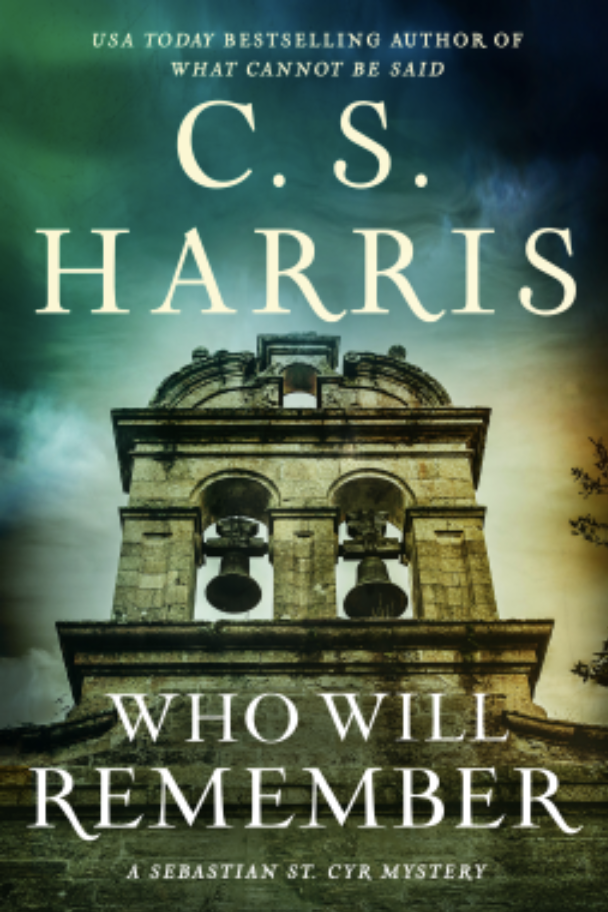
What Cannot Be Said by C.S. Harris (Historical Mystery — audio book)

The latest (number 19!) of the early 19th century series centered around Sebastian St. Cyr, Viscount Devlin, who has a calling to help Bow Street untangle tricky murder cases, particularly when the upper classes are involved.

This episode takes place in July, 1815 — just as Napoleon is captured for the second time, his fate left to the British to determine (exile was chosen because nobody wanted to create a precedent for murdering heads of state, regardless of their crimes). Sebastian is brought in to investigate the brutal murder of a Baronet’s wife and her 16 year old daughter, their bodies posed in the exact same positions as those in a prior crime fourteen years earlier. Through an investigation tangled with possibilities, we are led to a dark conclusion that I admit I never would have suspected (though all the clues were there).

Harris excels at the successive unfolding of layer after layer of intrigue, suspects, and background stories. From lunatic asylums to the work houses to neglectful baby fostering to Dickensian apprenticeships and cruel taskmasters for the unfortunate orphans to soldiers returning from war along with the ever present sniping, posturing, and opportunities for outrage of the upper classes, the story gets richer and richer as it progresses.

The audio book reader was new for me — the first 16 books were narrated by Davina Porter who is one of my absolute favorites. I have no complaints at all about Amy Scanlon but I do miss Ms Porter’s voice.

Murder at the White Palace by Allison Montclair (Mystery)

Writing: 3/5 Plot: 4/5 Characters: 4/5

Book six of the Sparks and Bainbridge historical mystery series. These books are just fun — a combination of novel, historical interest, and always an interesting body or two that unravel into quirks and twists and plenty of opportunity for the two women to evolve personally. Set in post-WWII London, the two have started the Right Sort Marriage Bureau. Iris Sparks, with a mysterious past in British Intelligence, and Gwendolyn Bainbridge, a genteel war widow who has recently been pronounced “sane” after an extensive engagement with the lunacy courts. I’ve only read book five so I’ll have to go back and start from the beginning to get all the details, but the author does a decent job of giving you enough background to make sense of the present.
In this episode, Gwen has fun with some bad boys and turns out to be a snooker shark (I’m afraid I skimmed over the snooker scenes — all I got was that it is played on a table with some balls) and has the uncanny ability to tell when someone is lying. Iris is dating a charming man whom we love instantly along with her, though he has ties to the underworld that should be unattractive. A body is found that ties back to history and an old bank robbery, and both women take some pretty interesting twists in their love life. They don’t actually match anyone in this story so (as a fellow reviewer pointed out) we have to hope that they manage to stay in business and nobody is paying them to solve mysteries!

Very entertaining and just the right amount of “cozy” for me.

Thank you to Minotaur Books and NetGalley for providing an advance copy of this book in exchange for my honest review. The book will be published on July 30th, 2024.

The Hungry Season by Lisa M. Hamilton (Biography)

This is the biography of a Hmong woman — Ai — born in Laos in 1964. It covers her life journey from Laotian hill dweller through years of war to a Thai refugee camp to a (more or less) successful rice farmer in Fresno. Told in a memoir style, Hamilton does a decent job of telling the story the way she hears it from Ai (through an interpreter as Ai cannot read or write in any language, or speak any English). There is no novel-like narrative arc that makes sense of the various pieces, and the reader is left with many questions about basic aspects of her life — like what happened to her eleven children?? But this is what makes it more interesting — this really is Ai’s story the way she thinks about it — not the way Hamilton might have framed it. Therefore there is no agenda, no political commentary, and no call to action. On the one hand, I was left with the question of “What am I supposed to do with this information?” But, on the other hand, I realized I’m not supposed to do anything with it: It’s a recollection of a specific woman’s life as she told it. Specifically, the memoir of an illiterate woman who would not be penning one of her own. It’s rare to be able to encounter that kind of verisimilitu

I learned a lot about the huge impact of the Vietnam War on Laos, quite a bit about the Hmong — their culture, sense of identity and belonging and utter disassociation with the countries they live in — and quite a bit about rice farming. In Ai’s personal story is plenty of matter-of-fact detail about what it is like for a girl to grow up in what I would call a primitive and truly patriarchal society as well as the personal and confusing experience of immigration bureaucracy. I have no idea how similar Ai’s story is to stories from other Hmong refugees, but Ai was driven and the various ways she seized opportunities when others did not was very telling. I was fascinated by the way she viewed the different people in her life. Both alien and intriguing.

I found it surprisingly easy to read, even though it didn’t appear at first to be something that would hold my interest. The style was a bit dry, but utterly authentic.

Lucky by Jane Smiley (Literary Fiction — Audio Book)

Ostensibly the story of a Jodie Rattler — from childhood until her 80s — who achieved moderate fame as a folk/rock singer/composer and, due to some clever investing of the money she had, was able to live her life and create her music without having to make herself a slave of the music industry. I never get the impression that she has any particular plans or goals. Instead she does what she wants to at the time, gathering (and enjoying) experiences that she often embeds into her music. This takes us from her birthplace in St. Louis to England, to recording studios, to tropical beaches, to New York City, and often back home to St. Louis. It takes us through her 25 lovers and their stories. The book is highly reflective with Jodie clearly describing her experiences, her feelings at the time and upon later reflection, and her thoughtful musings on life as a result. It’s really a personal voyage of self-discovery and ongoing development but without the cataclysmic events that often send people into these states. While it sometimes felt a bit slow moving (especially as the audio book reader spoke at a measured pace) I found myself consistently interested. By the end I felt like I knew what it was like to be Jodie. At the same time, I didn’t resonate with her — we are very different kinds of people — which made it even more interesting to be her for the duration.

There is a theme throughout the book where she reflects on how lucky she is every step of the way — chance meetings, being seen by a promoter etc. Hence the title. There is a lot of interesting detail on how she writes her songs, where her ideas come from, how she develops them, and what kind of experimentation she does to get a particular sound — all of which was completely accessible to me as a non-musician. Because the book spans about 80 years (from 1955 – 2030), we also get to watch (through her eyes) the evolution of the music industry, the political scene, and the planet. The worries about climate change and political instability float about the book, settling into something more solid by the end of the book as Jodi ages.

Now — I very much enjoyed listening to this book and thought the end was reasonable. But. I hated the epilog and I would honestly suggest you just don’t read it. It’s short and has a very interesting twist to it (and a tie in to the name of the book), but it has a complete downer of a future prediction that honestly has nothing at all to do with the story and just left me in the worst mood for no good reason! I don’t want to include a spoiler so I’ll say no more except that I really found it both emotionally draining and literarily gratuitous.

How to Age Disgracefully by Clare Pooley (Fiction)

I loved this book. It was hysterically funny and I found myself laughing out loud on almost every page, multiple times on some. I definitely got some looks on the subway.

A community center housing a senior citizens social club and a daycare is threatened with closure when the board gets greedy for development money rather than making the effort to fundraise for repairs. But the senior citizens (and one desperate teen father) will do anything to keep that from happening and come up with some pretty interesting long shot ideas. FYI these are not senior citizens living up to society’s (pallid) expectations! We’ve got the larger than life Daphne whose future is bleak but whose past was “extraordinarily colorful;” Art, the actor who specializes in playing dead bodies while managing a small kleptomania problem; Ruby, the Banksy of knitting; Anna, the ex-trucker with quite a number of dead husbands to her credit; and William, the retired Paparazzo who puts his (IMHO sleazy) skills into useful practice. All supposedly organized by the 50 something Lydia, whose life has been drained of purpose but filled by an utter a*hole of a hubby. There is something very appealing about old cranky people getting a new lease on life, and this intensely uplifting book has that in spades.

I loved the characters (a teen father? how often does that happen?), loved the humor and excellent writing, and loved the random thoughts on aging — like how to take advantage of the apparent invisibility of the aged for your personal aging benefit. I loved the author’s note where she claimed she still did not feel like a “grown up” despite her “advanced” age — I so relate to that! Lastly, I loved the reference to the Dylan Thomas poem “Do not go gently into that good night.” How many times have I heard of that poem without ever bothering to actually read it and think about what it means? Here are the first lines:

Do not go gentle into that good night 
Old age should burn and rave at close of day;
Rage, rage against the dying of the light.

There is more — it is good — go read it if you haven’t …

Some great quotes — only a tiny fraction!
“She appeared to have jumped out of the frying pan of sexism and into the fire of ageism. The final frontier of isms.“

“There was nothing better than listening to someone else’s guilty conscience being offloaded.”

“Her comfort zone was exceedingly spacious, but this experience lay well outside of it.”

“She needed to turn over a new leaf. Become an entirely new plant, even.”

“Despite her age, Daphne seemed to have the hearing of an adolescent bat.”

“Why on earth, when there were so many more important things they could be teaching their children, would parents waste their time reading stories about an insect with a dysfunctional relationship with food?” (about the Hungry Caterpillar)

“Daphne wrote texts, he’d discovered, just the way she spoke in proper full sentences and with perfect grammar and an under current of condescension.”

“She leaned forward and gave the man she was with a peck on the cheek, an incidental comma nestling up to a bold exclamation mark.”

“Art had tried to call his new pet Maggie, as instructed by Lydia, but her surname lurked in the ensuing pause like toxic waste.” (pet’s full name was Margaret Thatcher)

Thank you to Pamela Dorman Books and NetGalley for providing an advance copy of this book in exchange for my honest review. The book will be published on June 11th, 2024.

City of Secrets by P. J. Tracy (Mystery / Crime)

Book four of Tracy’s Los Angeles based, Detective Margaret Nolan crime series. I wait for these books — for me they are a perfect combination of pacing, surprises, and just the right amount of tension (i.e. not too much because I don’t enjoy being anxious, but just enough that I’m not bored reading about tea parties while someone is murdered offstage).

In this episode, what appears to be “just” another fatal car jacking, turns out to be a far more complex crime involving big business, cartels, and some pretty crazy people. I love Margaret Nolan as a detective. She has the same qualities you would appreciate in a male detective — strong, competent, honest, determined — and manages to be simultaneously female without having to introduce any “traditionally feminine” traits. No shopping scenes! No whining with girlfriends about men! No struggling with single motherhood while trying to have a career! She’s just a consummate cop who happens to be a woman. Thank goodness. She’s a great character and I’m happy to read more about her. Other strong characters populate the series — her cynical and somewhat world-weary partner Al Crawford, Sam Easton — a friend recovering from Afghanistan induced PTSD, and Remy Boudreau, fellow homicide detective and a more serious than planned lover.

One of my favorite mystery / crime writers. I really like her writing — a few quotes:

“They were victims of a rotting culture of violence — domestic terrorism, really, — that wouldn’t go away, no matter how many gangsters the LAPD locked up.”

“He was wearing a foul weather windbreaker and his frowny, pissed-off face. Maybe it was because his tiny umbrella had unicorns on it.”

“From a young age, her mother had always told her that her rare combination of strawberry-blonde hair and pale skin made her a genetic tinderbox and her temper should be managed early.”

“Consorting with evil to exterminate greater evil was an existential conflict of the job — hell, of the world — but it was getting more difficult to justify.”

“Interviewing witnesses was like slowly unwrapping a gift, hoping there was a gold nugget inside instead of a lump of coal.”

“Nolan was always amazed by the sullen indifference of criminals, like they were ordinary citizens who’d just gotten a bogus speeding ticket.”

“The job was slowly corroding him from the inside, like poison that didn’t kill you right away. So was Los Angeles. It had a shrill, dangerous hum that hadn’t existed five years ago, and it scared him.”

Thank you to Minotaur Books and NetGalley for providing an advance copy of this book in exchange for my honest review. The book will be published on August 20th, 2024.

Shy Creatures by Clare Chambers

Writing: 4/5 Characters: 5/5 Plot: 3.5/5

1964. When William — a mute and (very) shaggy man — is found in decrepit conditions in a London suburb, he is taken to a psychiatric clinic for evaluation.  He apparently had not left the house for over ten years.  When William turns out to have a real artistic talent, Helen, the clinic art therapist, feels drawn to the “Hidden Man” and makes him into a special project.  The narrative branches off in two directions.  The first follows Helen as she tries to unravel the mystery of the Hidden Man’s origins while also coming to terms with her increasingly disastrous relationship with the appealing, but definitely married, psychiatrist treating William.  Alternating sections follow William’s story backwards through time — eventually providing the answers in events taking place in 1938.

The story was compelling, and I liked the backwards progression through William’s life slowly explaining how he developed into the man he became.  All of the characters were deftly drawn, and I enjoyed the reflection and details that helped me understand (though not necessarily empathize with!) their various personalities.  I found the psychological tools and thinking of the era fascinating and wished there had been slightly more of that and less day-to-day descriptions.  I found the book a little long winded, but with a little judicious skimming (sorry!) I enjoyed it from beginning to end and appreciated the relatively upbeat ending (will say no more about this!)

I found the writing at the sentence level to be excellent.  Here are a few quotes:

“Helen started to feel the intestinal cramping and queasiness that often accompanied the contemplation of her moral failings.”

“As usual, thoughts of her mother prompted a wave of guilt, swiftly followed by a cancelling backwash of resentment.”

 “The fact that his ire was aimed not at them, but at some nearby object that confounded him didn’t make it any easier to ignore; for quiet people, raised voices are experienced as a kind of aggression even when directed elsewhere.”

Thank you toMariner Books and NetGalley for providing an advance copy of this book in exchange for my honest review.The book will be published on November 12th, 2024.

Within Arm’s Reach by Ann Napolitano (Literary Fiction)

I can’t fault the writing of this book and I’m guessing that it will be very popular because people today seem to like melodramas about unhappy people and this book has that in spades. It’s a giant soap opera about the generally dysfunctional relationships within a large, ethnically Irish, Catholic family and all the ways the individuals seem bent on making themselves and their loved ones even more miserable. It is told from six viewpoints — Catherine, the matriarch; her eldest daughter Kelly; Kelly’s husband Louis; their two children Gracie and Lila; and the nurse who attends Catherine after a fall (who has other unexpected connections to the family). I was hoping the end would either be uplifting or teach me something but I got … nada. There was also a pattern of emotional women being “saved” by decent, well-grounded, men. While there is honestly nothing wrong with that, it doesn’t seem like something to aim for.

I really loved Napolitano’s “Hello Beautiful”, and heard wonderful things about “Dear Edward” (I could not bring myself to read that book because it sounded so depressing), but while the writing was good and the characters well-drawn, the only characters I liked at all were the ones that had tied themselves voluntarily to this troubled family and I honestly couldn’t figure out why they ever would have done that…

Some quotes that I think illustrate my point:

“… there’s little point in drawing all of my brothers and sisters and their families together. What you get when we are all in the same room is not love. It is a potent combination of our childhood, my father‘s anger, and my mother’s deliberate silence and pointless, barbed comments. It is the long, thin, thorny end of the rose.”

“Why would I be working hard? And for what? For Gram? That isn’t enough of a reason. Life isn’t supposed to be hard. F*** that. Gram is wrong. I’ll end up like uncle Pat, sitting like a popsicle on the edge of a folding chair, feeling nothing. And Gram wouldn’t want that. I picture Weber’s face, bright with happiness.”

“She has the ability to make a decision and then inflate her emotions like a bicycle tire until they back up the decision with no wiggle room.”

Thank you to Dial Press Trade Paperback and NetGalley for providing an advance copy of this book in exchange for my honest review. The book will be published on April 30th, 2024.