Grave Reservations by Cherie Priest (Mystery)

Writing: 4/5 Plot: 3.5/5 Characters: 4/5
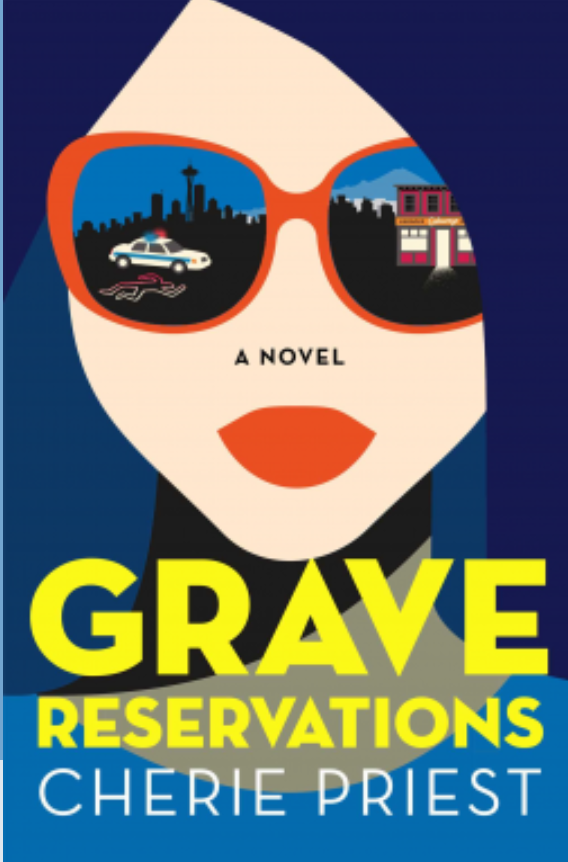
This was a real palate cleanser for me. A light and funny murder mystery written by a woman who typically writes award-winning Steampunk and Horror novels. Leda Foley is an “inconsequential psychic” who is struggling to get over the murder of her fiancée (Tod) a few years before. Her life consists largely of “Klairvoyant Karaoke” at a local bar and getting her travel agency (Foley’s Far-Fetched Flights of Fancy) going. Until one day she manages to save the life of a Seattle cop who is investigating a murder that just might be tied to Tod’s murder … Lots of fun references to the Seattle goth scene (I think? Some scene anyway!) and favorite (to me) places such as Elliot Bay Books and the Seattle Central Library. Irreverent, tongue-in-cheek tone.

Some good quotes: Quotes:
• “But this was the granddaddy of them all — eleven geometrically styled stories of pure, weapons-grade knowledge.” (About the Seattle Central library)
• “Dude pronoun for the sake of statistical likelihood, though I wouldn’t count out his wife. If anyone hated that guy as much as I did, it’s probably her.”
• “Steve folds like a paper crane any time someone mentions about the cops.”
• “… and a waistcoat with a pocket watch that said he visited the nineteenth century in his downtime, for funsies.”
• “An army of ankle-high canines spilled out of the house, swarmed Grady’s feet like furry piranhas, and followed both men back inside — where they thoroughly sniffed the newcomer, deemed him harmless, and immediately began fighting over whose belly he’d pet first.”

Thank you to Atria Books and NetGalley for providing an advance copy of this book in exchange for my honest review. The book will be published on October 26th, 2021.
The Color of Law: A Forgotten History of How Our Government Segregated America by Richard Rothstein (Non-fiction)

This is a thought-provoking, though somewhat rambling, overview of the impact of systemic racism in U.S. housing policy on African Americans. To be clear (because systemic racism has become an almost meaningless phrase thrown at everything), Rothstein documents the laws and policies — federal, state, and local — that explicitly made it illegal to sell real-estate to non-whites, give mortgages to non-whites, or offer certain kinds of tax-breaks to non-whites. These laws and policies were in action just as the suburban lifestyle took center stage with new housing developments supported by transportation networks optimized for suburb to city commutes. Subsequent chapters followed the resulting situations as housing prices outstripped wage gains and tax policies swerved to benefit home owners over city renters, etc.

While Rothstein’s extended research is accurate (and horrifying) it is anecdotal and not comprehensive. In other words, we hear about all of the racist laws, the long court battles trying to change them thus upholding the 14th amendment, and the many workarounds people used to avoid repercussions for ignoring court decisions — but we don’t really get to understand how prevalent this behavior was. I’m guessing it was quite prevalent, but I can’t actually tell from reading this book.

I’m also not thrilled by his conclusions — he constantly conflates race and class and often leaps straight from terrible situations to unsupported causal connections. For example, in one part he goes from housing unfairness to gangs in four sentences without considering any other possible explanations. Similarly, in a discussion of income mobility, the data showed African Americans had less income mobility than whites — but not as much less as one might expect under the circumstances. This he explained with a wave of hands suggesting that African Americans had worked twice as hard and / or that affirmative action was “working.” Lastly, despite the title, this book focussed only on the aspect of law that relates to housing and not to the many other aspects of law that could be shown to support racist policies.

Still — incredible eye-opening descriptions of what was done by the government to treat African Americans unfairly and the lengthy and complicated process required to make changes. If you can find someone to give a good summary, that might be preferable to actually reading the book which is a bit of a slog.

All Together Now by Matthew Norman (Fiction)

Writing: 4/5 Plot: 3/5 Characters: 4.5/5

In a kind of modern-day Big Chill, four far-flung high school friends are brought together for one last blow out weekend. Billionaire Robbie Malcolm is dying of cancer and asks his oldest friends to come for one last get together. Cat Miller — Hollywood producer — has just quit her job and ended her lesbian relationship with the married star of her show; Wade Stephens — “inexplicably good at useless things” — is flat broke as he watches his second novel go through a long string of rejections; and Blaire McKenzie Harden — married with children — is wondering how on earth she ended up owning a minivan. For each, it becomes a time of reflection about friendships, parenthood, relationships, and the inevitable effects of time marching on without consent.

As an aside, l Iearned about an interesting financial scheme called viatical settlement — where someone buys the insurance policy from someone who is dying for less than its value. I honestly didn’t understand what was so despicable about it — it allows someone access to money before their death and they pay for the privilege. There was some discussion about rich people, how they got their wealth, whether or not they could be good people, etc. but not at the depth it deserved. That was one aspect of the book that fell into stereotyped treads and wasn’t really developed on either side.

I liked Norman’s last book — The Last Couple Standing. He is good at writing realistic relationships and presenting multiple character viewpoints well and that comes out here as well. For this book, I didn’t really love the “billionaire facilitation” aspect of this story, though it served its purpose and didn’t sink into too much Lifestyles of the Rich and Famous. Overall an easy and enjoyable read.

Thank you to Ballantine Books and NetGalley for providing an advance copy of this book in exchange for my honest review. The book will be published on June 15th, 2021.

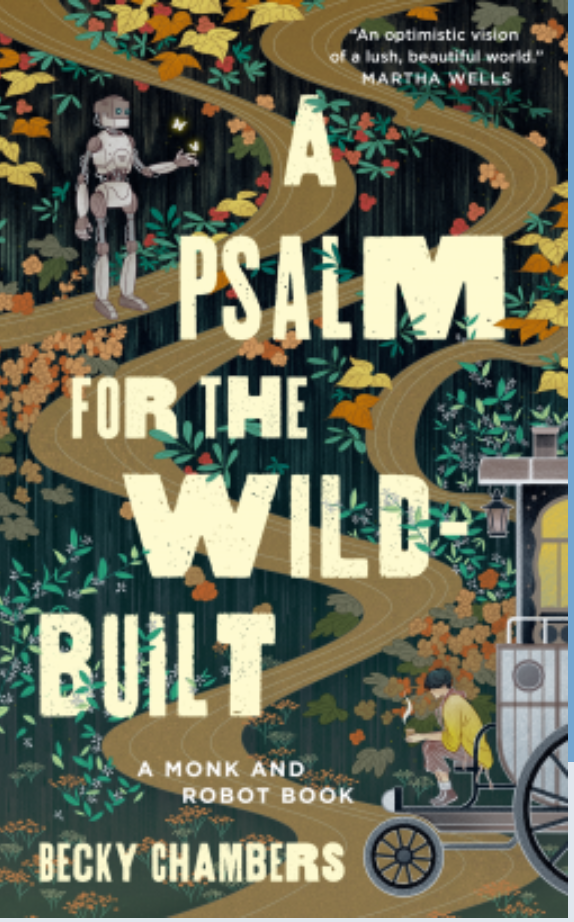
A Psalm for the Wild-Built by Becky Chambers (speculative fiction)

200 years after The Awakening — when sentient robots left the abusive factories for the wilderness, rejecting further contact with humans — a human and robot meet in a twist on the traditional “First Contact” story. Sibling Dex — a gender neutral monk, meets Mossbank — a sentient “wild-built” robot whose family tree boasts several generations of wild-built individuals descending from16 factory bots. What follows is short on plot but long in world building, while we follow the two as they wander through untraveled areas and talk about their similarities, differences, and rising self-awareness.

I’m a big Becky Chambers fan — I enjoy her writing and her exploration of cultures. This is the beginning of a new series, and I’m hoping some of the future episodes have a little more plot to them. While this was philosophically interesting, I did get a little bored to be honest. Also, she uses the pronoun “their” for Dex and his/her fellow monks. This drove me crazy — I was not able to get used to it although it peppered every single page. Every time I read the word I struggled to figure out who the rest of the people were and then had to remember it was only Dex! Every time! I’m super happy to use someone’s choice of pronoun when I remember — including a made up one (I like zhe) — but using plurals for a singular drives me batty. I probably won’t read the next book because of this — I just don’t need the cognitive load. However, if this doesn’t bother you and you enjoy slow-paced, philosophical, stories, you will enjoy this!

Thank you to Macmillian-Tor/Forge and NetGalley for providing an advance copy of this book in exchange for my honest review. The book will be published on July 13th, 2021.

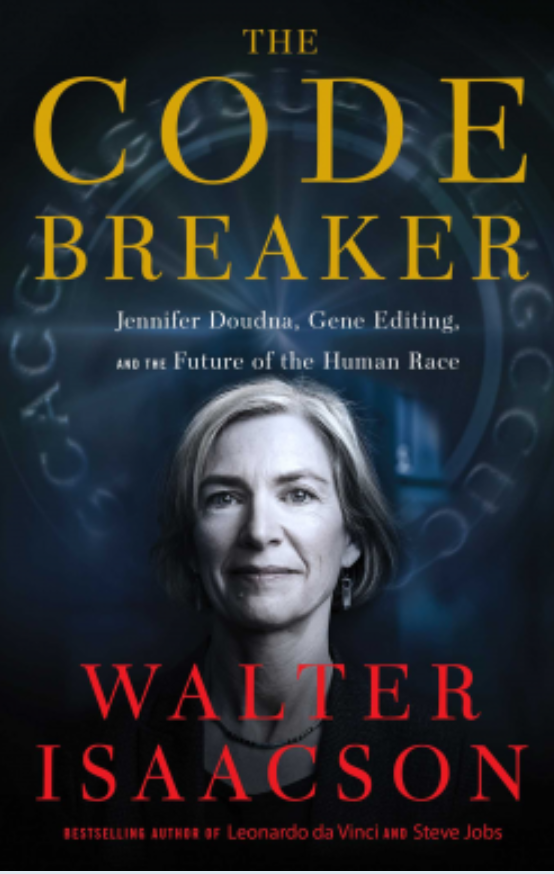
The Code Breaker: Jennifer Doudna, Gene Editing, and the Future of the Human Race by Walter Isaacson (Non-fiction)

A fascinating and timely story about the life sciences revolution (specifically gene editing) and the Covid bomb that ignited a community already poised at the brink of discovery — all told through the biographical lens of recent Nobel winner Jennifer Doudna.

Isaacson is a skilled biographer and synthesizer. He has an unsurpassed ability to explain very complex concepts in accessible terms. I’ve read four of his books and have been impressed by his ability to explain well things I already know (Steve Jobs and computers) and things in which I have little background and zero aptitude (Leonardo Da Vinci and 15th century art). His descriptions of CRISPR (DNA sequences that enable the gene editing at the heart of the book) and the myriad ways it was discovered, applied, and deployed do not disappoint. What I liked best? You actually feel the zing of scientific discovery as he describes the evolution of gene editing tools and techniques and the researchers who made it happen.

Getting to know the researchers was almost as interesting as learning the science — to the point where Jennifer Doudna — while thoroughly admirable — did not have a personality that eclipsed the other players, making it feel less like a biography and more like a community portrait. Every one of the key contributors was profiled in a succinct but insightful way: James Watson of DNA discovery fame (more on him later); Harvard Medical School geneticist George Church (who felt trapped in the present when he should be in the future); Doudna’s co-Nobelist and co-discoverer of the CRISPR/Cas9 “genetic scissors” the peripatetic Emmanuelle Charpentier who likes to keep herself on edge and not get too comfy; Feng Zhang — credited (but bitterly contested) with applying CRISPR to the human genome; and the many, many additional researchers pursuing careers in the field.

In addition to the science and the scientists, Isaacson spends a fair amount of time on the aspects of commercialization including the competition between academics resulting in sometimes bitter patent battles on rights regarding various facets of the technology and its applications. In contrast, he also gives plenty of air play to the wealth of technologies born of necessity during the COVID-19 pandemic covering how the community was poised to act and the incredible bureaucracy and what strings had to be pulled to get through it (and who had the clout to pull those strings). Also included is a pretty comprehensive description of the requirements and applied innovations to virus detection, vaccination, and treatment. I actually feel much calmer about covid having read the book.

Lastly, Isaacson devoted a lot of time and discussion to the question of ethics — a topic I always enjoy. Ethical questions such as safety and unintended consequences, the tradeoff between individual needs and the needs of society, the potential widening of the privilege gap, and the potential impact on human diversity if we allow people free choice on gene selection for offspring. Isaacson inserted a lot of his own ideas into this section and I can’t say I agreed with everything he said, though he did fairly include multiple viewpoints. He appeared to conflate (as people often do) genius with debilitating problems — pointing to Van Gogh (mental illness) and Miles Davis (sickle cell anemia) as examples where a change to their genetic structure might alleviate their suffering but hamper their creative output — a loss to society as a whole. He (again, as most people do) also firmly yoked diversity to physical characteristics instead of a wide range of personality, opinion, intelligences etc. There appears to a strong fear that if left to their own devices, everyone would choose to have blonde haired, blue eyed children. Also — nobody ever seems to bring up the ethical question of parents making decisions for their as-yet-unborn children! I have more strong opinions on this chapter but I encourage you to read it yourself!

I have a few other issues with the book — Isaacson seems to insert himself into the action more often than I thought necessary and spent a little longer than I liked on a somewhat sensationalized version of the patent wars. He also loudly supported our new “cancel culture” with his full chapter treatise on James Watson’s fall from grace due to unpopular racial remarks. I’m a big believer in a free electorate who must be trusted to think for themselves and not in favor of shutting down people who have beliefs different from my own (no matter how distasteful). Controlling people’s freedom of expression is really a bad move for a free society, regardless of how much we each wish we could get the other side to shut up!

Still — small annoyances aside — this is a fully engaging book about a fascinating topic told in an accessible manner and covering one of the key turning points of human civilization — so go buy it today and read it!

Early Morning Riser by Katherine Heiny (Literary Fiction)

Jane is a second grade school teacher in Boyne City, Michigan. In chapter one she falls in love with Duncan — the town playboy — and spends the rest of the book following an unexpected path through her own life. Each chapter (carefully labeled with the year — thank you!) is a mini-story that captures the essence of Jane’s personal story in that time frame. Story and personal evolution proceed apace with humor, insight, and poignancy as she becomes deeply involved with a set of characters she might not have voluntarily sought out: Jimmy, Duncan’s sweet and intellectually slow colleague; Aggie, Duncan’s bossy ex-wife; and Aggie’s flat out strange husband Gary.

I love Heiny’s writing style — her precise language perfectly captures internal thoughts and external behaviors. Jane possesses a biting interior commentary and the descriptions of second grade classroom life are pointed and hysterical. The characters are real — some times you love them and sometimes they irritate you completely. Good for fans of Anne Lamott.

Some random quotes:

“In fact, she had not only stopped being the maid of honor, she nearly stopped being human and became just a help desk in a giant green dress. She had to tell the caterers to start serving, and direct the florist on where to put the arrangements and the staff which table to designate for gifts.”

“It all reminded Jane that having a baby was not that miraculous. Any two fools could do it.”

“Worst of all were the mood swings. Although, actually, could it be considered a mood swing if it only swung one direction? Maybe it was more like a mood acceleration. Like the needle on a speedometer that whipped straight from ZERO to ANNOYED and stayed there. Because it seemed like the world was in an unkindly conspiracy to irritate Jane.”

“Endless rolling nausea without vomiting, nausea that spun out before Jane like a curving country lane meandering through a hilly green landscape, the end always just out of sight.”

“Jimmy was always there. He lived with them, and sometimes Jane thought that spontaneous adult conversation had fled her life forever.”

“Little insights into the murky liquid that sloshed around in the fishbowl of Gary’s mind.”

“She felt a sort of cellular-level sorrow and wondered if she loved more deeply than other people. Or was everyone else just more mature, more rational? More realistic?”

Thank you to Knopf Doubleday and NetGalley for providing an advance copy of this book in exchange for my honest review. The book will be published on April 13th, 2021.

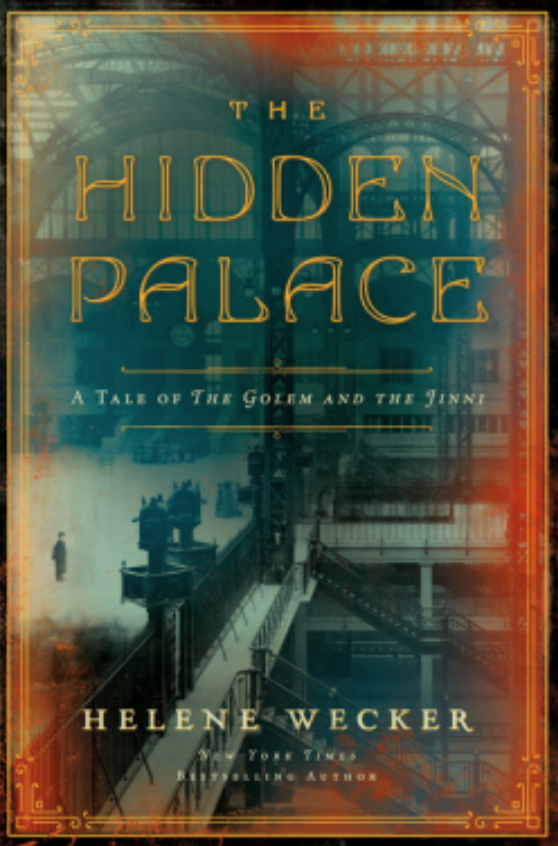
The Hidden Palace by Helene Wecker (Literary / Speculative Fiction)

Writing: 4/5 Characters: 5/5 Plot: 3/5

The Hidden Palace is a sequel to one of my favorite books: The Golem and the Jinni. Taking up where the G&J left off, we follow the two as they continue their inhuman lives amidst the sea of humanity that is New York City in the early1900s.

The story ranges over fifteen years encompassing WWI, the sinking of the Lusitania, the Triangle Shirtwaist Fire, and the disaster of the Titanic and takes place in New York City and parts of Syria. Including most of the characters from the first book, we also meet a Jinniyeh (a female Jinni) who is impervious to iron; an orphaned, ultra orthodox young girl who had helped her rabbi father create a golem to fight the pogroms in Russia; and Yosselle, the new golem himself.

I enjoyed many aspects of this book — the portrayal of the characters and their interactions were fascinating — especially between the young girl and “her” golem. The continuing themes of “otherness” and immigration continued from book one with additional examples through various human and inhuman characters. I’m sorry to say that I wasn’t captivated in the way I was by the first book — for me there was too much time spent evoking the time and place through description when I prefer character interaction. Also, the overall tone felt more sorrowful than I remember book one, which is perhaps more realistic, but less satisfying. While book one brought multiple cultures together through these (non-human) representatives, this book felt more like the follow up on a couple in love but with such different essences that they were heading for an inevitable divorce (my impression — not what actually happens). For those who haven’t read the first book, she does a decent summary of the important background and events in the first few chapters.

Thank you to Harper and NetGalley for providing an advance copy of this book in exchange for my honest review. The book will be published on June 8th, 2021.

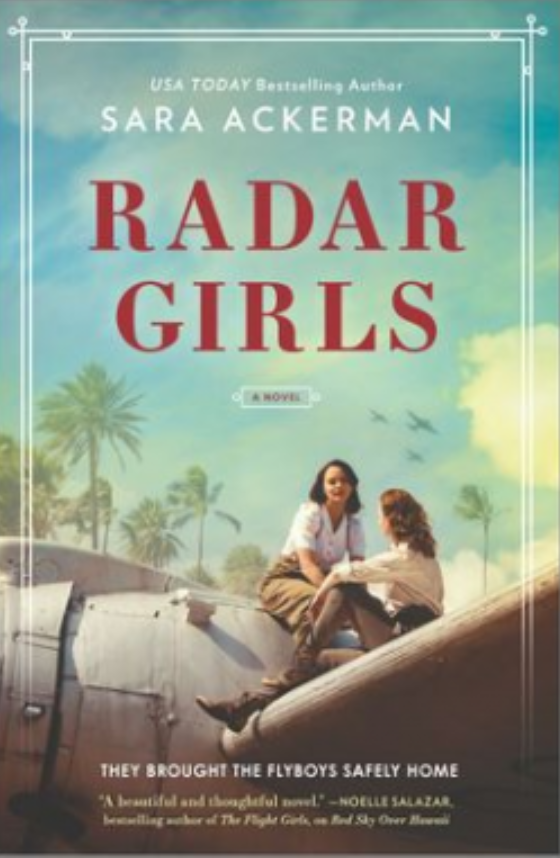
Radar Girls by Sara Ackerman (Historical Fiction)

Writing: 3/5 Plot: 4/5 Characters: 4/5

1941, Oahu: Daisy Wilder — high school drop out, gifted horse trainer, and sole support for her widowed and non-functioning mother — is out diving for supper when the world changes. It’s December 7th and it’s Pearl Harbor. She feels the vibration of hundreds of Japanese planes in the sea.

This book is an ode to female friendship, love, and … learning the intricacies of the then brand new weapon — RADAR. Daisy becomes a newly minted WARD (Women’s Air Raid Defense) and dives into learning everything there is to know to be able to support the war effort in this capacity. While there is romance, what I liked about this book is that it really follows Daisy’s growth and development through multiple facets in her life. Fully half of the book is focused on her war work — what she learns, what she experiences, what gets in her way and how she overcomes obstacles. Often in a romance the heroine has a kind of pretend career with no depth while she goes after her personal hunk. In this book she tackles everything you should be tackling in your twenties — meaningful work, good friends, and a life partner. I was impressed by the (not dull, not dry, not boring) descriptions of the organization and implementation of the war work — using radar to spot planes and ships, vectoring in pilots in trouble, and traffic filtering. Really pretty fascinating and not at all typical women’s fiction fare.

To be honest the writing was OK but not great. There are a lot of cliches, some characters are extremely shallow (the “bad” guys), and some of the action was choppy. However, the story was engrossing, I liked the portrayal of most characters, and I really enjoyed myself while reading it!

Thank you to Harlequin and NetGalley for providing an advance copy of this book in exchange for my honest review. The book will be published on July 27th, 2021.

Dictionary of Lost Words by Pip Williams

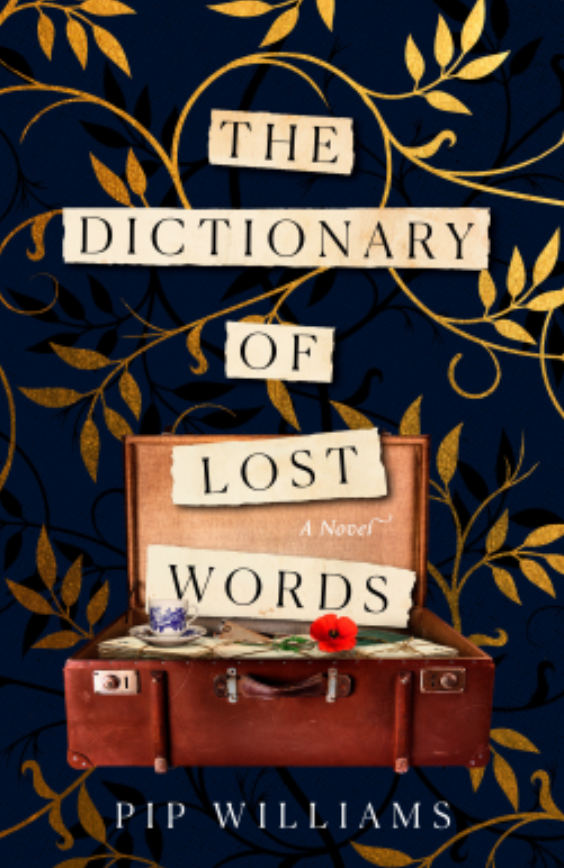
Loved this book! Motherless Esme grows up in the Scriptorium — OED prime editor James Murray’s repurposed garden shed — playing under the table as her father and other lexicographers labor over entries for the decades long effort that will result in the magnificent Oxford English Dictionary.

As she grows older and becomes more involved in the work, Esme begins to notice patterns in the words that are excluded and the definitions that lean away from certain interpretations. She begins to collect words — women’s words, bawdy words, words spoken but never written from the poor and illiterate. Her awakening to the world around her via the medium of the constituent pieces of the English is simultaneously subtle and stunning. Spanning and encompassing the women’s suffrage movement and World War I, it is a phenomenal coming-of-age story with intellectual and emotional growth circumscribed on the story.

Excellent writing with detailed and fascinating descriptions of the process of compiling a dictionary from scratch including solicitation, editing, typesetting, and printing. Wonderful characters including Esme, her Da, the individual lexicographers, her Godmother Edith (also a contributor / editor), and the Murray’s maid Lizzie who serves as a kind of mother figure. While Esme is fictional, many of the other named characters are not, and Williams does a skilled job at weaving Esme and her ideas into an historically accurate narrative.

Highly recommended.

Thank you to Ballantine Books and NetGalley for providing an advance copy of this book in exchange for my honest review. The book will be published on April 6th, 2021.

All the Little Hopes by Leah Weiss (Literary Fiction / YA)

Writing: 3.5/5 Plot: 4/5 Characters: 4/5

All the Little Hopes is a double coming-of-age story set in a North Carolina tobacco farming community from 1943 until the end of the war in 1945. Thirteen-year old Lucy Brown lives with her family on a tobacco and honey producing farm when she meets Allie Bert Tucker (Bert) who was shipped away from her Asheville mountain home when her mother died. The story alternates between their voices as they rapidly move from strangers to best friends to family. Lucy worships Nancy Drew and wants to be a detective; Bert wants more than the “puny life” she was headed towards back home. They both get what they want when a German POW camp provides labor nearby and men — not the nicest of men — start disappearing.

The story is firmly embedded in factual events and surroundings — WWII on the home front with a beeswax contract with the government; cheap labor from a nearby POW camp and community misgivings; an entire world of German glass marbles and the ubiquity of earned marble skills; purple honey with potentially healing properties; and Shape Note Singing (look it up — it’s cool) as examples. Racial and ethnic stereotypes, segregation, and attitudes are matter-of-factly included without being the focus on the story.

I thoroughly enjoyed this book which is billed as Literary Fiction but could easily serve as YA. It’s a small and local story painted on a big and global canvas that gives insight into young lives maturing under the auspices of war, propaganda, and local culture. Great characters and an intriguing plot as told from the perspective of youngsters who were forced to gather information piecemeal and fit it into their own emerging mesh of internal knowledge.

Some good quotes:

“I don’t tell Bert that sometimes I wonder if Irene’s heart is too small. She isn’t very amiable, and she’s stingy with kind words, like she’s scared she’s going to run out. It must be tiresome being Irene.”

“It’s got bits and pieces that glue me together when I’m coming apart.”

“It ain’t nice to shine a light on the ugly, but the ugly came home with Whiz and sits in our front yard.”

“We’ve crossed some invisible line into the land of beguile, and I feel a power I never knew before.”

Thank you to Sourcebooks Landmark and NetGalley for providing an advance copy of this book in exchange for my honest review. The book will be published on July 27th, 2021.