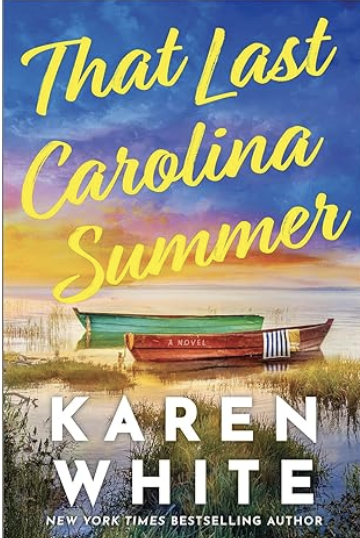
That Last Carolina Summer by Karen White (Literary Fiction)

Phoebe Manigault is called home to the South Carolina Low Country when her none-too-stable sister says she can’t handle their aging mother on her own. Phoebe has moved as far away as she can (Bend, Oregon) and is none too thrilled to be drawn back to a place that holds quite a few bad memories for her, including the fact that she barely survived being struck by lightning 20 years earlier, and has “enjoyed” strange premonitions ever since. What follows is a story of finding love, dealing with your demons, charting the narrows of dementia, and the Power of Place. And discovering the dark secret that underlies most of the pain of the last decades.

What could have been a simple (and pleasant) piece of women’s fiction quickly reveals itself to be a wonderfully insightful piece of literary fiction. The characters are deeply drawn with realistic confusions, longings, protections and vulnerabilities. They make mistakes, lose their way (and sometimes their cool), and general act like people, but they also push through bad habits, fears, and habitual suspicions and make their way forward — which is critical for me. The story was dramatic without going overboard into melodrama — I was gripped from page one yet never felt manipulated, never cringed from ridiculous coincidences, and could find myself relating to situations that were alien to me. The writing was so good that I even enjoyed the descriptions of the place (which I usually skip over, not being a great visualizer). She brought it to life for me by describing the place through the narrator’s eyes (and other senses and emotions). I should add that while the book dives deep into topics that can be very painful, I found it uplifting overall as intentional resolution led to closure. Lastly, lots of fascinating bits about birds — I’m no twitcher (love the word!), but I loved the bird facts peppered about and the ornithological epigraphs at the beginning of each chapter that often related bird behavior to aspects of people — all spot on.

I’m a big fan of Karen White’s Charleston-based Tradd Street series (and her newer New Orleans-based Royal Street series), but for me this book is in a class of its own.

Thank you to Park Row and NetGalley for providing an advance copy of this book in exchange for my honest review. The book was published on July 22nd, 2025.

The Everlasting by Alix E. Harrow (speculative fiction)

An Academic, a Hero, and a Wicked, Wicked, Queen who must be overcome — tumbled about via a magical book and a unique and somewhat poetic instantiation of time travel. Nobody can write like Alix E. Harrow and (most of) her characters are compellingly relatable as they come to terms with the barrenness and often hopelessness of their lives when closely examined. There is an insistent love story, which is both sweet and determined in the face of some pretty intense road blocks, and there is a very satisfying conclusion (thank goodness). The characters have real depth, and there is plenty of the reflection that I like. There is also plenty of action (the Hero is a fighter par excellence — demonstrated frequently lest we forget it!) and some nice twisty gender bending as your unconscious biases are challenged by the fact that the Academic is a man and the Hero a very strong and very believable woman. The story was well-paced with twists and explanations doled out to a curious and hungry reader brain.

I’m a long time fan of Harrow and have read (and mostly loved) everything she has written. This book is just as well-written as my favorites but I do have a few issues which make it not one of my favorites. It starts quite slowly — I almost gave up but read a few reviews which insisted that I get to the 35% mark before stopping and they were right — things got much more interesting at that point. My real complaint, however, is how bad the “bad guy” was — no complexity, just complete selfish evil — and how depressing and dystopic lives were across all of time. It’s a familiar and somewhat comforting (assuming a good ending) trope about the High Stakes, good vs evil, outcome, but I didn’t enjoy all the sadness, weariness, and hopelessness that comprised most of the pages. It may be that my tastes and needs are changing, but I prefer to read about people having the agency to improve their own lives, rather than the no-other-option need for rescue from the larger-than-life oppressor. Still — masterfully done by Ms. Harrow, as always.

Thank you to Tor Books and NetGalley for providing an advance copy of this book in exchange for my honest review. The book will be published on October 28th, 2025.

Some Bright Nowhere by Ann Packer (Literary Fiction)

I can’t say this is a happy or uplifting book, but it is a strong, powerful, complex, and very, very real book about a strong marriage and the intricacies of how it weathers the derailers of life. On page two, Eliot and Claire say goodbye to the oncologist who has treated her breast cancer for nine years. The end is near and there is nothing more that he can do. The book takes us from this point until the end, actually, has been reached. But while I think we all feel as though we’ve read this “story” a million times, I found this version quite different.

This story is told from Eliot’s perspective. After a surprising, and somewhat heartbreaking, last request, we see Eliot’s struggle with isolation, communication, understanding, and retrospective introspection. While it is easy to read and make judgements about what people think, say, and do, I don’t think that is really the point. This is life and a marriage and a family and a circle of friends, and there is no “correct” behavior, no hard and fast guidelines to what is right. But it is all exquisitely detailed — the conflicting thoughts, the desires, the dears, the selfishness and simultaneous generosity. I’m not surprised by the quality of the writing (this book could not have been an easy thing to pull off) because it is Ann Packer — I’m pretty sure I’ve read and loved all of her books. Hard to read such a story without having a heavy heart, but it relates to a part of life that we will all experience in one way or another. The depth of insight was worth the trip.

Thank you to Harper and NetGalley for providing an advance copy of this book in exchange for my honest review. The book will be published on January 13th, 2026.

Absolution by Alice McDermott

Officer wives stationed in Vietnam at the beginning of the War. I expected garden parties, sucking up to the wives of the senior officers, etc, but instead was thrown into the tumultuous era with confusion, secrecy, courage and multiple complex and interwoven ethical issues — all within the expectations and social mores of the time and place. Tricia is a young wife, married to an up and coming lawyer on loan to Navy intelligence; Charlene is a practiced corporate wife who takes charge with abandon and scoops Tricia up in her personal whirlwind. But the whirlwind is focused on “doing good” in the middle of an environment in which any good is extremely hard to find, and the ethical and socio-political questions that triggers are worth the price of admission to me.

I was so impressed by the descriptions of not only the (exotic) setting, but the interactions between wives and their husbands, other wives, native staff, and the local population. Each character was introduced with real depth, not to mention plenty of opinions. Mc Dermott did a great job of articulating the many different views of the war (at the time) through different mouths — all as perceived by Tricia, the young and naive wife who had never been encouraged to have opinions of her own.

The story was told through the unusual format of three long, saga-length letters between Trish and Charlene’s daughter Rainey (who was quite young when they met in Vietnam). The epistolary format was interesting because Tricia is recalling events from decades before, so there is introspection and retrospection layered on top of the memories. It is full of events, regrets, analysis, and the perspective that comes with time — all masterfully done.

To be honest, the start was quite slow, and I probably would have given up if I hadn’t been reading it for a book club. The topics, while intellectually interesting, were relatively depressing — after all, there is nothing about the Vietnam War that could be considered uplifting or even instructive. Still — beautifully written with an attention to the kind of detail that tells an entire (mini) story with just a sentence or two, and a different perspective and insight into a period of history that added much to my understanding.

The Correspondent by Virginia Evans (Literary Fiction)

This book is so beautiful, so elegant, and so full of depth I’m finding it almost impossible to write a meaningful review. Sybil Van Antwerp — a woman in her 70s — has lived a full life as a distinguished lawyer, wife, mother, and friend but over the five years of this epistolary novel, she has cause to reflect on her choices, her options, and her very real regrets. Through letters to (and from) friends, relatives, neighbors, stubborn academic deans, a precocious (and somewhat troubled) child of a colleague, a disgruntled (with reason) person from her past, and yes, the tech support person who helps her with the DNA test kit gifted her by her son — we are able to know Sybil with a depth difficult to reach even with those we are closest to.

Sybil (and Evans obviously) turns letter writing into an art form — these letters were simultaneously beautiful to read (clear, to the point, brimming with essentialness) and a piece of a puzzle as the archivist in me sought to piece it all together. I found myself in a constant state of intellectually stimulation while simultaneously moved to wonder or tears. I loved her letters to authors — Joan Didion, Larry McMurtry, and Ann Patchett to name a few — and their letters in return (I’m quite curious about how the author did that). I loved her taste in books as depicted by the exchanges with her sister-in-law — Ishiguro, Verghese, Patchett, Sue Miller, Stegner — so many of my favorites.

The writing, pacing, closure — all incredibly well-done. I wish I could remember how I even found this book — it wasn’t through my regular channels. For me, this was one of my top reads — I’m having trouble thinking of a book I liked more.

Happiness Falls by Angie Kim (Literary Fiction)

Mia’s family is unusual to say the least. Half Korean, half white, a working mother and a stay-at-home father, wildly different fraternal twins (Mia and John), and a younger brother (Eugene) who has both Autism and Angelman’s Syndrome (also known as the Happiness Syndrome as it is characterized by a happy demeanor). While Mia is hyperlexic (new word for me) and ultra analytic (sinking often into her vortex mode as in “warning, warning you’re sinking into a vortex of over analysis”), her twin John is ADHD, with a heavy emphasis on the H. Their mother is a linguist (who once helped with the libretto of a Vulcan opera) and their father is engaged in some very interesting “Happiness” research while caring full time for the now teenaged Eugene.

One day, the father goes missing and a very distraught Eugene — the only witness — makes it home on his own in a disheveled mess — without the ability to communicate anything about what occurred. What follows is an intricate plot to solve the mysteries of both the missing father and the essence of Eugene, complete with detectives, crowdsourced clues, behavioral specialists, plenty of confusion and misdirection, and some real surprises. The plot is engaging enough to attract most readers on its own, but what intrigued me was the obsessively interesting characters. The inner meanderings of our narrator (Mia — explained in the first pages as her compulsive need to digress) traipsed through philosophy, neurology, linguistics, human perception, music and emotion, modes of communication, and most especially the tools and abilities for understanding oneself and others — especially those others who do not function in the same way as yourself. Lots of research on conditions such as Eugene’s woven seamlessly into the narrative. While none of this would get in the way of a plot-oriented reader finding fulfillment, to me it was a Disneyland of intellectual treats that actually propelled the story forward.

Apropos of nothing, the author had a fantastic working vocabulary — I particularly liked the phrase “titular panache” — tickled me.

Highly recommended!

Isn’t it obvious by Rachel Runya Katz (Fiction)

Yael: public school librarian, runs a queer teen book club, podcasts on books that should be banned (she is highly opinionated), searches for the right antipsychotic. Ravi: part-Trinidadian social media designer and tech wizard who uprooted his life to help his brother care for his young daughter. The opening scene in the book? Where the two “sort of” meet? Masterfully done and priceless.

It’s a mix of “you’ve got mail” and “enemies to lover” tropes immersed in a multi-racial, queer, social media saturated situation. Great dialog, fun epistolary (email based) segments that perfectly recreate the excitement of slowly emerging emotions, interesting characters who are both completely foreign to me and surprisingly relatable and likable. I enjoyed getting to know them, though I doubt I would have had any opportunity to do so in real life.

I liked that the book felt like a story, not an agenda. The characters spent more time trying to make things better and not being confrontational and argumentative (although snide comments were obviously both allowed and encouraged). I liked the phrase “competency crush,” which I hadn’t heard before (but which I have a lot of). I generally enjoyed it and picked up several new ways of looking at things.

BUT — some bizarre (to me) nasty asides about a couple of my favorites. Ray Bradbury racist and homophobic? I’ve read everything the man has ever written and can’t think of anything that would earn him those epithets. The author of the Five Love Languages? The ONLY self-help book I’ve found illuminating and helpful? Katz writes: “the guy who wrote the love languages book is actually an intensely conservative Christian, who basically thinks the solution to all marital problems is to conform to gender roles.” I have no idea about Chapman’s background or opinions of gender roles, but there is nothing in the book that suggests Katz’ opinion. For me this smacks of labeling anyone negatively if they don’t completely adhere to your way of thought. Still enjoyed the book, but those barbs hurt and made me wonder at a generation so willing to toss aside a whole person’s work because someone tossed an unpopular label on them.

Thank you to St. Martin’s Griffin and NetGalley for providing an advance copy of this book in exchange for my honest review. The book will be published on October 21st, 2025.

The Frozen People by Elly Griffiths (Mystery / Speculative Fiction)

The first book in a brand new series from Elly Griffiths — one of my favorite mystery writers.
This book combines a mystery with speculative fiction (time travel). Ali Dawson’s cold cases are so cold they are frozen (thus jokes the team). Their secret? They can use time-travel to find out what actually happened. Now, to please a Tory Justice Minister whose grandfather was rumored (though never accused or brought to trial) of killing an artist’s model, Ali heads back to 1850 to see what she can find out. However, before she can return, a body turns up in the current day that is very much related to the case …

Griffiths is a great writer and brings all her powers of description and persuasion to the story, bringing the 1850s to life in exactly the way it would appear to someone born in our time. I liked the way Ali prepared for her “trip” — not just learning what to wear, eat, and say, but how to change the way she actually thought. A well-articulated differentiation between modern day and Victorian feminism ensued. I liked the cast of characters including Jones, the designer wearing communist physicist who is the time travel whiz (that’s the beauty of novels — characters don’t have to be internally consistent!). I’m sure they will be appearing in future books as there were some definite hints of stories left untold. Plenty of fun references — like using A Wrinkle in Time’s tesseract model (without actually stating such), and referencing the (real) match girls strike at the Bryant & May match factory (that’s how Christopher Fowler named his history obsessed, aged, detectives!). Lots of good history.

Really enjoyed this book — it won’t be available in the US until July 8th — I couldn’t wait and bought it on my (conveniently timed) trip to England. No regrets!

The Killing Stones by Ann Cleeves (Mystery — Jimmy Perez / Shetland)

I generally “read” most of Ann Cleeve’s work by watching the excellent BBC adaptations. This — the most recent of the “Shetland” series, and the first I’ve actually read — is so far from where the TV series has ended up that it was a bit of a shock for me!

The story takes place some time after Perez has left Shetland and is now living in Orkney with his partner and their child (with another on the way). It all starts when an old friend goes missing on Westray and found bludgeoned to death with one of the old Story Stones found in an archeological dig.

It’s a solid murder mystery full of island characters and relatable description of the incredible scenery (and weather) there. Not usually a fan of scenic descriptions, I could feel these descriptions and enjoyed them a lot. My only complaint is that the reader seems to be kept in the dark about the detective’s thinking so that the apprehension of the murderer is a bit of a surprise. Nonetheless, enjoyed it a lot.

Thank you to Minotaur Books and NetGalley for providing an advance copy of this book in exchange for my honest review. The book will be published on September 30th, 2025.

The Eights by Joanna Miller (Historical Fiction)

Historical fiction at its best! Four women are part of the historic 1920 matriculation of women to Oxford — the first in over 1,000 years. Roomed together in “corridor eight,” this is the story of their first year, with several flashbacks to flesh out their personal context. Beatrice Sparks — almost 6 feet tall, daughter of a famous (and vigorous!) suffragette, with an appetite for politics; Marianne Gray — the motherless daughter of an English vicar; Dora Greenwood — beautiful and still grieving for the brother and fiancee who died in the war; and Ottoline Wallace-Kerr — wealthy and at odds with her family’s expectations, who keeps herself calm with mathematics. There are some secrets and some surprises — all quite realistic and perfectly embedded in the well-drawn context of the time. And for the girls, a discovery of unexpected, but deeply felt, friendship.

I say this is historical fiction at its best because it finds the right balance between the extremes of dull, historic, facts and overly sensationalized (and manipulatively emotional) story telling with a minimum of historic accuracy. There are no modern sensibilities sneaking in — but plenty of individual reactions and experiences nestled in the very real context of the day. The country had just emerged from WWI, (some) women had just gotten the vote, and now — Oxford was open to women who wanted to pursue a more intellectual path through life. I loved the many small details that peppered the prose: a new mystery author — Agatha Christie — who was set the challenge to write a novel where it was impossible to guess who did it — and succeeded; the introduction of ouija boards; stories of the Bodlein library and how the rare books were protected during the war; the second wave of influenza; the origin of Chequers (home to Britain’s prime ministers); practice trenches in the countryside; suffragette pennies, etc. A pretty interesting Oxford-style debate on whether or not women should be at Oxford at all. I loved the bits of discussions on various studied subjects. The secondary impact of the war on various people after the war was over was equally interesting — more personal, individualized, and detailed. Philosophical and ethical issues pervaded the experiences because how could they not?

I like historical fiction because, when done well, you learn about what history might have meant to the people who lived through it. The author’s note delineates fact from fiction as well as describes inspirations — with a nice bibliography on relevant sources. Also — there is a glossary at the end that I really wish I had known about before I finished! Plenty of period specific slang was used that I had to constantly look up or guess at. Now you know!

Thank you to G. P. Putnam’s Sons and NetGalley for providing an advance copy of this book in exchange for my honest review. The book will be published on April 15th, 2025.