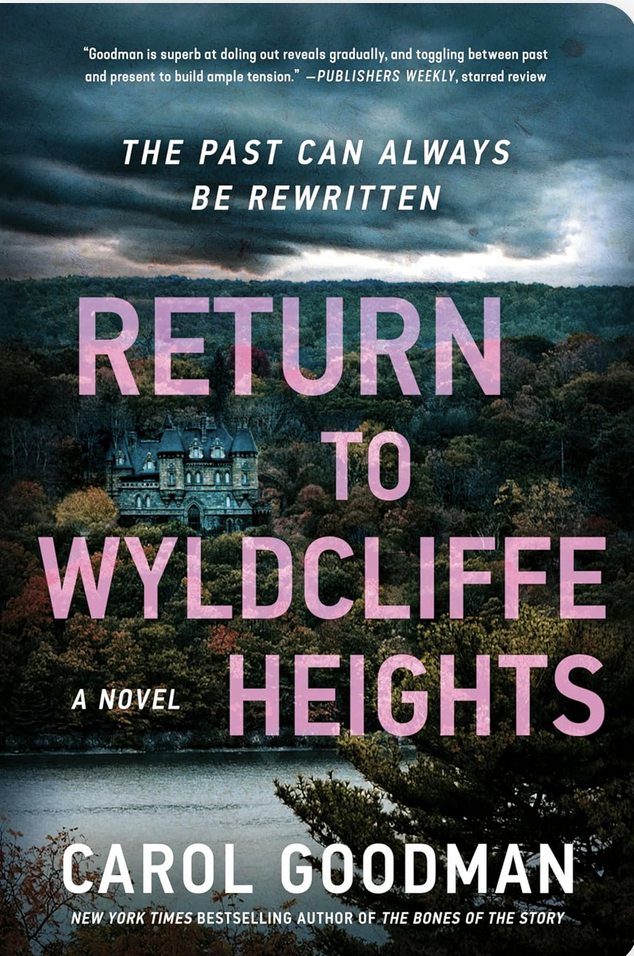
Agnes Corey — junior editor at Gatehouse Publishing — has managed to convince the reclusive author of a wildly popular book (The Secret of Wyldcliff Hall — think Jane Eyre style) to write a sequel. What’s more, as the author was blinded in a terrible fire shortly after the first book — Agnes is to move in to the crumbling estate (once a psychiatric hospital for wayward women) and serve as the author’s amanuensis. It’s clear that the original book, and the one that will follow, are more autobiographical than not, but whose autobiography exactly?
I was pulled in from page one and am in awe of just how many truly convoluted plot twists I read by the end, although I shouldn’t be too surprised as Goodman is a master storyteller and strange and twisted plots are her forte. (I’m pretty sure I have read all 25 of her books so I should know!) Stories within stories, fluid identities, and three distinct timelines that are recalled through memories, anecdotes, letters, and scraps of papers found in odd places. It would not hurt to take notes while reading! One consistent theme: women committed to various types of institutions and the very nasty men who kept them there. But this is by no means a depressing tale of oppression — our characters are strong, learn how to become effectively wary, and forge solid friendships that survive against some pretty terrible odds.
In summary: Creepy! Gothic! Twisted! One-sitting reading! Great for fans of Kate Morton and Diane Setterfield.
Thank you to William Morrow Paperbacks and NetGalley for providing an advance copy of this book in exchange for my honest review. The book will be published on July 30th, 2024.
Another powerhouse from Kate Quinn — propulsive (my new favorite word for books like this where one page practically forces you to turn to the next quickly) and intriguing at multiple levels. Parenthetically, I listened to this on audio and cannot stress enough how fantastic the reader (Saskia Maarleveld) was. I generally prefer reading to listening, but I’m fairly certain that her reading made this book significantly better than it would have been without (and that starts from a high rating to begin with!)
Three intertwined timelines racing towards the identification, location, and capture of the Nazi war criminal called die Jagerin — the Huntress. This is the woman who engaged in murder as Nazi sport, including the killing of children in cold blood towards the end of the war. The timelines: 1946 — Jordan — a 17-year old girl who passionately wants to be a photojournalist a la Margaret Bourke-White; 1950 — Ian Graham — world-weary British war correspondent turned Nazi hunter with an almost desperate need to see die Jagerin caught and tried; 1941 — Nina Markova — born in the frozen wastelands of Siberia whose sheer force of will gets her into the legendary (and historically accurate) Night Witches — an all female bomber squad that marked the beginning of Soviet acceptance of women in combat.
The writing is excellent, with perfect pacing. The characters are detailed and completely believable (to me). Tons of little details that make me feel as though I really know these people and made me miss them when the story was over. Plenty of reflection on life for each of the characters — threads of trust, context, truth without sensationalism (always my favorite), what it means to find a community, the importance of friendship and of having a purpose, and how someone can both love another person and be horrified by them at the same time. Additional details about groups as well — attitudes toward the war and the criminals it produced five years later. I really couldn’t stop reading (listening).
My only negatives — it felt just a little too long — especially listening to an audio book; and I had a hard time knowing who die Jagerin was (this is pretty obvious to the reader from the beginning) but I had to watch the characters NOT FIGURE IT OUT FAST ENOUGH FOR ME!
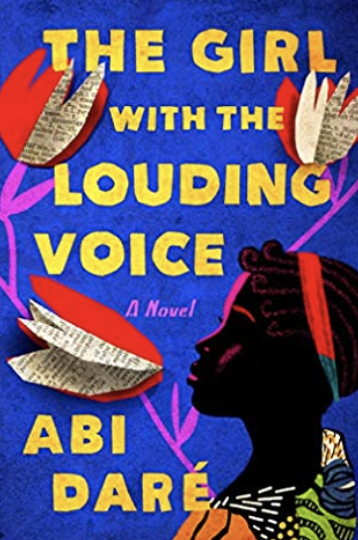
14-year old Adunni has grown up rural Nigeria with a drive to be educated that is foiled by her family’s lack of money for school fees and a father who thinks “a girl-child is a wasted waste, a thing with no voice, no dreams, no brain.” Married off at 14 as a third wife with a cruel elder wife and later sold into domestic slavery with a cruel mistress, she somehow never gives up hope — she has dreams of being a teacher and having a real voice — a Louding voice — that people will have to listen to.
The book is easy to read — the unique pidgin english (developed specifically for our fictional protagonist) wasn’t a problem, though I expected it to be. It was consistent and I found I adapted to its rhythm very quickly. There is no faulting the main message — that girls born into cultures where they are not educated, are married off at young ages into often polygamous households, or sold into domestic slavery — are still human, important, and valuable. Who wants to argue with that?
Adunni is a special character. She has real drive and an unquenchable curiosity despite the vicissitudes to which she is subjected. I loved the way she absorbed an education wherever she could find it. She read scraps of books when dusting in the library, she asked questions of everybody (despite receiving beatings for the impudence) and was constantly updating her understanding as a result. However, I did not enjoy reading it, and I’m trying to understand why.
First of all, it’s frustrating to read about such primitive conditions in the modern world with no real path to change. Although not explicitly stated, this story must take place in the Muslim Northern regions of Nigeria. While (civil marriage) polygamy is prohibited federally in Nigeria, polygamy is allowed in the twelve northern, Muslim-majority states as Islamic or customary marriages. And while the literacy rates hover between 80-90% (boys and girls) in the Southern part of Nigeria, the Northern regions show a 20% differential between boys and girls, with the boys at only 50-60% (source statista.com). So what exactly should I be doing with this information about how rural girls in Muslim Nigeria are living? I just find it depressing. The answers in this book are fictional and rely on help for one individual girl that came from a variety outsiders. One tiny drop in a giant bucket and I wasn’t left with the feeling that this kind of help would be easy to find.
Also, despite the fact that the (negative) practices and beliefs described are still in play today, it feels like the book is feeding right into Western stereotypes of Africans — uneducated, primitive, and holding beliefs anathema to our Western ideals of equality for all. And yet, Nigeria has the largest population and strongest economy in Africa, and leads the continent in literature, music, cinema and drama — surely there are other more nuanced worlds and characters who could populate a story. I much prefer the novels of Chimamanda Ngozi Adichie where each character is painted with the depth of an individual regardless of his or her identity and background.
So … well-written with an upbeat ending and some appealing characters, but I certainly didn’t feel inspired, nor did I feel like I learned anything new.
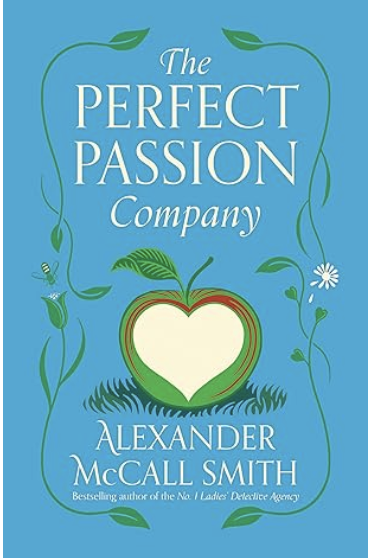
A new offering from Alexander McCall Smith — possibly the beginning of a new series. Katie has taken on management of the Perfect Passion Company — a matchmaking service with the personal touch. She is aided by the knitwear-designing, gorgeous but unavailable, William next door. Together they face a number of difficult-to-place candidates and manage to find matches for all in a typical McCall Smith simplistic, but effective and empathetic, approach to every day human problems (very reminiscent of Mma Ramtoswe’s style in the Number One Ladies Detective series).
I completely enjoyed reading this book with its emphasis on kindness and making a positive difference in people’s lives, though I admit to being slightly more annoyed than usual by some of the principles that inform his characters. Some are kind and empathic but also (IMO) weak, allowing themselves to be taken advantage of and turning the other cheek (they happen to be rich which I guess helps). There is also some not-too-subtle demonizing of the Right with, for example, some (very negative) descriptions of “libertarians” that don’t map to any of the libertarians I’ve ever met. However, as always I loved his ability to see people from different viewpoints and (except for the libertarian) accept people for who they are and acknowledge that they can still find happiness and love despite some very annoying (and pretty humorous) characteristics.
Thank you to Vintage and NetGalley for providing an advance copy of this book in exchange for my honest review. The book will be published on February 13th, 2024.
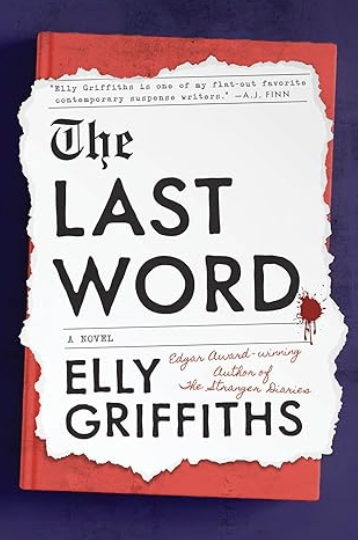
A fledgling detective agency is asked to investigate the (to all appearances natural) death of a client’s mother. The client is even so kind as to provide the name of the murderer — the mother’s second husband who has inherited the lot! Another client is worried about a similar situation, and oddly enough, the obituaries of both were written by a man who predeceased each of them! Natalka — a beautiful and blunt Ukranian careworker; her partner Benedict — a philosophical ex-monk who now runs a coffee shop; and Edwin — an erudite and genteel former BBC producer of advanced age all tackle the case which quickly heads off into surprising territories. At the center of the proliferating coincidences is a writers retreat and a book club run by one of the retreat’s instructors.
I always love Griffiths’ characters. They are interesting in the way real people are interesting — not just superficial quirks but different ways of thinking, different things that give them pleasure, different ways of tackling problems. While some characters get the diversity treatment (the DI with a small role in this book is a lesbian Sikh), they get to be individuals within that identity classification and do not pretend to represent the whole or spend much time letting their identity inform the important parts of their lives. Her characters are completely believable, and I would be very happy to spend time with most of them. I also love Griffiths’ writing which has been consistently good throughout all of her many (many) books. Although I would classify her mysteries as cozies, there is never any dull filler. In this book, what “fills” the pages are questions of spirituality and ethics, literary references ranging from Shakespeare to Christie to Richard Osman, (good) writerly advice, operatic clues, and feathered barbs relating English experiences to those of a Ukranian.
I read a lot of mysteries — they are my comfort reads — but most mysteries are nothing special. Some nice closure at the end, a few historical tidbits, an engaging character. I find Griffiths’ mysteries a cut (or two) above. She is in my top three along with Louise Penny and JK Rowling (as Robert Galbraith) — satisfying at every level. I’m so happy with her prolificity!
Thank you to Mariner Books and NetGalley for providing an advance copy of this book in exchange for my honest review. The book will be published on April 23rd, 2024.
Two determined women, a wealthy, charming, but deeply dangerous man, and a precipitous event come together in this propulsive novel by Kate Quinn and Janie Chang. I’ve read most of Quinn’s novels; I’m planning to read my first Chang shortly because it looks fascinating!
Gemma Garland comes to San Francisco to meet up with the Met traveling group to join the chorus when a current singer chooses to leave. Garland is a gorgeous soprano who is prevented from singing leading roles due to debilitating migraines she can’t control. Feng Suling is a (very) talented seamstress who is desperate to escape the arranged marriage her uncle is forcing on her to escape his (massive) gambling debts after her parents died. Mr. Thornton — a wealthy and ambitious patron of the arts — is in a position to help them both and yet… he is not necessarily what he seems to be. It is early April in 1906 and the infamous San Francisco earthquake is less than two weeks away.
Good writing encompassing plenty of richly detailed history. Real characters such as Enrico Caruso (famous tenor — I’m guessing most of you know this!), Martin Beck (the founder of the Orpheum theater), and Alice Eastwood (the curator of Botany at the California Academy of Sciences) are inserted into the plot without betraying their actual character or actions (at least not too much). Fascinating details about Asian art, including the Phoenix Crown (real and stunning), an exquisite Dragon Robe, and multiple object d’art are included — both in description and in terms of how they are made. A full description of Chinatown and the various laws, policies, and practices around Chinese immigrants at the time is provided with depth and nuance.
A powerful narrative with a real punch. Plenty of opportunity to perch on the edge of your seat and bite a nail or two.
Thank you to William Morrow Paperbacks and NetGalley for providing an advance copy of this book in exchange for my honest review. The book will be published on February 13th, 2024.
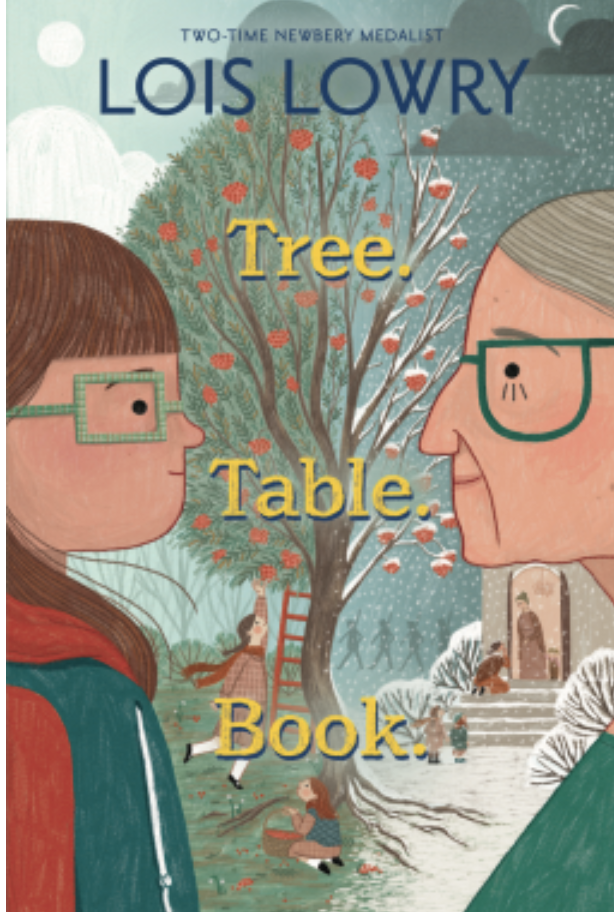
11-year old Sophie’s best friend is another Sophie — her 88-year old neighbor Sophie Gershowitz. Older Sophie is the one with whom young Sophie has a “true and lasting friendship, a friendship of the heart.” But older Sophie is not doing well — her memory is failing and there are rumors of her being removed to a facility in a distant town. To help, young Sophie tries to prepare her for the memory tests she will be faced with. She tries to get her to remember three simple words — Tree, Table, Book — by cementing them in stories that are important to the older woman. But the stories that come out are heartbreaking, secret, and revealing to the point of translucency. Pieces of history that explain who Sophie G is and how she became that person.
Lowry is (and always has been) an incredible writer. I’ve probably read everything she has written, and she has never failed to catch me in surprise with her revelations. The 86-year old author is able to put herself into the characters of both Sophies beautifully. Young Sophie’s mind meanders like an intelligent, curious, 11-year old. Older Sophie’s mind loses details but holds on tenaciously to the important truths of life. Lowry — as usual — manages to get essence into every single sentence. I was brought to tears multiple times. The tears were not dragged out of me, though, but were natural products of the feelings at the heart of the book. I felt more reading this 200 page book aimed at 8-12 year olds than the most dramatic adult books. And I love the (almost) last line which is included in one of the quotes below.
Quotes: “I had told Sophie Gershowitz that I always got the dates right, on history tests, always got As. That was true. But I had never really got it, never understood history, how things fit together, because I needed someone to tell me the stories not of politics and dictators, but of berries and bunnies and books. Of how things are lost, and what that means and how it hurts.”
“I prefer curved and winding roads. They make me think about Stuart Little setting off in his tiny car to look for love.”
“In order to understand how it feels to say goodbye to your dearest friend, you need to know about a flowered apron, a Jello-O mousse, an old refrigerator with ice trays, and a whistling teakettle. You need a size-small T-shirt that says Live Long and Prosper. You need a yardstick. Maybe you above all need a yardstick, because you have to measure everything so that it fits together, because you have to aim for an understandable ending.”
“It is exhausting to think about it. There is so very very much to fix. And I know, of course, that a lot of it isn’t fixable. I understand that. But I can try. I’ll start small.”
Thank you to Clarion Books and NetGalley for providing an advance copy of this book in exchange for my honest review. The book will be published on April 23rd, 2024.
An entertaining sequel to Station Eternity which was one of my favorite reads last year.
In truth, while I enjoyed this book, and appreciated the twists and the personal development of some favorite characters, it was a little disappointing when compared with book number one (or Lafferty’s other offering Six Wakes). No new alien cultures to explore, new characters (all human) whom I already can’t remember, and a basic mystery that kept me reading, but didn’t have any shocking twists. It was fine and I’ll probably read the next one when (if) it comes out, but I hope Lafferty will get back to the (IMHO) really good stuff in her next release.
A quiet, thoughtful, and utterly absorbing book about a young man from Hong Kong sent to a small, Japanese fishing village to recover from tuberculosis on the eve of the second Sino-Japanese war (Fall, 1937). Twenty-year old Stephen is a student and a painter. The year he spends in Tarumi is told through a set of journal entries which are equal parts descriptive and reflective. There is the distant war, with the radio intoning massive Chinese casualties along side propagandist calls for the enemy to “simply surrender to the kindness of the Japanese army, and all will be well.” There is the slow unraveling of his parent’s marriage as his father’s business interests keep him in Japan. And there is the burgeoning friendship with the older Matsu — caretaker and master gardener — and Sachi — whose life was abruptly shattered when leprosy swept the village decades before. Throughout the year, Stephen — feeling deeply but never loudly or dramatically — is slowly developing his own philosophy of living based on the lessons the world is teaching him.
The writing is exquisite — shifting between culture, character, and the natural (and unnatural) world. There is a recurring theme of beauty — sometimes found in the most unlikely places — and yet, once found, inevitable rather than surprising. Throughout all — war, destruction, disease, grief, and the ever tragic profusion of human contradictions — the focus is always on how to move forward — recognizing the fragility of life and finding your own peace and contentment within it. I liked the way the author made it clear that this was not an easy task. And I loved the fact that throughout this story teeming with essential truths, there was neither a cliche nor a saccharine sentiment to be found anywhere in the pages. Some beautiful descriptions of gardens and natural landscapes along with an artist’s way of engaging with the world as well.
Highly recommended.
Quotes: “ It’s harder than I imagined, to be alone. I suppose I might get used to it, like an empty canvas, you slowly begin to fill.”
“All over Japan they were celebrating the dead, even as more and more Chinese were being slaughtered. There would be no one left to celebrate them. I looked around at all the smiling faces, at Matsu and Fumiko who moved slowly beside me, and wished that one of them could explain to me what was going to happen.”
“Ever since I had come to Tarumi, I’d seen more deaths than in all of my life in Hong Kong. Everything before me was changing. I knew I would never be able to step back into my comfortable past, Ahead of me lurked the violent prospect of war, perhaps bringing the deaths of people I knew and loved, along with the end of my parent’s marriage. These were the terrors I’d somehow escaped until now. And as I sat among the white deutzia blossoms, I felt a strange sensation of growing pains surge through my body, the dull ache of being pulled in other directions.”
“I’ve tried to capture this ghostly beauty on canvas, but like anything too beautiful, it becomes hard to re-create its reality. There’s something about being too perfect, that, even this, which at times appears stiff, almost boring. I finally gave up after several tries.”
“She wasn’t beautiful, not in the way that Tomoko must’ve been, nor did she have the roughness of Matsu. Her attraction wasn’t in the form of perfect features, but from the deep, wrinkles, age spots, and eyes that have seen much of what life has to offer. Fumiko had a face that had been enriched through time.”
“I was old enough to understand everything he said, but as his mouth softly formed the words, I knew the sense of integrity I had long admired in him had died, and then I was already grieving for its loss.”
“He learns how to do art with the stones in her garden: it was a strange feeling, much different from working with the fluidity of brush and paint, or water and earth. The weight of the stones pulled against each stroke and left a distinct feeling of strength and permanence.”





 Books to look forward to ...