The Briar Club by Kate Quinn (Historical Fiction)

Writing: 5/5 Characters: 5/5 Plot: 5/5

Thanksgiving 1954. Washington, DC. A women’s boarding house. A body. And blood — lots of blood. That’s how Kate Quinn’s latest book gets started. And yes, once I started, I never put it down as per usual with her books. She can really write!

Backing up from the Thanksgiving turmoil, the book starts in June 1950 and shifts the POV from boarder to boarder as the timeline makes its inexorable crawl towards the “exciting” date. This is an excellent device as not only do we get the events leading up to the end from different perspectives, we also get the stories of the women — all from different backgrounds and with different goals which together comprise a compendium of women’s lives at that time. An injured female baseball player from the short-lived women’s leagues; an older immigrant from Hungary; a young mother whose doctor husband has been overseas for two years; a secretary for the (real life) female Maine senator who goes up against McCarthy when nobody else has the guts; a secretary for HUAC (House Un-American Activities Committee); a woman working for the National Archives in love with a gangster despite her best intentions; and the elusive Grace Marsh who brings them all together. These are just hints! Quinn does meticulous research and is able to bring so much of the McCarthy era to the surface — especially around the societal expectations of women. It felt like I was living it.

The book is non-stop action — but — I realized it is the kind of action I care about. Things change, people and their prejudices, fears, and disappointments have to be dealt with and some individuals actually use their experiences to shift their perspectives. Opportunities come up and people learn about themselves (for better and worse) when they choose a reaction. Action does not have to be long (and very dull) car chase scenes or long battles of any kind. Epiphany! Absolutely captivating characters — a couple of “bad men” with no real depth but plenty of men and women (and kids) who are each real in their own way. FYI two of the (fictional) characters were named after people who won the “name-a-character” raffle — what fun! Some impressive twists — do not read the end or the notes first. In addition to being a gripping read, I’m still thinking about it many days later. Always a good sign.

Highly recommended.

Thank you to William Morrow and NetGalley for providing an advance copy of this book in exchange for my honest review. The book will be published on July 9th, 2024.

The Glassmaker by Tracy Chevalier (Historical Fiction)

Writing: 3.5/5 Plot: 4/5 Characters: 4.5/5

A chronicle of glass making in Murano (still known as the center of glass!) as told through the life of Orsola Rosso — the eldest daughter of a glass blowing family. Orsola wants to work with glass herself, but it’s 1486 and the Renaissance hasn’t quite reached the stage of promoting social changes for women. The story uses the (very) unusual contrivance of allowing Orsola and those in her immediate orbit to age slowly while time for the world at large gallops by. While the “action” starts in 1486 and ends in the present day, Orsola only ages from nine to her late sixties. While this device is explained (poetically) in the prolog, I didn’t really get it so I’m hoping that I can help you avoid bafflement by stating it here with less skill but more clarity 🙂

Orsola’s life embodies the personal (love, marriage, and children in a large extended family rife with personalities), the political (Venice shifting from commercial center to Austrian occupied territory to part of a United Italy to tourist center) , and the business (Guild control to competitive pressures to tourist-driven). She and her family go through the Plague (and later Covid!), two world wars, and the changing mores of an evolving Europe as the Renaissance gave way to the Age of Enlightenment followed by whatever our current age is destined to be called. I learned a lot about Italian history — details that I had learned in the past now integrated and brought to life in this story of artisans buffeted by the constantly shifting trends over time. The history became so much more real to me told through the lens of this particular family.

I give this a four star rating because for my taste there was a little more description than I like, though that same description may fascinate others.

Thank you to Viking and NetGalley for providing an advance copy of this book in exchange for my honest review. The book will be published on June 18th, 2024.

Family Family by Laurie Frankel (audio book – Literary Fiction)

Writing: 5/5 Characters: 5+/5 Plot: 4/5

I loved absolutely everything about this audio book — the story, the writing, the characters, and last but definitely not least, the audio book reader.

The book follows India Allwood along two intersecting timelines: from precocious and unintentionally pregnant teen to TV super star; and the weeks following a media storm raining down on India following her truthful comments about her recent movie’s position on adoption. You see, India has quite a personal relationship with adoption, having placed her baby with a family she specifically selected. On the other hand, the movie she stars in (and most of the way she sees adoption portrayed in the media) focuses only on the negatives: trauma, regret, and pain. When she admits in an interview that she doesn’t think the movie got it right — that adoption can (and usually is) a very good experience for all involved, it seems like everyone on the planet has nasty things to say about her. When her ten-year old twins see what she is going through, they decide that finding Rebecca — the baby 16-year old India delivered and placed — is the answer to all of their problems…

This book is incredibly well-written and covers all sorts of issues pertaining to families, relationships, aspirations, values, and, well, life with balanced and exceptionally articulate interactions, reflections, introspection and dialog. I cannot stress enough how happy I am with high quality dialog like the kind I found in these pages. As an aside, I found it interesting that I really did not take to 16-year old India. I found her to be a pain in the butt. But she grew on me as she grew on herself, figuring more things out, always striving to understand her own motivations and make good decisions, until by the time she was current day India I was ready to be her best friend.

I’m trying hard not to give away the many surprises that pop out along the way — suffice it to say that the pacing is excellent, the revelations are eye-opening and well-integrated in the plot, and I liked every single character in the book (and there are many). While covering adoption from many angles, the author (through the voice of India) is also very clearly pro-choice, with a great scene between India and some right-to-lifers camped out on her driveway seeking a mascot for their cause. The author also shows strong support for non-traditional family units — but again, I don’t want to give anything away… Lastly, some very in depth and illuminating commentary on the life of an actor!

Highly recommended.

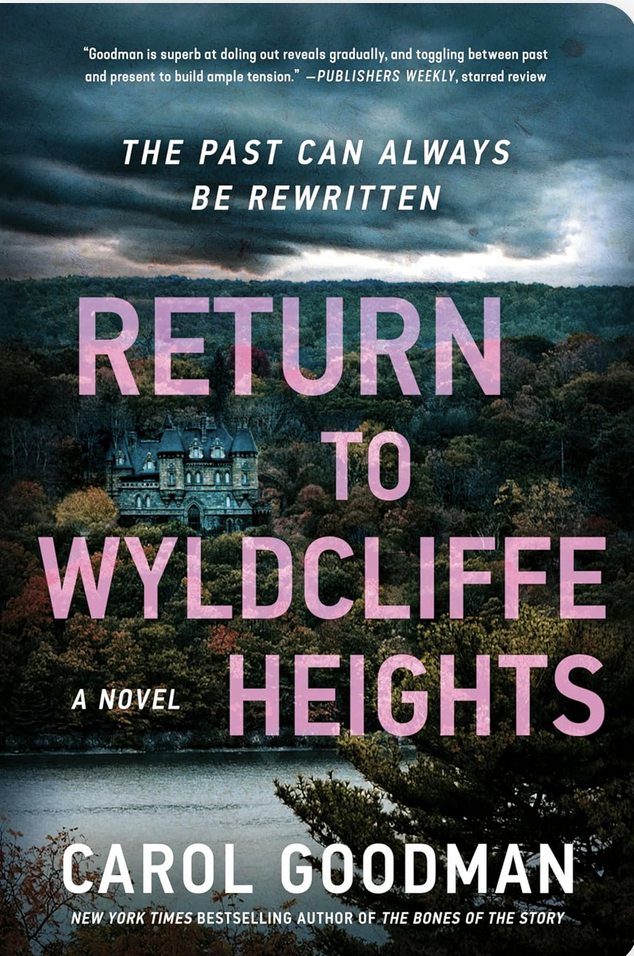
Return to Wyldcliffe Heights by Carol Goodman (Fiction)

Agnes Corey — junior editor at Gatehouse Publishing — has managed to convince the reclusive author of a wildly popular book (The Secret of Wyldcliff Hall — think Jane Eyre style) to write a sequel. What’s more, as the author was blinded in a terrible fire shortly after the first book — Agnes is to move in to the crumbling estate (once a psychiatric hospital for wayward women) and serve as the author’s amanuensis. It’s clear that the original book, and the one that will follow, are more autobiographical than not, but whose autobiography exactly?

I was pulled in from page one and am in awe of just how many truly convoluted plot twists I read by the end, although I shouldn’t be too surprised as Goodman is a master storyteller and strange and twisted plots are her forte. (I’m pretty sure I have read all 25 of her books so I should know!) Stories within stories, fluid identities, and three distinct timelines that are recalled through memories, anecdotes, letters, and scraps of papers found in odd places. It would not hurt to take notes while reading! One consistent theme: women committed to various types of institutions and the very nasty men who kept them there. But this is by no means a depressing tale of oppression — our characters are strong, learn how to become effectively wary, and forge solid friendships that survive against some pretty terrible odds.

In summary: Creepy! Gothic! Twisted! One-sitting reading! Great for fans of Kate Morton and Diane Setterfield.

Thank you to William Morrow Paperbacks and NetGalley for providing an advance copy of this book in exchange for my honest review. The book will be published on July 30th, 2024.

The Huntress by Kate Quinn (Historical Fiction)

Another powerhouse from Kate Quinn — propulsive (my new favorite word for books like this where one page practically forces you to turn to the next quickly) and intriguing at multiple levels. Parenthetically, I listened to this on audio and cannot stress enough how fantastic the reader (Saskia Maarleveld) was. I generally prefer reading to listening, but I’m fairly certain that her reading made this book significantly better than it would have been without (and that starts from a high rating to begin with!)

Three intertwined timelines racing towards the identification, location, and capture of the Nazi war criminal called die Jagerin — the Huntress. This is the woman who engaged in murder as Nazi sport, including the killing of children in cold blood towards the end of the war. The timelines: 1946 — Jordan — a 17-year old girl who passionately wants to be a photojournalist a la Margaret Bourke-White; 1950 — Ian Graham — world-weary British war correspondent turned Nazi hunter with an almost desperate need to see die Jagerin caught and tried; 1941 — Nina Markova — born in the frozen wastelands of Siberia whose sheer force of will gets her into the legendary (and historically accurate) Night Witches — an all female bomber squad that marked the beginning of Soviet acceptance of women in combat.

The writing is excellent, with perfect pacing. The characters are detailed and completely believable (to me). Tons of little details that make me feel as though I really know these people and made me miss them when the story was over. Plenty of reflection on life for each of the characters — threads of trust, context, truth without sensationalism (always my favorite), what it means to find a community, the importance of friendship and of having a purpose, and how someone can both love another person and be horrified by them at the same time. Additional details about groups as well — attitudes toward the war and the criminals it produced five years later. I really couldn’t stop reading (listening).

My only negatives — it felt just a little too long — especially listening to an audio book; and I had a hard time knowing who die Jagerin was (this is pretty obvious to the reader from the beginning) but I had to watch the characters NOT FIGURE IT OUT FAST ENOUGH FOR ME!

Highly recommended — especially the audio book.

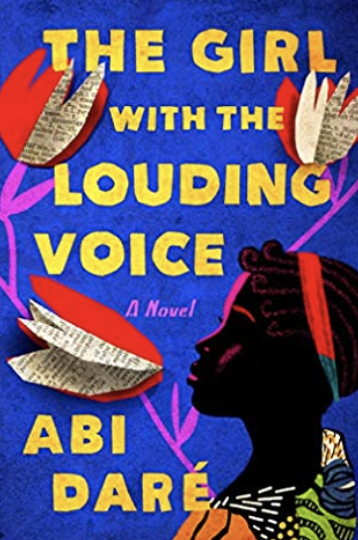
The Girl with the Louding Voice  by Abi Dare (Multicultural Fiction)

14-year old Adunni has grown up rural Nigeria with a drive to be educated that is foiled by her family’s lack of money for school fees and a father who thinks “a girl-child is a wasted waste, a thing with no voice, no dreams, no brain.” Married off at 14 as a third wife with a cruel elder wife and later sold into domestic slavery with a cruel mistress, she somehow never gives up hope — she has dreams of being a teacher and having a real voice — a Louding voice — that people will have to listen to.

The book is easy to read — the unique pidgin english (developed specifically for our fictional protagonist) wasn’t a problem, though I expected it to be. It was consistent and I found I adapted to its rhythm very quickly. There is no faulting the main message — that girls born into cultures where they are not educated, are married off at young ages into often polygamous households, or sold into domestic slavery — are still human, important, and valuable. Who wants to argue with that?

Adunni is a special character. She has real drive and an unquenchable curiosity despite the vicissitudes to which she is subjected. I loved the way she absorbed an education wherever she could find it. She read scraps of books when dusting in the library, she asked questions of everybody (despite receiving beatings for the impudence) and was constantly updating her understanding as a result. However, I did not enjoy reading it, and I’m trying to understand why.

First of all, it’s frustrating to read about such primitive conditions in the modern world with no real path to change. Although not explicitly stated, this story must take place in the Muslim Northern regions of Nigeria. While (civil marriage) polygamy is prohibited federally in Nigeria, polygamy is allowed in the twelve northern, Muslim-majority states as Islamic or customary marriages. And while the literacy rates hover between 80-90% (boys and girls) in the Southern part of Nigeria, the Northern regions show a 20% differential between boys and girls, with the boys at only 50-60% (source statista.com). So what exactly should I be doing with this information about how rural girls in Muslim Nigeria are living? I just find it depressing. The answers in this book are fictional and rely on help for one individual girl that came from a variety outsiders. One tiny drop in a giant bucket and I wasn’t left with the feeling that this kind of help would be easy to find.

Also, despite the fact that the (negative) practices and beliefs described are still in play today, it feels like the book is feeding right into Western stereotypes of Africans — uneducated, primitive, and holding beliefs anathema to our Western ideals of equality for all. And yet, Nigeria has the largest population and strongest economy in Africa, and leads the continent in literature, music, cinema and drama — surely there are other more nuanced worlds and characters who could populate a story. I much prefer the novels of Chimamanda Ngozi Adichie where each character is painted with the depth of an individual regardless of his or her identity and background.

So … well-written with an upbeat ending and some appealing characters, but I certainly didn’t feel inspired, nor did I feel like I learned anything new.

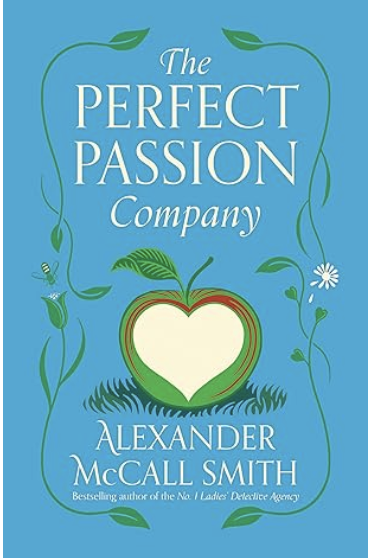
The Perfect Passion Company by Alexander McCall Smith

A new offering from Alexander McCall Smith — possibly the beginning of a new series. Katie has taken on management of the Perfect Passion Company — a matchmaking service with the personal touch. She is aided by the knitwear-designing, gorgeous but unavailable, William next door. Together they face a number of difficult-to-place candidates and manage to find matches for all in a typical McCall Smith simplistic, but effective and empathetic, approach to every day human problems (very reminiscent of Mma Ramtoswe’s style in the Number One Ladies Detective series).

I completely enjoyed reading this book with its emphasis on kindness and making a positive difference in people’s lives, though I admit to being slightly more annoyed than usual by some of the principles that inform his characters. Some are kind and empathic but also (IMO) weak, allowing themselves to be taken advantage of and turning the other cheek (they happen to be rich which I guess helps). There is also some not-too-subtle demonizing of the Right with, for example, some (very negative) descriptions of “libertarians” that don’t map to any of the libertarians I’ve ever met. However, as always I loved his ability to see people from different viewpoints and (except for the libertarian) accept people for who they are and acknowledge that they can still find happiness and love despite some very annoying (and pretty humorous) characteristics.

Thank you to Vintage and NetGalley for providing an advance copy of this book in exchange for my honest review. The book will be published on February 13th, 2024.

The Samurai’s Garden by Gail Tsukinaya (Historical Literary Fiction)

A quiet, thoughtful, and utterly absorbing book about a young man from Hong Kong sent to a small, Japanese fishing village to recover from tuberculosis on the eve of the second Sino-Japanese war (Fall, 1937). Twenty-year old Stephen is a student and a painter. The year he spends in Tarumi is told through a set of journal entries which are equal parts descriptive and reflective. There is the distant war, with the radio intoning massive Chinese casualties along side propagandist calls for the enemy to “simply surrender to the kindness of the Japanese army, and all will be well.” There is the slow unraveling of his parent’s marriage as his father’s business interests keep him in Japan. And there is the burgeoning friendship with the older Matsu — caretaker and master gardener — and Sachi — whose life was abruptly shattered when leprosy swept the village decades before. Throughout the year, Stephen — feeling deeply but never loudly or dramatically — is slowly developing his own philosophy of living based on the lessons the world is teaching him.

The writing is exquisite — shifting between culture, character, and the natural (and unnatural) world. There is a recurring theme of beauty — sometimes found in the most unlikely places — and yet, once found, inevitable rather than surprising. Throughout all — war, destruction, disease, grief, and the ever tragic profusion of human contradictions — the focus is always on how to move forward — recognizing the fragility of life and finding your own peace and contentment within it. I liked the way the author made it clear that this was not an easy task. And I loved the fact that throughout this story teeming with essential truths, there was neither a cliche nor a saccharine sentiment to be found anywhere in the pages. Some beautiful descriptions of gardens and natural landscapes along with an artist’s way of engaging with the world as well.

Highly recommended.

Quotes:
“ It’s harder than I imagined, to be alone. I suppose I might get used to it, like an empty canvas, you slowly begin to fill.”

“All over Japan they were celebrating the dead, even as more and more Chinese were being slaughtered. There would be no one left to celebrate them. I looked around at all the smiling faces, at Matsu and Fumiko who moved slowly beside me, and wished that one of them could explain to me what was going to happen.”

“Ever since I had come to Tarumi, I’d seen more deaths than in all of my life in Hong Kong. Everything before me was changing. I knew I would never be able to step back into my comfortable past, Ahead of me lurked the violent prospect of war, perhaps bringing the deaths of people I knew and loved, along with the end of my parent’s marriage. These were the terrors I’d somehow escaped until now. And as I sat among the white deutzia blossoms, I felt a strange sensation of growing pains surge through my body, the dull ache of being pulled in other directions.”

“I’ve tried to capture this ghostly beauty on canvas, but like anything too beautiful, it becomes hard to re-create its reality. There’s something about being too perfect, that, even this, which at times appears stiff, almost boring. I finally gave up after several tries.”

“She wasn’t beautiful, not in the way that Tomoko must’ve been, nor did she have the roughness of Matsu. Her attraction wasn’t in the form of perfect features, but from the deep, wrinkles, age spots, and eyes that have seen much of what life has to offer. Fumiko had a face that had been enriched through time.”

“I was old enough to understand everything he said, but as his mouth softly formed the words, I knew the sense of integrity I had long admired in him had died, and then I was already grieving for its loss.”

“He learns how to do art with the stones in her garden: it was a strange feeling, much different from working with the fluidity of brush and paint, or water and earth. The weight of the stones pulled against each stroke and left a distinct feeling of strength and permanence.”

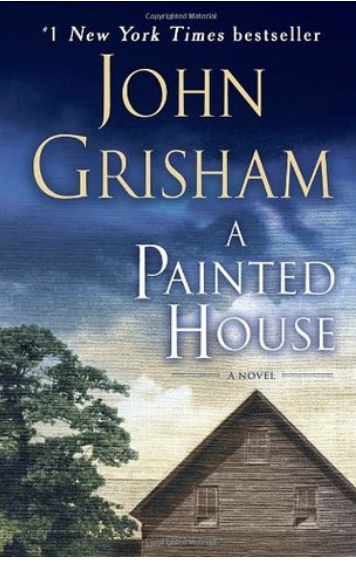
A Painted House by John Grisham (Historical Fiction — audio book)

Writing: 5/5 Characters: 5/5 Plot: 4/5
This book is unlike any other book Grisham has written — no courtrooms, not a lot of official justice, and not a thriller — but I found it utterly enthralling. It drew me into a world I knew nothing about and brought it to full sensory life. At least part of this was due to the audio book reader (David Lansbury) who captured the mood perfectly with his tone, pacing, and wide range of voices. Not every book (IMHO) is improved by listening to it — but this one certainly was.

The story is apparently somewhat autobiographical and takes us through one picking season on an Arkansas Delta cotton farm in 1952. Told from the perspective of seven year old Luke Chandler, the clarity of his reflections as he learns about life, morality, and people during this period is priceless. The family hires itinerant help in the form of ten Mexicans and a family of hill people. As with most farmers of the time, they are in debt from one season to the next, on the edge of ruin with every storm, flood, broken truck, or the transitory nature of picking labor. Luke is part of it all — the picking, the worrying, and the witnessing. He becomes the holder of too many secrets, and we feel the potential bursting and sickness he takes on with the keeping.

I’d forgotten how good Grisham’s writing is because I’m not that interested in legal thrillers but I was rapt throughout. His characters are such real people — each struggling in his or her own way with constant questions of both survival and morality. Making do in a rough world with little in the way of legal support — people have to figure out how to handle their own problems. Bittersweet and poignant, the narrative spans the Korean war, the movies of the day, the newness (and rareness) of television sets, flooding and tornados, farming economics, and the tension between the old ways and new possibilities.

Loved it.

Reunion by Elise Juska (Literary Fiction)

June 2021 — Three friends anticipate a Covid postponed college reunion at the Maine campus. Hope — a stay at home mom with an increasingly distant husband — is desperate to return to what she remembers as her happiest time; Adam looks forward to reconnecting but feels guilt at leaving his perpetually sad wife with the twins in the house that she hasn’t left in a very long time; and NYC based single-mom Polly who doesn’t share her friends fond memories, but is persuaded to attend by her reclusive son who wants to visit a nearby friend.

This character-driven novel explores friendships and personal growth against the backdrop of lock down parenting and recovery alongside some pretty intense environmental anxiety. With every relationship comes inevitable clashes and this story covers quite a few. I particularly “enjoyed” the generational clashes — some familiar and some brand new to me as successive generations bear less and less in common with my own. Well written probes into the evolution of friendships
— what connects people with little in common and what decisions can impact the closeness over time. I really liked that the ending for all of our protagonists had a closure that was more about understanding the nature of their issues, thereby clarifying a path towards closure, rather than any kind of quick solution to the problem itself — because there really are no quick solutions to relationship issues…

One kind of funny (to me) quote as Hope thinks about her teenage daughter Izzy: “Meanwhile, Izzy was skeptical of all things where Hope was concerned. Her Spotify list. Her low-carb bread. Her Facebook posts — too frequent, too obviously curated — why was she even on Facebook? Her overuse of exclamation points. Her leather tote. Sometimes Hope secretly wondered if Izzy had become a vegan primarily to get on her nerves.”

Thank you to Harper and NetGalley for providing an advance copy of this book in exchange for my honest review. The book will be published on May 11th, 2024.