A Short History of Ancient Rome by Pascal Hughes (Non fiction – Audio Book)

The title doesn’t lie — the book covers about 1,000 years of Roman history (from founding to end) and is only 352 pages (or in my audio book case, about 8 1/2 hours of listening). I don’t read a lot of non-fiction, as I find most of it muddied, tedious with extraneous detail, and overly biased, BUT I found this one to be very well-organized, clear, engaging, and with plenty of reference to the (sometimes competing) sources. It also started with a quip from Monty Python which put me in the right mood!

The book was well-structured, beginning with the stories of Rome’s founding (Romulus and Remus) and traipsing through a set of chronicles garnered from pivotal points in Rome’s history including the “real” stories behind popularized versions of characters like Spartacus, Caesar, Nero, Boudicca, and Attila the Hun. Progressing through the history at a reasonable pace allows the reader to watch the evolution of culture and values, political systems, definitions of personhood, and the technical accomplishments for which the Romans are justly famous. It was a bloody and brutal story from start to finish, to be honest, but it helps put our current issues and ideas of civilization into perspective. I found listening to it (while out on walks) to be useful as I enjoyed breaks from the (mostly unpleasant) “action.” After reading, I find myself marveling at how civilized we actually are in comparison, and also how fragile civilization always is.

Thank you to Harlequin Audio and NetGalley for providing an advance copy of this book in exchange for my honest review. The book was published on November 11th, 2025.

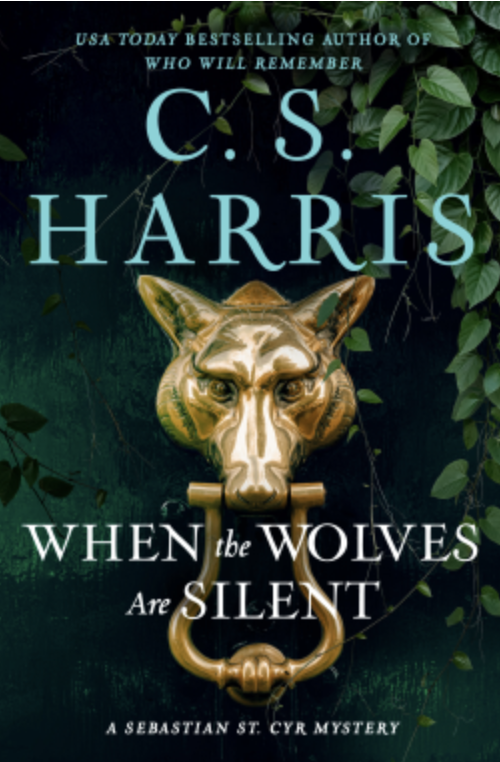
When the Wolves are Silent by C. S. Harris (Historical Mystery)

Number 21 in the Sebastian St. Cyr historical mystery series. Regency period — 1816 — London and environs. This was the “year without a summer” due to the eruption of Mount Tambora in 1815.

Sebastian — son and heir to an Earl — has a habit of involving himself in bringing justice to murder victims, regardless of their class. In this episode, first one and then another of a group of high born friends is murdered — one found in the river and the other burned to death. One of the group is Sebastian’s nephew Bayard. The entire group — Bayard definitely included — is what are known as “bad ton” where “ton” refers to the state of being fashionable and high society. The men in this group feel they are above any law or sense of human decency.

In solving the evolving mystery (more bodies turn up) there is reference to the American wars, the slave trade, ancient Celtic practices including human sacrifice, and potential Druid revivals. I always thought of Celts as ancient Britons but learned recently that in fact Celtic tribes were roaming around Central Europe as early as 1200 BCE. and as for Druids, I found this note in the book interesting: “Actually as far as we can tell, the Druids were more like what we might call the intellectual class of the ancient celts. The poets, historians, musicians, physicians, and astronomers of their day and advisors to Kings.”

The writing is decent, the characters (from the high to the medium and low) have evolved over time and have depth, and the mystery was quite convoluted, but completely consistent and engaging. The historical setting is excellent.

As an aside, the author’s note at the end of these books is always illuminating as she clearly delineates the fact from the fiction. I was particularly interested in a “real” character — German chemist Friedrich Accum who, among his other many accomplishments, was one of the first to draw attention to the danger of food additives and was involved in gaining acceptance for beet sugar, which was notable for not being derived from slave-driven sugar production from cane.

Thank you to Berkley House and NetGalley for providing an advance copy of this book in exchange for my honest review. The book will be published on April 14th, 2026.

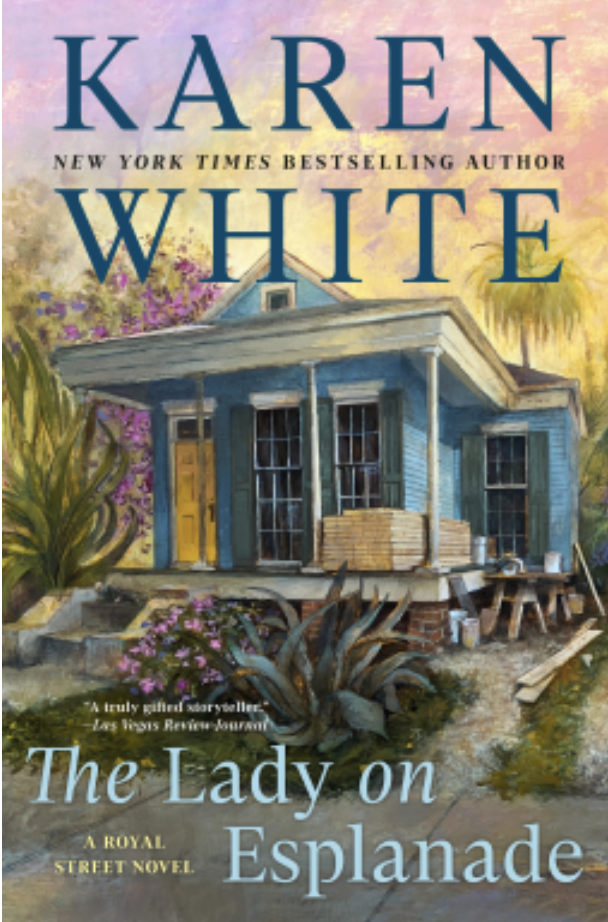
The Lady on Esplanade by Karen White (Mystery / Ghost story)

The third installment (not necessary to read the first two, but they are good!) of the New Orleans-based Nola Trenholm mystery / romance/ dear-departed-spirits series — itself a spinoff from the similar Charleston-based series starring Melanie Trenholm — Nola’s relatively new stepmother. Nola and best friend Jolene (unrelenting fashionista and all-around force-to-be-reckoned-with) tackle two mysteries centered around the haunting spirits of two old houses under renovation: Nola’s Creole cottage (a lovely money sink of renovation needs) and a new house that will be the first project for the Murder Flip Business Nola is starting with reluctant psychic Beau, with whom she has an undesired (from both sides) strangely strong connection. A few new characters, wickedly tangled stories from the past, and a pretty creepy Madame Alexander doll that manages to appear inopportunely where she isn’t wanted without any external help.

The whole series is entertaining — fun writing, plenty of colorful characters and great banter (both inside people’s own heads and in dialog exchanges). The spirit-augmented mysteries are interesting and always somewhat historical, the action well paced and full of humor, and despite the fact that this is book is number ten for me, none of the stories feel repetitive or in any way dull. They grab my interest on page one and continue through the end. For those who enjoy architectural marvels and renovation stories, plenty of that, too. Not my thing but the descriptions never get in my way.

Thank you to Berkley and NetGalley for providing an advance copy of this book in exchange for my honest review. The book will be published on Nov. 4th, 2025.

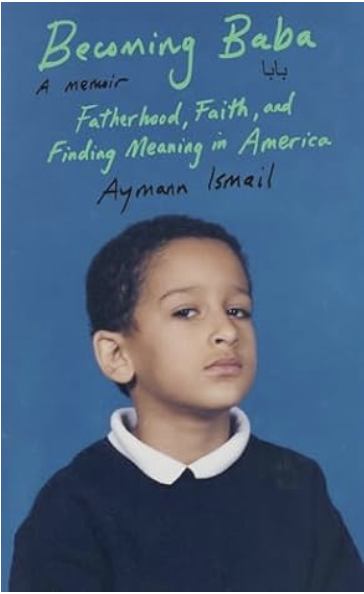
Becoming Baba: Fatherhood, Faith, and Finding Meaning in America by Aymann Ismail (Memoir)

This is a well-written and illuminating memoir recording Ismail’s personal experience of building a life as American Muslim. In many ways, this is a typical “child of immigrants” story — finding a balance between the traditional values and expectations in which he was raised and the not-so-traditional American culture in which he lives — but the story is somewhat atypical because being a Muslim in America is not always an easy thing to be. The memoir focuses primarily on the topics in the subtitle — how to live a good and meaningful life, be a good Muslim, be a good husband and father with the definition of “good” being something that evolves over time with a great deal of thought and discussion.

I read this book to better understand the Muslim religion and those who practice it — especially in light of the pretty scary practices of the more extreme Muslim groups which (unfortunately) seem to have control over the places most Muslims live. I did get a much better understanding of what I would called “American Islam” vs extremist Islam from Ismail’s 15 short “Who’s Afraid of Aymann Ismail?” video episodes than I did from the book, which didn’t obviously differentiate between the two. I got the impression that Ismail didn’t think he should have to explain that, but to those of us who have met few Muslims but read a lot of (scary) news, the clarification of his video series helped a lot. In the memoir, his comments on both 9/11 and the Israel Hamas war were complaints about the negative impact on American Muslims without a word of condemnation of the attackers or acknowledgement of the pain of the victims. This disturbed me. To be fair, Ismail is unashamedly anti-Israel and doesn’t seem to feel the need to understand “the other side” at all, though one of his video episodes focussed on man who had tried to do that — and was roundly attacked by the Islam community. At any rate, I did enjoy most of the video series, and gained some real education on topics that had not been clear to me, and when I step away from the political (which was NOT the focus of the memoir) I found it to document a well reflected journey that supports values I could easily relate to.

Thank you to Doubleday and NetGalley for providing an advance copy of this book in exchange for my honest review. The book will be published on July 8th, 2025.

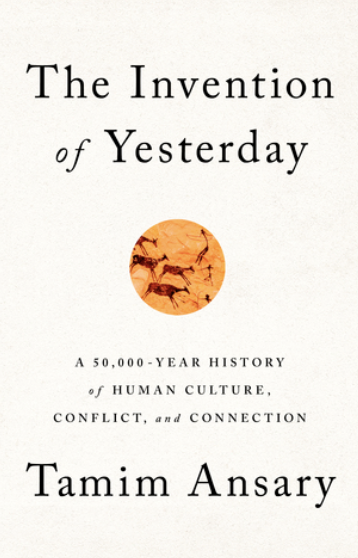
The Invention of Yesterday: A 50,000-Year History of Human Culture, Conflict, and Connection by Tamim Ansary (Non Fiction)

In this ambitious book, Ansary tackles 50,000 years (literally) of history with the thesis that pervasive narrative is the key driver of both cohesion and conflict. Narratives are the glue holding together the social constellations that give rise to culture. From stone age to digital age and beyond the singularity, he traces these narratives through giant hinge points such as the evolution of language, worldviews stemming from religion or ideologies, and methods of conquest and absorption. Why can’t we all get along? Because we are living in different worlds of meaning.

What I gained from reading this book is a much better understanding of the Islamic World, as that, of all the histories, is the one I know least about. Looking through his other books, I now wish I had read “Destiny Disrupted: A history of the world through Islamic Eyes” or “Games Without Rules,” a history of Afghanistan. His primary concept is (to me) not new, and does not really help think of solutions — I think we’ve known for a long time that we need to really understand the other in order to try to find some kind of compromise — and sometimes that is simply impossible. The way he tied global peoples and events across time was pretty interesting, though I found it often very high level.

There were a lot of small surprises (to me). Here are some of them (I have fact-checked some, but not all):
• North Americans didn’t develop the wheel because they had no tamable beasts (I don’t completely understand this since 1) a wheeled cart would be helpful to a person and 2) has anyone tried to tame a buffalo? I really don’t know.)
• Unlike the Western world, the Chinese had no tradition of jealous gods, demanding exclusive worship, so it was easier to absorb multiple narratives.
• Arabs were the (big) slave traders in East Africa, while Europeans became the traders in West Africa. Since Islam forbids enslaving Muslims, many conquered peoples decided to convert.
• Rome never fell, but did kind of get taken over by the conquered who had been given a path to citizenship through battle. More of the German tribes (German meant “barbarians who keep bugging us” — his words) ended up in leadership positions shifting things.
• Persians were OK with Islam but not with Arab superiority and so found an acceptable path by finding a Persian descendant of the Prophet leading to the Shia split.
• History of the development of the Caste system in India and description of why political fragmentation did not lead to cultural fragmentation there.
• The main Arab contribution around 800 CE was to catalog everything done elsewhere, e.g. medical knowledge. Their central project was the documentation of Sharia — the complete manual of how to be a Muslim. Meanwhile, the central project of the Western world was Science.
• Mongols brought bubonic plague to Europe from the Himalayan foot hills via fleas. In 1345 they lay siege to cities by catapulting diseased warrior corpses into the city.
• Movable type could handle the Roman alphabet better than Chinese pictographs. Arab writing also had something about it (he was vague) that made it more difficult.
• When Mongols took over China they tried to be Chinese, but their policies came from a different environment (e.g. water shortage in their home on the Steppes led to policies that discourage bathing in China)
• Systems based on patronage and relationships (Islamic world) vs commerce (western) and what that led to.
• Columbus “discovering” America led to one of the biggest hinges: — some estimates are that 90% (55 million) of people in all the Americas died — mostly of disease — after that “visit.” A catastrophe that dwarfs the Mongol hordes, the Holocaust, the Black Death, and both world wars.
• Tools and machines were as seminal as the acquisitions of language. Western social constellations could incorporate machines into their networks of meaning much more easily than the other large empires of the time.
• The Muslim narrative with its patronage networks and Sharia law did not have a way of turning inventions into products. The Chinese world with its dream of a socially cohesive centralized state operated by an all pervasive bureaucracy didn’t either. New technology had the potential for disrupting existing social arrangements, and in much of the world preserving existing social arrangements took precedence over building better stuff.
• Societies shaped by the progress narrative (ie the West) had an advantage not because of the tools, but because of the improvements and variations they kept building on the first.
• The invention explosion was the busy energy of all the entrepreneurial companies and corporations that got excited about making things happen

In summary — it was a long book and the ratio (for my personal background) of new ideas or information to number of pages was lower than I would like. However, the writing was accessible — it didn’t tend to get dragged into too much tedium — and I did learn a lot about the Muslim World. However, at this point I’m more interested in going back and reading the two books I mentioned at this beginning of this review. I did read (in 2007 so I unfortunately do not recall the details) his memoir of growing up in Afghanistan and then coming to the U.S. in high school. That was excellent!

Toward the Corner of Mercy and Peace by Tracey D. Buchanan (Fiction)

Writing: 4/5 Plot: 2.5/5 Characters: 4/5

Minerva Place, church organist, piano teacher, and long time resident of Paducah, Kentucky. Relatively crusty with a deeply suspicious nature and a dislike of personal interactions of any sort, Minerva does have one angle in her life which is quite engaging: she often visits the local cemetery, finds an interesting gravestone, researches the person portrayed and … is often visited by the spirit of that person who sets her story straight. Newcomers to the town — engineer Robert McAlpin and his seven year old, somewhat undisciplined son, George — appear on her doorstep requesting piano lessons. From this set of characters the story follows three separate lines simultaneously: the current day, the slow unfolding of Minerva’s person history, and the elaborations of the lives of the cemetery denizens, injected with Minerva’s imagination to fill the blank spots. There is personal growth and a real shift in Minerva’s life — however it comes rather slowly, and I admit to skimming a bit at the end. I really enjoyed Minerva’s creative stories about the historical figures interspersed in the narrative, but too much of the story focussed on shame and guilt (for my taste) and took too long to get to a (weakly) positive resolution.

Thank you to Regal House Publishing and NetGalley for providing an advance copy of this book in exchange for my honest review. The book will be published on June 20th, 2023

Lillian Boxfish Takes a Walk by Kathleen Rooney (Literary / Historical Fiction)

Writing: 5/5 Plot: 4/5 Characters: 5/5

What a wonderful book! The novel follows 85-year old Lillian’s perambulation around her beloved New York City on New Year’s Eve 1984/85. Alternating chapters expand on her memories of the city beginning in 1926 when she started as an assistant copywriter for RH Macy’s and continuing through her meteoric rise to the “most highly paid woman in advertising.” Walking is not an unusual activity for the elderly Lillian — she has claimed the ancient Greek motto “Solvitur Ambulando — it is solved by walking” as her own.

The exquisite language — completely evocative of the age — folds in bits of the history of New York, the history of advertising and the history of feminism into the story. Lillian’s stunning rebuttal to her younger colleagues’ endorsement of shifting advertising from clever and witty to manipulative and infantilizing is worth the entire price of admission.

This novel is a love song to the beauty of language, the city of New York, and to Lillian’s idea of civilization. Her true religion is “civility” (see full quote below) and she practices this — and her delicious grasp of language — with everyone she meets: the family that encourages her to join them at dinner, the young immigrant manning his parent’s all night bodega in a dangerous part of town, the night watchman, the young bohemians who invite her to their New Year’s party, and even the thugs who want her money.

Lillian’s character is loosely based on Margaret Fishbeck — the original “most highly paid woman in advertising.” The poems, ads, and two letters are hers, though the story around them is complete invention.

While I’ve listed some of my favorite quotes below, the entire book was filled with language that communicates complex ideas clearly and is utterly stylish — a delight to read and a perfect book on which to end my reading year.
Some quotes:
“For though I was raised Protestant, my true religion is actually civility. Please note that I do not call my faith ‘politeness.’ That’s part of it, yes, but I say civility because I believe that good manners are essential to the preservation of humanity — one’s own and others’ — but only to the extent that that civility is honest and reasonable, not merely the mindless handmaiden of propriety.”

“Then she and I got to work, sprinkling each page of copy, mine and others’, with irresistible little eyedrop-sized points of wit.”

“In the 1950s, when I was freelancing, I was often enlisted as a grocery-aisle Cyrano, a ventriloquist for the new and improved, repeatedly making the case that the way Mother did it was not, in fact, best.”

“The city is dazzling but uncompassionate. It always has been, but I feel it more now.”

“Solutions of style have a greater moral force than those of obligation.”

“A disco rhythm, I suppose. I never warmed to disco — which always struck me as crass yet flaccid, all buildup with no payoff — but rap I like. That’s because of the words, of course, which instead of being chained to some inane melody are freed to lead the rappers where they will, by way of their own intrinsic music.”

“Among the many unsurprising facts of life that, when taken in aggregate, ultimately spell out the doom of our species is this: People who command respect are never as widely known as people who command attention.”

“I’m afraid I’ve arrived unprepared to defend my approach to writing ads, never mind the very concept of professional responsibility, or the practice of simply treating people with respect. Therefore I’m compelled to defer to the au courant expertise of my two successors. Please, ladies. resume the accounts of your efforts to unwind the supposed advances of civilization and return us consumers to a state of pliable savagery. Who knows, perhaps some young lady who watches this program will take up where you leave off and find a way to ease us all back into the trees with the orangutans, who I gather are deft hands at the fruit market. With luck and hard work, perhaps we’ll even recover our old gills and quit terrestrial life entirely.”

“We chat about the things New Yorkers chat about — the constant low-grade lunacy of life in the city — but I am surprised to find, and I think they are too, that our stories emphasize the serendipitous, even the magical. Our tone is that of conspirators, as though we are afraid to be overheard speaking fondly of a city that conventional wisdom declares beyond hope.”

“It went by the name of Radio Row before the Port Authority — that practically paramilitary factotum of the odious Robert Moses — demolished it all in 1966, citing eminent domain.”

“We drift — all of us — farther from the fraught spasm of midnight, settling into the fog of another year.”

The War That Ended Peace by Margaret MacMillan (Non-fiction)

I was surprised at how much I loved this book. I’m a fiction reader and get easily bored (or horrified) by drawn out descriptions of battles, strategies, and political maneuvers. This book was fantastic because it focused on the “why.” The eponymous war (World War I) is literally the epilogue of this book. The first 600+ pages is on what happened in the 30+ years before that made the war possible … though not inevitable.

That is what really fascinated me about the story. MacMillan brings out the details of the individuals involved, the context of the time, the recent events, and the crises averted, to show that so many small things — had they gone just a little differently — might have averted the war that cost 8.5 million lives, with 8 million others missing, and 21 million wounded. Her style is ideal — every detail relevant, a cohesive structure that brings elements to light at the right time and a narrative style that brings the details together to make a coherent story. And no rambling! I don’t know why, but so many non-fiction writers seem to ramble endlessly!

In many places, the book read like a giant game of Risk. Large empires — some new (e.g. Germany had just unified in 1871), some dying (e.g. the Ottoman empire), some struggling to maintain the status quo (e.g. Austria Hungary) — each vying for status in the International community (largely by bickering over colonies and building up impressive militaries) while simultaneously dealing with internal strife in the form of nationalist movements from conquered peoples and new socialist / workers parties demanding rights. Philosophically, social Darwinism concepts had been introduced. Conrad, Austria Hungary’s chief of staff had the core belief (as did many others) that “existence was about struggle and that nations rose and fell depending on their ability to adapt.” MacMillan presents in-depth and well-documented character studies of all the players from the volatile and unpredictable Kaiser Wilhelm II, to his cousins, Britain’s Edward VII and the weak and unprepared Tsar Nicholas II (and his wife Alexandra — “a will of iron linked to not much brain and no knowledge”) to the spartan Franz Joseph of Austria Hungary as well as a panoply of prime ministers, ambassadors, military personnel and socialist leaders.

But my favorite line of all: “Finally…we should never underestimate the part played in human affairs by mistakes, muddles, or simply poor timing.”

As I read I kept having what I call my Gone With the Wind moments — I knew what was going to happen but I somehow kept hoping it would work out differently. With only verified quotes and actual events as material, MacMillan manages to convey the absolute desperation of many as the world drew closer and closer to war and the slow unraveling of the Concert of Europe. The description of this was chilling — rail and telegraph lines were cut, bank reserves were frozen, currency exchange stopped, trade stopped. “The lamps are going out all over Europe; we shall not see them lit again in our life.” (attributed to Sir Edward Grey, Britain Foreign Secretary in 1914). Although written in 2013 (pre-Trump), she often draws unnerving parallels between the situations in 1914 and those of our current time.

Some advice for reading — if you’re like me and find 600 pages of dense history overwhelming and off putting — read one chapter at a time and take as long as you like. The contents are so memorable that you can pick it up days later and not have forgotten a thing.

The Undoing Project by Michael Lewis (Non Fiction)

Fascinating book about the birth of the field now known as Behavioral Economics. Part biography, part history, part research summary, this is the story both of the evolution of a friendship and collaboration as well as the melding of two previously disconnected fields: Economics and Psychology.

After their first meeting around 1968, Amos Tversky and Daniel Kahneman were rarely apart. The decades long tight collaboration that resulted produced a stunning number of key insights and seminal papers on the psychology of Judgement and Decision Making. The primary idea: there is systematic bias in the way people make decisions. Their work was responsible for the fall of the concept of the “rational man.”

They studied the cognitive basis for common human errors and elaborated on a set of heuristics (simple rules) and cognitive biases that subconsciously influenced the way people formed judgements or made decisions. Many of the resulting concepts — such as Anchoring, Framing, Hindsight, and the Halo Effect — have become household terms. Their “Prospect Theory,” created in 1979 and developed in 1992, was a “psychologically more accurate” description of how people made decisions, replacing the previously accepted Utility Theory which claimed that people made decisions by rationally calculating the utility (or value) of all potential outcomes. Applications of this work are widespread, ranging across medicine (evidence based medicine), sports, finance, and military uses.

Some of the heuristics:
• Representativeness heuristic: the decision making shortcut that determines probability based on how well the subject is representative of a stereotype.
• Availability heuristic: the mental shortcut that makes decisions based on examples that come immediately to mind.
• Anchoring and adjustment heuristic: the influence of a previously suggested reference point (the anchor) on a person’s assessment of probability.
• Simulation heuristic: the shortcut for determining an event based on how easy it is to imagine – or “the power of unrealized possibilities to contaminate people’s minds.”

Some of the biases
• Recency bias: Decision making based on the relative ease of remembering something that happened recently rather than long ago.
• Vividness bias: bias based on the ease with which an option can be recalled.
• Hindsight bias: the tendency of people to overestimate their ability to have predicted an outcome that they could not have possibly predicted.
• Present bias: The tendency of people to undervalue future with respect to present.

The structure of the book follows the story of the two men. Though the closest of friends and collaborators until the last few years of Tversky’s life, their personalities and background were quite different. While both Israeli, Amos came from an aggressive Zionist family, while Danny and his family escaped from Nazi Europe; Danny was an appeaser, Amos a bully; Amos loved theory while Danny liked practical application of psychology, “Amos was built to fight, Danny was built to survive.” The book includes captivating detail about their backgrounds and interactions, and the process by which the work took flight and captured the interest of researchers and practitioners around the world.

The journalistic style of the story makes the personal bits easy to remember, with the research results a little harder to grasp in its entirety. The narrative jumps around a bit and the down side of watching a theory evolve (and not necessarily in a linear order) is that it can be harder to comprehend the whole. I found reading the Wikipedia articles on Kahneman and Tversky helped supplement my understanding of the actual work.

Some great quotes:
Asked if their work was related to AI, Amos said: “We study natural stupidity instead of Artificial Intelligence.”

In response to evolutionary psychology proponents Amos said, “The mind was more like a coping mechanism than it was a perfectly designed tool.”

On “Creeping determinism,” Amos says: “He who sees the past as surprise-free is bound to have a future full of surprises.”

“Economics was meant to be the study of an aspect of human nature, but it had ceased to pay attention to human nature.”

“Theories for Amos were like mental pockets or briefcases, places to put the ideas you wanted to keep.”

Goodbye, Vitamin by Rachel Khong

Writing: 4/5 Plot: 4/5 Characters: 4/5 Personal Enjoyment: 5/5

Sweet, touching, and laugh-out-loud funny — and this is a book about Alzheimers. I didn’t think that sentence was even possible!

30-year old Ruth quits her job in San Francisco to move back home (Southern California) to help with father —a prominent history professor father (Howard) who is slowly losing his mind to Alzheimers. Written in a journal style (short, dated, segments over a year), the entries slowly morph into a set of notes addressed to her father describing their days together — a mirror of the delightful notes he had addressed to her about their time together during her childhood.
Ruth, her brother, and her mother all have their own issues to deal with — breakups, infidelity, betrayal — but the focus on helping Howard helps them in unexpected ways: Ruth finds herself more forgiving, and more understanding of the frailties of the people around her. The story abounds in kindnesses, both large and small. Instead of focusing on the loss, they are able to reestablish the love and connections that bind them into a family, with this new (or old) version of their father. A beautiful, and insightful, line: “Sharing things is how things gets started, and not sharing things is how they end.”
Well-written, fun to read, full of odd factoids and observations, and really touching insights into what relationships (of any kind) are really about.
Great for fans of Weike Wang.