
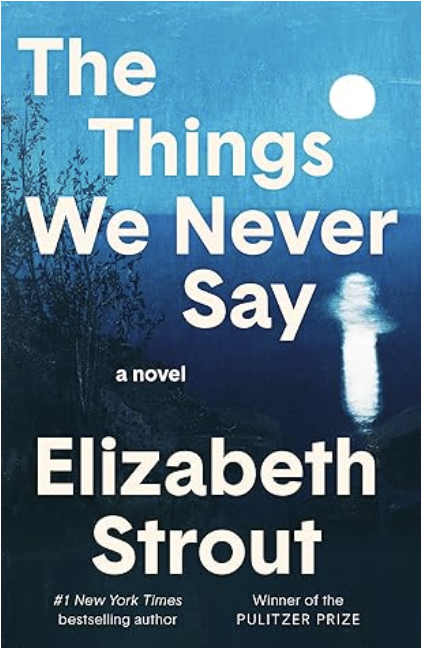
Writing: 5/5 Characters: 5/5 Plot: 4/5
I was instantly hooked by the epigraph: Loneliness does not come from having no people about one, but from being unable to communicate the things that seem important to oneself, or from holding certain views which others find inadmissible. — Carl Jung
This was the beautifully written, deeply reflective story of Artie Dam — a high school history teacher who spends time considering free will, loneliness, and whether or not anybody can really know anybody else. He watches his own mind a lot — I like that concept. He has been married 34 years, has a grown son who has become more distant, and a deep love for his students who he fears, based on the last election, he is sending out into an unsafe world.
I love the way the author (who is one of my favorites) paints a scene from multiple points of views. We spend a lot of time in Artie’s head, but we also get snapshots of what each of the people in his life think about him simultaneously and why. The elucidation of how we perceive the people around us, how they perceive us, and how we manage to make a connection to them despite this variance is brilliant. I also loved the fluid way Artie reflects on his life — memories precipitated by small events and interactions and the larger social shifting in reaction to the big events — Covid, the 2024 election, and the (ever changing) perceptions of right and wrong.
Political angst is a big piece of the context for Artie and several other key characters. Semi-oblique references to orange hair, cancelled government contracts, ICE “Nazis”, and general loathing for certain personages (you know who they are!) are tossed out without too much discussion. I found this interesting not because I agree or disagree with the view, but because of how having these feelings — justified or not — deeply impacted the characters. I appreciated that the author did include other characters — presented as reasonable and good people — who held either opposing views (they voted for Trump!) or who were simply content to wait and see what actually happened, rather than get too intensely worked up about it. What I loved about this book was that in spite of the angst — both internally and externally induced — the novel was primarily about personal insight and the way that we can have a positive impact on others and work to achieve the contentment and connection that we want. I found this book ultimately uplifting.
Quotes:
“She was unaware — even after their thirty-four years of married life — of the deep pockets of sensitivity that Artie had. And why did she not know? Because she herself did not have those particular sensitivities — and like almost everyone else on this Earth her imagination could not take her fully to another place, even with her husband.”
“So blind we humans are — so blind. To each other and to ourselves, moving through life as though through shadows, putting out a hand in the dark and thinking we have touched someone. And maybe we have, as Artie did with Rhonda Lazarre that day. But mostly we travel through life unsighted, grasping only the smallest details of one another’s selves, including our own. Thinking all the while that we can see.”
“And then she leaned her head against his shoulder, and this is what stabbed Artie now, their innocence, and how badly he wanted — as that elderly woman had — to lean his head against a loving person, to be innocent and incorruptible.”
“And now he knew why. Because to say anything real was to say things that nobody wanted to know. Or if they wanted to know, they would not care in the right way. Or even understand. It was a private thing, to be alive. He understood this now.”
“As he walked slowly up to the bedroom, he thought that now, after all these years, he was finally becoming a grownup. What did he mean by that? That he was finally beginning to understand the multitudinous aspect of people. He was amazed by it, really, now that he thought about it. In his study of history, he had learned about the leaders, and the various groups involved, but he had some how missed this fact about every single person: that they held within themselves a vast, unknowable universe. And he understood that it could make a person lonely; people had to take and give to one another whatever they could. If it was not enough … Well, then it meant one just had to be a grownup.”
Thank you to Random House and NetGalley for providing an advance copy of this book in exchange for my honest review. The book will be published on May 5th, 2026.

 Books to look forward to ...