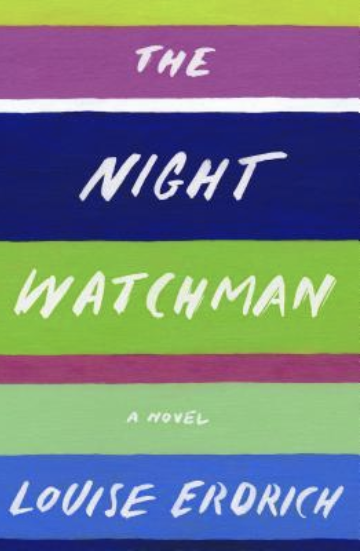
The Night Watchman by Louise Erdrich (Literary Fiction / Multi cultural)

Writing: 5/5 Characters: 5/5 Plot: 5

I’m grasping for words to express how much I loved this book but all the good words — profound, brilliant, amazing, etc. — have been rendered meaningless through overuse. So just think about what they used to mean and apply here.

The novel is based on the experiences of Erdrich’s grandfather, Patrick Gourneau, in his determined fight against the proposed termination of his Turtle Mountain Band of Chippewa named in House Concurrent Resolution 108 passed in August of 1953. Gourneau is fictionalized as Thomas Wazhashk.

While that is the overarching plot line, the story is told as a set of short chapters from various character viewpoints. While the termination fight touches everyone, much of the content covers the progression of individual lives in the community. Pixie Paranteau supports her family with earnings from a job at the new jewel bearing plant; her sister, Vera, has disappeared in the Cities and has been caught in the underbelly of the beast; Wood Mountain is becoming a top boxer, training with Barnes, a local white coach with eyes glued on Pixie; Millie Cloud is in Minneapolis and has authored a study of her father’s reservation which will be useful in the fight against termination; and Thomas spends his nights as the Night Watchman at the plant — struggling to stay awake by writing letters using the Palmer Method ingrained in him at the Indian boarding school. Other characters are ghostly visitors, Mormon missionaries, and various officials from the BIA, congress, and tribal councils.

Erdrich’s characters are wonderful — each one an individual that defies stereotype; each one full of complexities that never descend into entertaining “quirks.” In contrast, we do see the usual stereotypes through the perspective of others — in Barne’s memory of the “luscious” Indian girls depicted in ads and earnest lectures given by the missionaries, for example.

What I love most about this book is Erdrich’s articulation of the feelings, perspectives, and philosophies of the various characters. Thomas, in his desperation to leverage every possible angle available to him reads the Book of Mormon to better understand the bill’s author — Arthur V. Watkins — a staunch Mormon. He has discussions with Barnes about why Indians can’t / don’t want to become “regular” Americans and why Barnes could never “become” an Indian. He is immensely philosophical, and we are treated to his thinking, his process, and his growing understanding of life and his part of this world. Every chapter is full of enlightening description and presence.

This is the best book I’ve read in a long time and by far my favorite Erdrich book. The Pulitzer committee definitely got it right this time.

Some quotes:
“This termination bill. Arthur V. Watkins believed it was for the best. To uplift them. Even open the gates of heaven. How could Indians hold themselves apart, when the vanquishers sometimes held their arms out, to crush them to their hearts, with something like love?”

“Thomas was convinced that he’d destroyed their chances. He couldn’t point out exactly how he’d done it, but he knew. And the other thing. The senator had also asked every single Indian person who testified about their degree of Indian blood. The funny thing was, nobody knew exactly.”

“Especially Senator Watkins. The word supercilious. That was the word for every detail. Watkins’ coin-purse mouth. His self-righteous ease. The way he held himself, giving off that vibration. Filling the air with sanctimony. Another word that flung itself into her mind.”

“She was inhabited by a vengeful, roiling, even murderous spirit. The same spirit had hatched the bird that pecked Bucky’s face. When she got home, she’d clean up the sweat lodge and ask her mother to help her get rid of these thoughts.”

“All were cast together onto allotments, to break apart the earth, to learn the value of a dollar, and then how to make one dollar into many dollars and cultivate the dollar into a way of life.”

“His father was so very old now that he slept most of the day. He was ninety-four. When Thomas thought of his father, peace stole across his chest and covered him like sunlight.”

“To most of their neighbors, Indians were people who suffered and hid away in shabby dwellings or roamed the streets in flagrant drunkenness and shame. Except the good ones. There was always “a good Indian” that someone knew.”

“For days. he’d tried to make sense of the papers, to absorb their meaning. To define their unbelievable intent. Unbelievable because the unthinkable was couched in such innocuous dry language. Unbelievable because the intent was, finally, to unmake, to unrecognize. To erase as Indians him, Biboon, Rose, his children, his people, all of us invisible and as if we never were here, from the beginning, here.”

“Emancipation. This word would not stop banging around in his head. Emancipated. But they were not enslaved. Freed from being Indians was the idea. Emancipated from their land. Freed from the treaties that Thomas’s father and grandfather had signed and that were promised to last forever. So as usual, by getting rid of us, the Indian problem would be solved.”

“He wasn’t one for giving names to things. Or finding their basis. His feelings were like weather. He just suffered or enjoyed them.”

“He felt it coming. Wanted to duck. Winced. A sensation like when he was chastised at school gripped him. Like when he went into a bank or bought something expensive in an off-reservation town. Their looks pressing down on him. Their words flattening him. Their eyes squeezing him. Isey, for shame. As his mother used to say. But it was so much worse in English, the word shame.” It made him curdle inside. And the curdling became something hard in his stomach. Or a thought that stabbed so hard he might cast it out in a flare of anger. Or it might stay in there hardening even further until it flew up to his brain and killed him.”

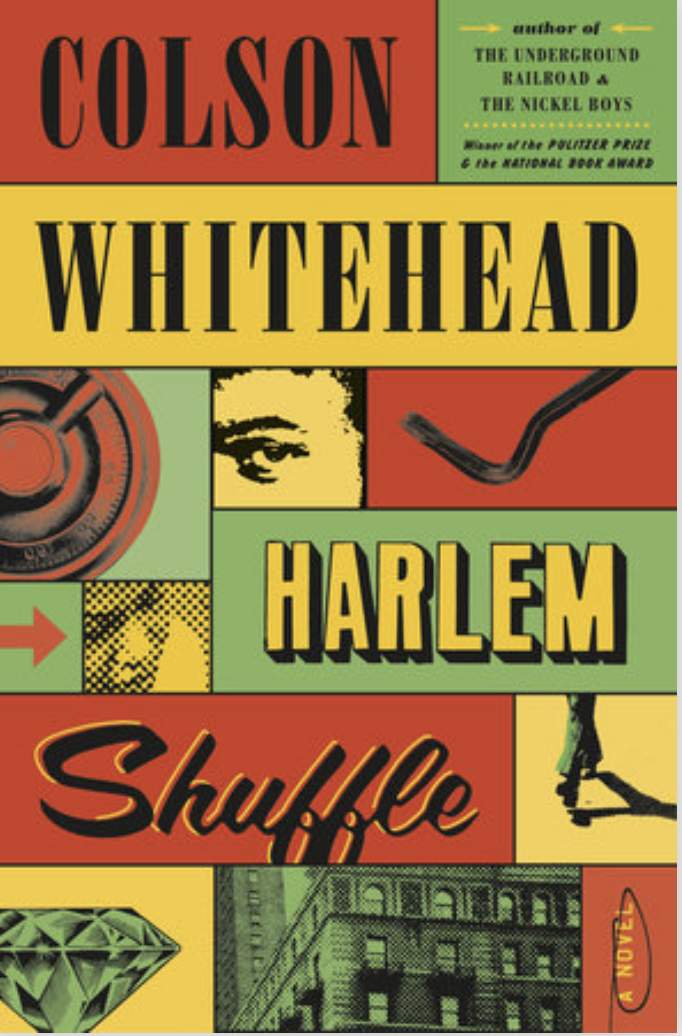
Harlem Shuffle by Colson Whitehead (Literary Fiction)

Writing: 5.5/5 Characters: 5/5 Plot: 4.5/5 (for me)

Colson Whitehead is a master of bringing a place and time to life. Harlem in the 60s — this is the story of a man who came from nothing and relentlessly made something of himself. But it’s not the typical rags to riches story with people “managing” to do this and that. This includes all the details of just what he had to do to make it in the world as it was — the pay offs (to gangsters and the police), the loyalties and trust, the “deals” made, the heists, and the constant jockeying for power, influence, and importance by the big shots while everyone else struggles to get by.

Carney is “only slightly bent when it came to being crooked”. He has principles but suspends them as necessary with full awareness. He runs a furniture store with a secret side line in low level fencing of stolen goods. He primarily manages to stay out of trouble except when his cousin Freddie pops up (Freddie’s most constant refrain — “I didn’t mean to get you in trouble”).

Fantastic scenes in Harlem — The Theresa Hotel, known as the “Waldorf of Harlem,” Striver’s Row for the African-American elite, Black Star Travel agency to help black travelers at the time make their way through parts of the US without getting lynched. Some vivid scenes from the 1964 Harlem riots, resulting from the shooting of an unarmed black teenager by a white policeman. All narrated by Carney with his somewhat cynical (and pretty realistic) worldview.

Whitehead is a fantastic writer — this had a little more focus on unsavory elements for my taste but it was very hard to put down.

A few quotes (out of many):

“Carney took the previous tenants’ busted schemes and failed dreams as a kind of fertilizer that helped his own ambitions prosper, the same way a fallen oak in its decomposition nourishes the acorn.”

“There was a hole in the air where the Ninth Avenue el used to run. That disappeared thing.”

“He reconsidered: The consequences remained, but the reasons had turned spectral, insubstantial. Harlem had rioted — for what? The boy was still dead, the grand jury cleared Lieutenant Gilligan, and black boys and girls continued to fall before the nightsticks and pistols of racist white cops. Freddie and Linus were gone, their heist unwound as if it had never happened, and Van Wyck kept throwing up buildings.”

“Death took Freddie from Carney and mourning returned to him a visitation, an invisible companion who shadowed him everywhere, tugging at his sleeve and interrupting when he least expected: Remember what my smile looked like, Remember when, remember me. Its voice grew quiet and Carney didn’t hear it for a while and then it was loud again: Remember me, This is your job now, Remember me or no one else will.”

Thank you to Doubleday Books and NetGalley for providing an advance copy of this book in exchange for my honest review. The book will be published on Sept. 14, 2021.

In the Wild Light by Jeff Zentner (YA)

Writing: 5/5 Characters: 4.5/5 Plot: 4/5

Delaney Doyle and Cash Pruitt are best friends. Growing up in a very poor small town in East Tennessee with a large addiction problem, both having seen their share of hardship and trauma. When Delaney manages to get both of them a scholarship to an elite private high school in Connecticut, a new (and utterly unpredictable) chapter begins for both of them.

There is a lot of depth to this book. Told from Cash’s perspective we get both typical coming-of-age experiences and some very atypical life experiences. Delaney is a gifted scientist — her talk is peppered with black holes, human wormholes, olfactory fatigue, and a theory of how humans may have descended from aquatic apes (I love this one). She sees patterns everywhere — in people as well as the natural world. Cash is sure that his only choices are a “sh**ty life or an ordinary life.” His Papaw (grandfather) is slowly sinking with emphysema back home, and Cash has the strongest feeling that he doesn’t even deserve an opportunity like this in the first place. And then, in a complete surprise to himself, he discovers the magic of poetry.

The book is very sweet and brought tears to my eyes multiple times. Themes of love, family, loneliness, being an outsider, and doing the right thing, even when it is difficult pervade. Some fascinating discussions on the similarities between the sciences and the arts in trying to understand the world we live in. I am absolutely not a poetry person, but I found the descriptions of how Cash came slowly to love both reading and writing poetry to be fascinating — an aspect of character development through passions that I don’t often see to this extent. Some of the language seemed a bit overdone at times to me, but I do find Zentner’s writing quite beautiful. The negative characters seemed kind of two dimensional to me but I’m guessing that is how they appeared to Cash so it makes sense.

Good for fans of John Green.

A few good quotes (there are many):
“Because it’s heretical. That’s how science advances and takes humanity with it. People have to be brave enough to look stupid in a field where looking stupid is the worst thing you can do.”

“I think the real problem is you feel so lucky to have survived what you did, you think you bagged your limit of luck by finishing out your childhood in a safe and loving home.”

“You’ll never regret a decision more than the one you make out of fear. Fear tells you to make your life small.”

“Life often won’t freely give you moments of joy. Sometimes you have to wrench them away and cup them in your hands, to protect them from the wind and rain. Art is a pair of cupped hands. Poetry is a pair of cupped hands.”

“It feel like he’s bequeathing me an inheritance of the only wealth he possesses — his memories, his quiet joys.”

“Being a poet takes bravery. Yes, the courage to bleed on a page. But also to bleed for the world we write poetry about.”

Thank you to Crown Books for Young Readers and NetGalley for providing an advance copy of this book in exchange for my honest review. The book will be published on August 10th, 2021.

The Ghost Dancers by Adrian C Louis (Literary / Multi-cultural Fiction)

Writing: 4.5/5 Characters: 4.5/5 Plot: 4.5/5

A posthumous publication by the author of Skins, this is a raw story of Indian life in late 80s / early 90s. Bean Wilson is an educated Indian — a well known poet and journalist. Born and raised a Paiute in Nevada, he now lives and works with Lakota Sioux on the Pine Ridge reservation in South Dakota. The events in the book follow Bean, his son Quanah, and his girlfriend’s son Toby. Wilson’s interior and verbalized rants permeate the pages on topics ranging from Indians (and himself in particular) being their own worst enemies to harangues on White oppression. While he tries to honor the old ways, he grapples with alcoholism and his womanizing tendencies. The writing depicts his internal struggles and the male culture in which those are common and even respected traits. This is extremely well done. It’s often crude, but feels real and does an excellent job of fleshing out each of the primary male characters — their experiences, their interactions with friends, family, and those who are “other” and the impact on their personal development. Oddly enough, while plenty of bad things happen, I didn’t find it depressing the way I do most Louise Erdrich books (for example). The tone is not as emotional, or maybe it is just more angry and less hopeless. Perhaps this is because the real focus is on men? The women characters have depth, but the real magnifying glass is on the men.

I have no insight into why this was not published when it was written — probably in the late 80s or early 90s according to the Forward. That was the only frustrating bit — the world was so well-depicted and I have no clue how things may or may not have changed since then.

The writing is powerful, insightful, and supports the complexity required of any real story. Some quotes below demonstrate both the writing and some of the rants. I loved the first line (which is also the first quote) — somehow it just completely grabbed me.

“The Cancerous burrito of Los Angeles summer seemed to have no effect upon the rambunctious innocence of yelling Chicano kids.”

“Bean looked from the two warriors in the painting to the two Pine Ridgers and repressed an urge toward epiphany.”

“America was a cannibalistic society. There was no true freedom in America. The White man thought he was free. The Black man thought he had been freed. The Indian knew he had been corn-holed.”

“…that garish monument to White greed, carved out of the mother earth, gouged out of the sacred Black Hills, and stolen from the Indians despite the treaties promising no intrusion.” (About Mount Rushmore)

“He despised the rhetoric of contrition that AA and its kindred organizations espoused. He despised the self-righteous reformed drunks who made their various programs for alcoholics a large industry on the Pine Ridge reservation.”

“It’s depressing to the max around here. I hate to say it, but you Sioux live like Black people in ghettos. No pride. No hope. Just booze, drugs, and violence. Pregnant teenagers and commodity cheese.”

“And as educated Indians, we know who our worst enemies are. Some of the worst are our own people. They must be re-educated, those that are the rip-offs. And the other bad enemy is the White liberal who lives on the reservation and purports to help our people. They are bloodsuckers. But that is a different matter.”

Thank you to University of Nevada Press and NetGalley for providing an advance copy of this book in exchange for my honest review. The book will be published on September 14th, 2021.

The Lincoln Highway by Amor Towles (Literary / Historical Fiction)

Writing: 5/5 Characters: 5/5 Plot: 4/5

On the one hand, a wild adventure story. It is 1954 and 18-year old Emmet Watson is driven back to Nebraska by the warden of the juvenile detention facility where he has served 15 months for involuntary manslaughter. His mother left years ago, and his father just died; the bank is preparing to foreclose on the farm and all their belongings. He is now the guardian of his 8-year old brother, Billy. While they plan to drive to California to start a new life, two stowaways (Duchess and Woolly) from the facility have a different idea. And so it goes…

The writing is — of course — excellent. The narration alternates between Emmett, Duchess, and Woolly, with occasional chapters from a few others. Each character has a distinctive voice as they describe both events and their inner thought processes during the ten days covered. Billy is my favorite character — never a narrator he somehow becomes a focal point for all of the stories. He is earnest, innocent, smart as a whip, and somewhat beatific. Billy doesn’t go anywhere without his large red book — Professor Abacus Abernathe’s Compendium of Heroes, Adventurers and Other Intrepid Travelers. This book — which mixes mythical with real-life heroes (all male by the way) in its A to Z collection — serves as a kind of Greek chorus for the action as Billy pores over the pages offering its inspiration to those he meets.

There are many layers to this book, and I don’t claim to understand them all. Well articulated moral themes as interpreted and internalized by our different players. I loved Sister Agnes’ Chains of Wrong doing lecture (which I include in the quotes below) — this book will keep book club discussions going forever. Interesting note: I loved Rules of Civility and yet tried twice to read A Gentleman of Moscow and could not get past about page 50. Lincoln Highway was impossible to put down. One more interesting note: I did find this book a little stressful which says more about me than about the book. It reminded me of the nightmares I sometimes have where I need to get to the airport but things keep happening and then while trying to address those things, other things keep happening, etc. There is an element of that in the pages that stressed me while I tried (in my head) to get our protagonists back on track. My advice for reading — just let it go and enjoy the ride.

A few good quotes:

“Rather, the comfort of knowing one’s sense of right and wrong was shared by another, and thus was somehow more true.”

“Some evidence of that one desire so delectable, so insatiable that it overshadowed all others, eclipsing even the desires for a home, a family, or a sense of human dignity.”

“From a man’s point of view, the one thing that’s needful is that you sit at his feet and listen to what he has to say, no matter how long it takes for him to say it, or how often he’s said it before.”

“One of her favorite lessons was something she referred to as the Chains of Wrongdoing. Boys, she would begin in her motherly way, in your time you shall do wrong unto others and others shall do wrong unto you. And these opposing wrongs will become your chains. The wrongs you have done unto others will be bound to you in the form of guilt, and the wrongs that other have done unto you in the form of indignation. The teachings of Jesus Christ Our Savior are there to free you from both. To free you from your guilt through atonement and from your indignation through forgiveness. Only once you have freed yourself from both of these chains may you begin to live your life with love in your heart and serenity in your step.

“Let’s simply say that my academy was the thoroughfare, my primer experience, and my instructor the fickle finger of fate.”

Thank you to Penguin Group Viking and NetGalley for providing an advance copy of this book in exchange for my honest review. The book will be published on October 5th, 2021.

Oh William! by Elizabeth Strout (Literary Fiction)

Characters: 5/5 Plot; 3.5/5 Writing: 5/5

I loved this deeply meditative book about how much we can really know one another. This is written as a novelized memoir of the fictional character introduced in a previous work — I am Lucy Barton. It felt so incredibly real to me that it’s hard to remember that she is a work of fiction. Here, Lucy reflects on her first husband — William — with whom she is still friendly and the prior and current relationship between them. The “action” takes place a year after Lucy’s second husband has died and William’s third wife has left him.

I resonated with so many of the feelings and experiences described in this book. Strout has a beautiful and apt writing style that captures the essence of what is important in any human interaction — even within oneself. I was often brought to tears — not because anything particularly sad was happening — but because she captured it so perfectly.

A great line:
“Grief is such a – oh, it is such a solitary thing; this is the terror of it, I think. It is like sliding down the outside of a really long glass building while nobody sees you.”

I also loved the last line but I won’t list it here — you need to read the rest of them first!

Thank you to Random House and NetGalley for providing an advance copy of this book in exchange for my honest review. The book will be published on October 19th, 2021.

The Human Zoo by Sabina Murray (Literary Fiction)

Writing: 4/5 Characters: 4/5 Plot: 4/5
An unusual (and engaging) book — the narrative felt so real I had to remind myself it was fiction, not memoir.

Filipino-American writer Christina Klein (Ting) travels back to the Philippines — ostensibly to write a book about an episode in Filipino history featuring a headhunter tribe’s role in Coney Island’s “human zoo.” A short year after the election of a dictatorial leader, Ting experiences the new Manila superimposed on the remembered culture and practices of her youth, which in turn are layered on stories and experiences from a more distant past as told through her historical research and the stories of her many elderly Titas and Titos.

The writing is fluid and provides fascinating linkages over time and class — her interactions span people with varied backgrounds, living conditions, and political opinions, from her aristocratic family to earnest socialists to those in the current circles of power. The dialog perfectly distills different perspectives and her ongoing reflection gives us insight into her personal journey to understand and evolve her sense of morality in a situation where nothing at all is perfectly clear. It’s masterfully done, IMHO.

As an aside, I learned a lot about Philippine history, although it is a backdrop to the story rather than a comprehensive presentation — 7,000 islands and 182 non mutually intelligible languages!

Some good quotes:

“Morality is the spine of fiction, even if it is most often twisted and deformed.” <— my fav

“They liked microphones and Spam. America’s streets and classrooms had instilled in many a sense of inferiority and in some a seething resentment at being brown in a white world. The Fil-Ams suffered from the shame of otherness, while Filipinos born and educated in the Philippines struggled with disdain for gauche American culture. In the States, we were all seen as being of the same tribe, but it was, at times, a flawed taxonomy.”

“This was to illustrate the colorful ways of the backward Filipinos and justify American’s occupation of the islands. Why exterminate all the brutes when you could display them and make a profit?”

“Inchoy watched me watching the children, and I felt my perspective slowly shift from mine to his: from my joy at the beauty of the children to Inchoy’s perception of forced child labor. He flicked his eyebrows at me to drive home the point.”

“Tita Rosa’s ambush resolved itself quickly: this was Manila and duty presented itself in clear, direct ways. Resignation was the backbone of survival here. Resistance only created anxiety.”

“The results of Gumboc’s presidency are that the poor live in fear for their lives and with reason. Gumboc’s army of assassins operates in a price per head economy and there is no due process. These people are murdered for money as part of a government-sanctioned program.”

Thank you to Grove Atlantic and NetGalley for providing an advance copy of this book in exchange for my honest review. The book will be published on August 10th, 2021.

Early Morning Riser by Katherine Heiny (Literary Fiction)

Jane is a second grade school teacher in Boyne City, Michigan. In chapter one she falls in love with Duncan — the town playboy — and spends the rest of the book following an unexpected path through her own life. Each chapter (carefully labeled with the year — thank you!) is a mini-story that captures the essence of Jane’s personal story in that time frame. Story and personal evolution proceed apace with humor, insight, and poignancy as she becomes deeply involved with a set of characters she might not have voluntarily sought out: Jimmy, Duncan’s sweet and intellectually slow colleague; Aggie, Duncan’s bossy ex-wife; and Aggie’s flat out strange husband Gary.

I love Heiny’s writing style — her precise language perfectly captures internal thoughts and external behaviors. Jane possesses a biting interior commentary and the descriptions of second grade classroom life are pointed and hysterical. The characters are real — some times you love them and sometimes they irritate you completely. Good for fans of Anne Lamott.

Some random quotes:

“In fact, she had not only stopped being the maid of honor, she nearly stopped being human and became just a help desk in a giant green dress. She had to tell the caterers to start serving, and direct the florist on where to put the arrangements and the staff which table to designate for gifts.”

“It all reminded Jane that having a baby was not that miraculous. Any two fools could do it.”

“Worst of all were the mood swings. Although, actually, could it be considered a mood swing if it only swung one direction? Maybe it was more like a mood acceleration. Like the needle on a speedometer that whipped straight from ZERO to ANNOYED and stayed there. Because it seemed like the world was in an unkindly conspiracy to irritate Jane.”

“Endless rolling nausea without vomiting, nausea that spun out before Jane like a curving country lane meandering through a hilly green landscape, the end always just out of sight.”

“Jimmy was always there. He lived with them, and sometimes Jane thought that spontaneous adult conversation had fled her life forever.”

“Little insights into the murky liquid that sloshed around in the fishbowl of Gary’s mind.”

“She felt a sort of cellular-level sorrow and wondered if she loved more deeply than other people. Or was everyone else just more mature, more rational? More realistic?”

Thank you to Knopf Doubleday and NetGalley for providing an advance copy of this book in exchange for my honest review. The book will be published on April 13th, 2021.

The Hidden Palace by Helene Wecker (Literary / Speculative Fiction)

Writing: 4/5 Characters: 5/5 Plot: 3/5

The Hidden Palace is a sequel to one of my favorite books: The Golem and the Jinni. Taking up where the G&J left off, we follow the two as they continue their inhuman lives amidst the sea of humanity that is New York City in the early1900s.

The story ranges over fifteen years encompassing WWI, the sinking of the Lusitania, the Triangle Shirtwaist Fire, and the disaster of the Titanic and takes place in New York City and parts of Syria. Including most of the characters from the first book, we also meet a Jinniyeh (a female Jinni) who is impervious to iron; an orphaned, ultra orthodox young girl who had helped her rabbi father create a golem to fight the pogroms in Russia; and Yosselle, the new golem himself.

I enjoyed many aspects of this book — the portrayal of the characters and their interactions were fascinating — especially between the young girl and “her” golem. The continuing themes of “otherness” and immigration continued from book one with additional examples through various human and inhuman characters. I’m sorry to say that I wasn’t captivated in the way I was by the first book — for me there was too much time spent evoking the time and place through description when I prefer character interaction. Also, the overall tone felt more sorrowful than I remember book one, which is perhaps more realistic, but less satisfying. While book one brought multiple cultures together through these (non-human) representatives, this book felt more like the follow up on a couple in love but with such different essences that they were heading for an inevitable divorce (my impression — not what actually happens). For those who haven’t read the first book, she does a decent summary of the important background and events in the first few chapters.

Thank you to Harper and NetGalley for providing an advance copy of this book in exchange for my honest review. The book will be published on June 8th, 2021.

Dictionary of Lost Words by Pip Williams

Loved this book! Motherless Esme grows up in the Scriptorium — OED prime editor James Murray’s repurposed garden shed — playing under the table as her father and other lexicographers labor over entries for the decades long effort that will result in the magnificent Oxford English Dictionary.

As she grows older and becomes more involved in the work, Esme begins to notice patterns in the words that are excluded and the definitions that lean away from certain interpretations. She begins to collect words — women’s words, bawdy words, words spoken but never written from the poor and illiterate. Her awakening to the world around her via the medium of the constituent pieces of the English is simultaneously subtle and stunning. Spanning and encompassing the women’s suffrage movement and World War I, it is a phenomenal coming-of-age story with intellectual and emotional growth circumscribed on the story.

Excellent writing with detailed and fascinating descriptions of the process of compiling a dictionary from scratch including solicitation, editing, typesetting, and printing. Wonderful characters including Esme, her Da, the individual lexicographers, her Godmother Edith (also a contributor / editor), and the Murray’s maid Lizzie who serves as a kind of mother figure. While Esme is fictional, many of the other named characters are not, and Williams does a skilled job at weaving Esme and her ideas into an historically accurate narrative.

Highly recommended.

Thank you to Ballantine Books and NetGalley for providing an advance copy of this book in exchange for my honest review. The book will be published on April 6th, 2021.