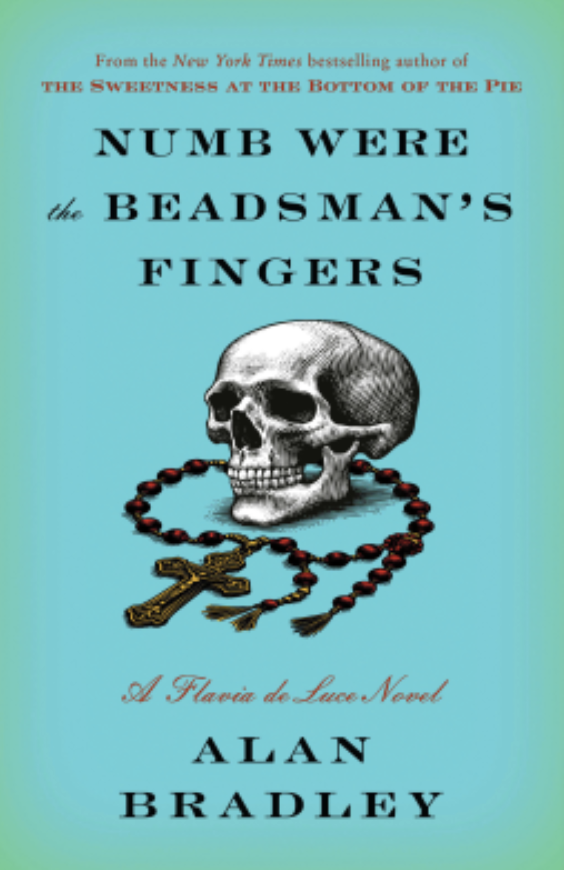
Numb Were the Beadsman’s Fingers by Alan Bradley (Historical Mystery)

This is the 12th, and probably last, delightful mystery in the Flavia de Luce series. If you’re new to the series, it follows an 11-year old irreverent chemist and amateur detective pottering about with her poisons in her family’s decaying estate in 1950s rural England. If you are newbie, I recommend going back and starting at the beginning — it isn’t necessary, but it’s much more fun.

This book starts with an immediate hook — Flavia and Dogger (the family manservant with a complex past and a “black belt in noncommittal”) are called in to the (silent) Sisters of Clemency convent to help identify a recently deceased nun who — wait for it — turned out to be a man. The (quite satisfying) unraveling of this mystery takes us to the Klondike, the shell-shock victims of WWI, and an intriguing Rosary Code. The writing is humorous and full of the creative and surprising asides that constantly stream out of Flavia’s fertile mind. The characters are highly competent (each in their own way) and likably quirky. The story is fun to follow with the kind of relevant (and sometimes utterly irrelevant) tangents that will attract the intellectually curious reader.

Alan Bradley wrote the first book in the series when he was 70 based on his winning entry for the Debut Dagger fiction competition. He passed away at the age of 87 just this last May.

Thank you to Bantam Sons and NetGalley for providing an advance copy of this book in exchange for my honest review. The book will be published on November 3rd, 2027.

Chemistry by Weike Wang

Writing: 4/5 Characters: 4/5 Plot: 4/5 background: 5/5

A belated (she’s in her 20s) coming-of-age story about a young, Chinese-American woman in the midst of capsizing both her Chemistry PhD and long-term relationship. We view the process of life dismantling and reconstruction from within her own mind through her unique, first-person voice.

The writing style is spare and humorous, comprised of short 1-3 page segments bundled into two large “parts.” Tidbits of chemistry, science, Chinese history, culture, and parenting are brought in as elements of the crucible which forged her personality. We never learn her name — the narrative is all 1st person — and only one character — the man she lives with — is given a name (Eric). Everyone else is referred to by label: the best friend, the lab mate, the dog, her mother, her father, the math student, the husband (of the best friend), and the Chinese roommate.

While some of the characters (her emotionless, overbearing, push to succeed parents for example) might appear to be stereotypes, they are completely personalized in backstories told through her memories. They appear quite real. One day our narrator sees a flyer in the park written by someone named “Peggy” that says: “The way you talk to your human children becomes their inner voice.” She rails at this: “Who is Peggy? I ask the other dog owners. And does she have a PhD to back up such claims?” I love this short scene because clearly her upbringing has been condensed into the inner voice that constantly plagues her.

I had a hard time reading this at first — I found the narrator to be self-absorbed and that is not a characteristic I favor in my book-friends. I felt sorry for the boyfriend who had no flaws, was very good to her, and who proposed marriage in chapter one. However, as I continued reading, it became clear that she was literally unable to cope with the life she was living and was going through the necessary steps to create a life that she could live — and voila — the story!

Very well-written, entertaining, and insightful.