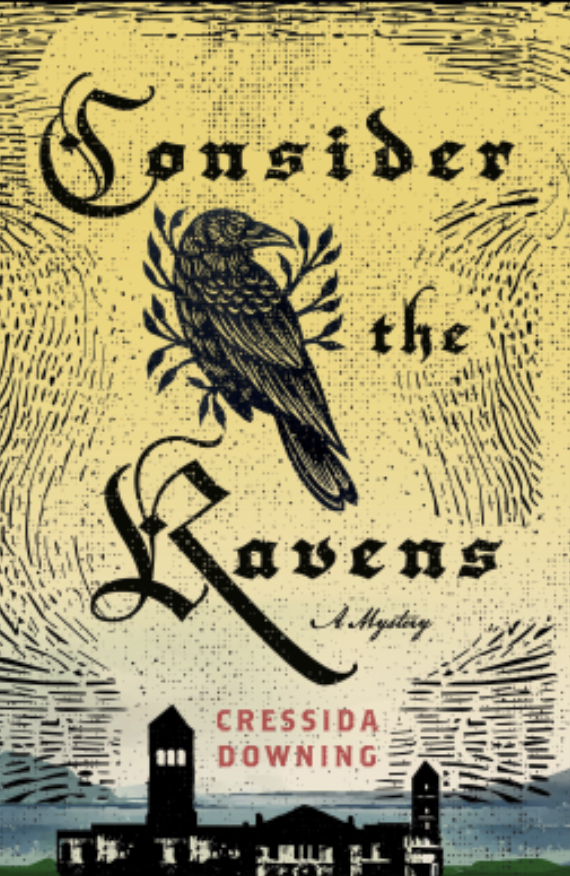
Consider the Ravens by Cressida Downing (Historical Mystery / Fiction)

The first in a new mystery series set in the Lindisfarne monastery in 1494. Linnet is a female scribe seeking sanctuary on the island she grew up on, making herself useful through her skills as a scribe. She is fairly friendless when she arrives — only an old fisherman from her childhood and a stray child with her raven can be counted on as somewhat connected — and she has much to hide. When three bodies turn up one by one — two “accidents” and a suicide, she begins to be suspicious but has no one she can trust to turn to.

This book was a real surprise for me — I expected a nice, palate cleansing, historical cozy, but what I got was a fascinating piece of historical fiction with a mystery providing the plot and pacing. I was drawn into the writing, completely forgetting that I was reading a book. I was fully immersed in the (quite foreign) time and place — a monastery on a Holy Isle with a strong interest in producing manuscripts. A woman who is respected by some for her great skill, and shunned by others for being a woman (and a bastard at that!). Each of the characters — the various monks, the Prior, the hellfire breathing Inspector, the locals, and the odd child who seems to be on her own and difficult to boot — all have their own personalities, their own interpretation of a moral code, their own inner turmoils and weaknesses. I liked the tangled knot of the community formed by all the slippery pieces.

I also absolutely loved the details on the process and experiences of scribing, especially as pertained to a woman practicing the craft at the time. The author included a historical note which pointed out that women in the 1400s were often skilled tradespeople and were allowed to practice their crafts (see links to articles about the recent exhibit at the British Library about Medieval Women). I found every bit of the descriptions of penmanship — some of the monks could barely read and were copying shapes rather than letters and content — illumination (illustrating), making inks, making pens from quills, etc. quite fascinating. As she tries to piece together clues from the dead Oswyn’s scraps of paper, Linnet must translate from Latin — I enjoyed the process by which she does that, along with her passing on her knowledge of reading and writing to those interested. I also enjoyed the medieval theology that came out through orations, considerations, and reflections. Something that surprised me — the “sins that cry out for vengeance” that are: Willful murder, oppression of the poor, withholding laborers pay, and sodomy. All drawn from specific bible verses. Plenty to keep the mind busy while simultaneously unraveling the mystery.

From the afterward — sources of information on the lives of Medieval women:
• http://www.bbc.co.uk/news/science-environment-46783610
• https://www.bl.uk/about/press/releases/last-chance-to-see-major-exhibition-that-tells-the-story-of-medieval-women-in-their-own-words

Thank you to Minotaur Books and NetGalley for providing an advance copy of this book in exchange for my honest review. The book will be published on July 20th, 2027, although an earlier edition of the book, from another press, was published this year.
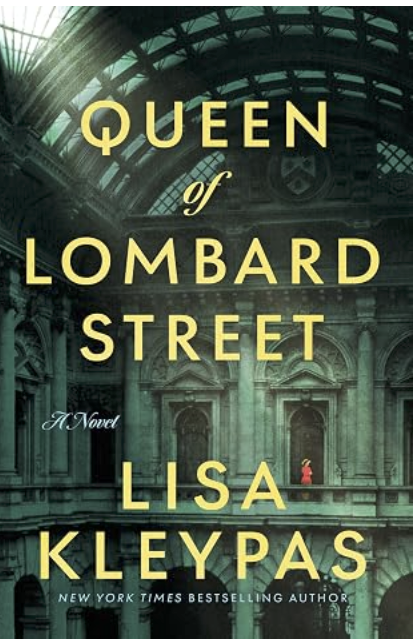
Queen of Lombard Street by Lisa Kleypas (Historical Fiction – Audiobook)

London in the late 1800s. Reina is a financial / economic genius with a disreputable background: she is the illegitimate daughter of a Spanish dancer and a married (now deceased) aristocrat. A wonderful character with real, elaborated competence and a full (if sometimes naive) heart, the story takes her through the building of her household (stocked with servants on prison early release!), pushing for banking reforms to support women and the working class, and building her own “family” based on principles of love and mutual care. One of these “servants” is actually an undercover police detective who is tasked with investigating suspected fraud on a large scale by Reina’s mentor.

The story is fast paced with simultaneous progression of adventure, romance, and historical elaboration threads. I found the storytelling riveting (i.e. I made up chores to do so that I could listen to the audiobook), the world building intellectually fulfilling, and the Romance heartwarming. This is the kind of book that you know will have a happy ending, so you can progress through any trials and tribulations safe in the knowledge that all will be well! Some of the intellectual candy: Welsh linguistics, unearned shame, funny inventions of the era, laws relating to women, class privileges and restrictions, how a “house” is run, what people eat. Romance wise — really well done. Romance is not my genre, but while this book did have a few (extremely tasteful and quite engrossing) steamy scenes, there was much more on what it means to be a “good” man and a “good” woman — at the deepest level, not necessarily conforming to societal rules. People in this book are shown to be complex beings — never all evil or all good. I loved a Welsh (I think) saying about “Finding joy in a minor key” — knowing that life can and will be unfair, but not allowing yourself to let it make you bitter.

This is not the kind of book I normally read but I absolutely loved it. An upbeat mood throughout — even in times of stress. Love as caring over lust. Good relationships that evolve through effort and self reflection. And very attractive (to me) models of masculinity and femininity — competence, partnership, and care rather than ownership, obedience, and simpering. No lashes were ever batted. Whew.

A note: I listened to this on audio book and while I’m sure I would have enjoyed reading it, the two readers (Mary Jane Wells and Joe Jameson) that I listened to were some of the best I’ve heard, giving sound to a variety of British (and Spanish) dialects perfectly and further bringing the characters to life with individual accents, cadences, and tones. Highly recommend listening to this one, though I do in general preferring reading my books.

Quote — right from the first pages…
“Memory is a hoarder’s closet, in which we can never find the item we want, while the things we’d rather avoid insist on tumbling out.”

Thank you to Avon Audiobooks and NetGalley for providing an advance copy of this book in exchange for my honest review. The book was published on October 20th, 2026.

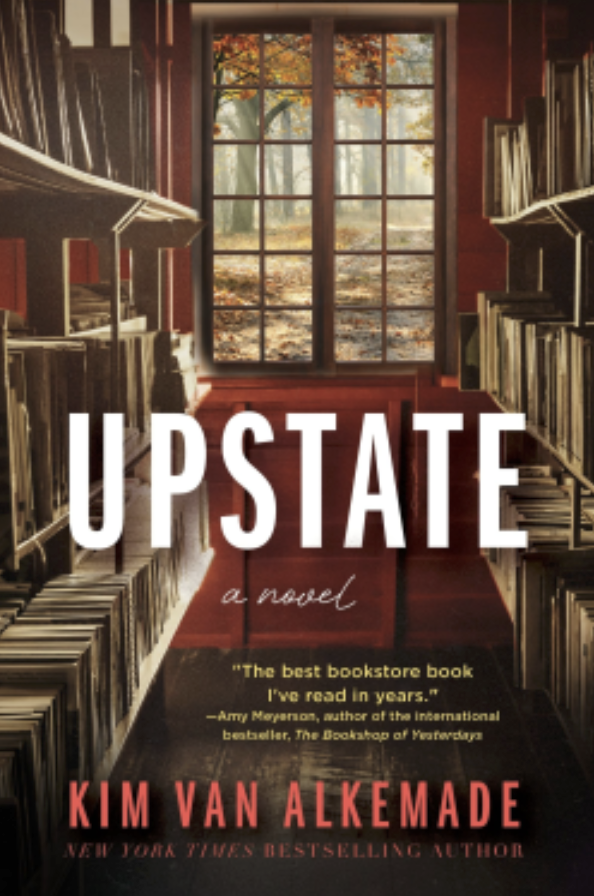
Upstate by Kim van Alkemade (Historical Fiction)

Plot: 5/5 Characters: 4/5 Writing: 3.5/5

It is 2021 and Audrey Beacon has escaped to the Adirondacks — buying a house and a somewhat derelict barn based book store in a desperate play to get away from New York City, Covid, and the devastating death of her young husband, alone in a hospital ward. We watch as she makes her (woefully unprepared) way in an isolated, rural, and fairly republican community (about which she has some strong concerns!). Paralleling her own journey through grief and toward self sufficiency are two interspersed narratives: a set of magazine articles written by Evelyn, the previous property owner ranging from 1960 to 1983; and a set of letters written to Evelyn by her longtime lover, Hazel, as Evelyn sinks into dementia (simultaneously telling us their story). The lines between these narratives start blending together into a very satisfying conclusion towards the end.

It is an emotional tale with strong themes of alienation, loneliness, and the kind of family and social dysfunction that arises from not fitting into an expected mold. Rejection based on a person’s ethnicity, sexual orientation, or as a result of suicide born of despair all come into play during the dramatic recounting and connecting of several life stories in this absorbing book. I was never bored and finished in just a few sittings. While the primary narrative follows Audrey in her current day search for meaning, the real heart of the story (IMHO) is the love story between Evelyn and Hazel — occurring at a time and place where lesbian love was by no means an accepted practice. Their story also encompassed some very frustrating facts about what women were and were not allowed to do period. Sometimes it’s hard (for me) to remember what actual laws, norms, and policies restricted women from doing pretty normal things such as holding positions of authority, working while pregnant, or getting a mortgage without a husband.

Great storytelling, decent writing, good characterization — although to be honest, I found I didn’t actually like some of the main characters very much, finding their behavior less than exemplary even with a description as to their probable motives. Still, very enjoyable read and you might relate to the characters more than I do!

Quote: “No wonder humans are storytelling animals, I think. Our lives are little more than an infinite series of random collisions. We need narrative to corral the shapeless stream of chance into a navigable river.”

Thank you to William Morrow Paperbacks and NetGalley for providing an advance copy of this book in exchange for my honest review. The book was published on October 27th, 2027.

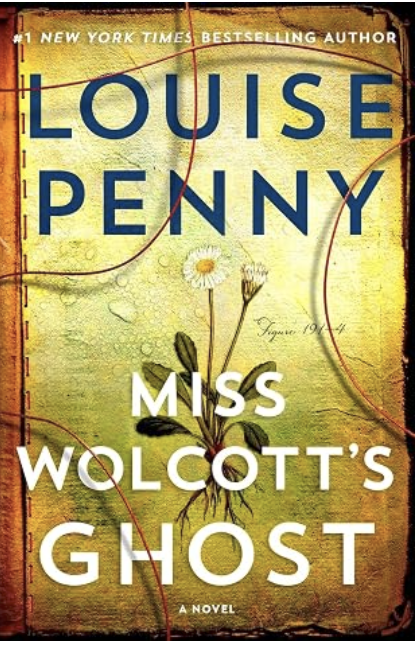
Miss Wolcott’s Ghost by Louise Penny (Mystery)

Loved this latest installment of Penny’s Inspector Gamache series. It returns the series to the kind of mystery stories that I love — individually intriguing cases, rather than high stakes terrorism, deeply corrupt institutions, or world shattering events. And the always cherished Three Pines with its idyllic existence (despite the prevalence of tricky murder cases!)

This story is launched with a mysterious middle of the night phone call from a wispy, yet somehow familiar voice. There is a body in the Lost Nation — an area few have heard of. The body leads to an investigation that reaches back through history to the sinking of the RMS Empress of Ireland — the 1914 maritime disaster that took the lives of over 1,000 people. In a typically (for Penny) convoluted set of plot lines, a very strange plant, long thought to be extinct, is found literally growing out of the body.

This is Penny at her best. Excellent crime writing with perfect pacing, full of psychological and philosophical themes, and multiple threads weaving throughout leading sometimes to closure and other times into (literal and figurative) weeds. Our favorite characters return — everyone in Three Pines is the best at what they do and it is fun to temporarily inhabit an environment full of competence and intellectual curiosity —an artist, an archivist, a baker, a psychologist / book store owner, and an nth degree crank of a Poet Laureate. The homicide squad characters are equally engaging — ideal, but somehow not idealized. Strong, competent, principled, but also reflective and aware of biases and flaws. And with Inspector Gamache, we are exposed to the fallibility of a Godlike hero — which makes a far more interesting detective than the old fashioned Hero archetype or the more modern, morally ambiguous, and deeply flawed protagonists.

It’s a complete page turner with plenty of depth about subjects you may not have ever considered but now find intriguing. Lots of little dopamine hits as you go. This episode epitomizes everything I like about my favorite Penny books: focused mystery, historical and cultural detail, characters I like to spend time with, and moments of poetic poignancy.

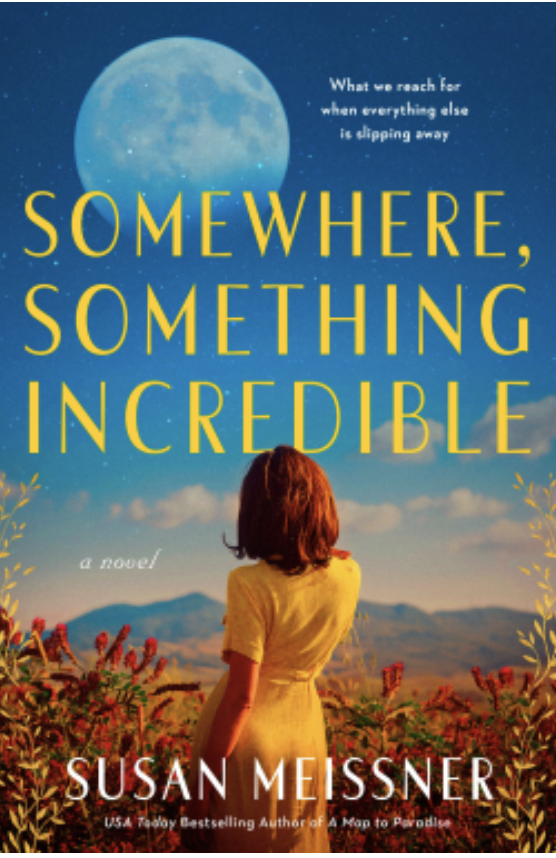
Somewhere, Something Incredible by Susan Meissner

I’m a big Susan Meissner fan — she writes deeply felt, concisely relevant, historical fiction spanning a wide variety of times, places, and cultural contexts. This book is set in the late 60s — a time of great upheaval, violence, idealism, disorder, and for many — despair. The story focusses on an aging parent (Lucille) who, after a fall and a brief coma, seems to have had a personality change. She is happier, but in her daughter Gwen’s eyes, more impulsive, vulnerable, and making bad decisions. One day she appears to have gone missing, in the company of a man that Gwen deeply distrusts.

The story bounces between the present and an episodic progression to the present, starting from nine months prior. Told from alternating perspectives — Gwen’s and granddaughter Natalie’s — it is a story full of hope in the face of disaster, self realization, and blundering about the border of responsibility, care, protection, and control — all with the best intentions!

Meissner brings to life both the historical context and the very real danger of misperceptions, misguided and / or misunderstood goals, and teasing apart the very difficult decisions around autonomy, rights, and abilities as one ages.

I loved this quote from the afterward:

“Who gets to decide what makes another person happy? Does there ever come a point as we age when someone else needs to decide what we’re allowed to enjoy? At what juncture should an adult child intervene when an aging parent begins to make what appear to be unwise choices?”

Thank you to Berkley and NetGalley for providing an advance copy of this book in exchange for my honest review. The book will be published on February 9th, 2027.