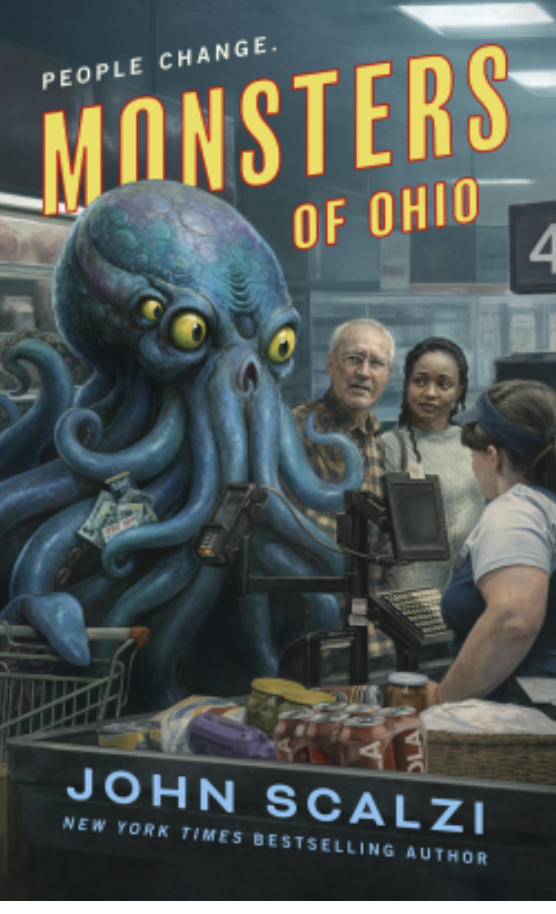
Monsters of Ohio by John Scalzi

Another wacky (and every-page humorous) story from John Scalzi. I love that every Scalzi story that I read reminds me of … absolutely no other story I’ve read. Unique, fun, and — regardless of the weirdness (and sometimes grossness) — pretty upbeat! I bet Scalzi doesn’t even have to work hard on this stuff — I think his tall tales come tumbling out of his brain already perfectly formed.

The setting — a small town in Ohio, a greedy corporation ready to extract every resource before tossing the remainders away, an even sleazier representative of said corp looking to further line his own pockets with some friendly embezzlement on the side. One thing about Scalzi’s books — it’s always very clear who the good guys are and who the bad guys are. Enter our hero, the wry, competent, guy-you-want-on-a-desert-island Mike Boyd — freshly “released” from a D.C. job in the USDA, coming “home,” tail between legs to an emotional set of townies. And then things start to get weird in the way only Scalzi tales can get. Check out the book cover for a few hints. Reminds me of old Astounding magazine covers…

A couple of extra points. Loved the first chapter which is told in second person from the perspective of … a rabbit. Hysterical. Could not stop laughing but also completely engrossed in the rabbit’s experience! Also — cryptids — have not heard that word before but I like it and it has high relevance. Look it up!

Fun, easy to read, a great reality-based hero, and did I mention weird? Really stimulates the creative centers and the funny bone.

Thank you to Tor Books and NetGalley for providing an advance copy of this book in exchange for my honest review. The book will be published on November 3rd, 2026.

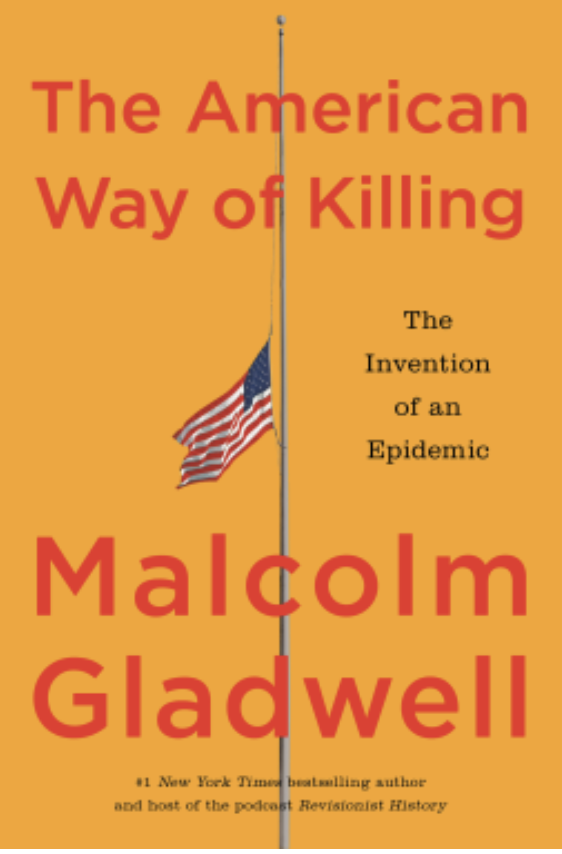
The American Way of Killing by Malcolm Gladwell (Non fiction)

Gladwell’s latest tackles the highly emotional topic of Violence in America — and he tackles it with a shocking amount of anger and aggression aimed at Americans — all 350 million of us. Gladwell’s general approach to his subjects is to (in his words) find interesting anecdotes and interesting research and pair them up. The set of vignettes in this collection do this but in a hostile and often misleading way. Hostile in that he’s clearly angry at Americans (again — all of us) literally and repeatedly calling us stupid, dishonest, “morally reckless,” and pedantic at various points in the narratives. Misleading in that none of his “stories” are comprehensive — some offer partial (but never tested at scale) solutions, many describe efforts and explain why they are a waste of time, a few contradict each other, and several leave out critical aspects of the data that could change the conclusions. I am glad I read this book and I did learn some new and relevant information, but I strongly recommend reading the book critically and doing your own supplemental research to get a fuller picture.

The bits I found interesting: Americans (according to Gladwell) think they are over policed, but in fact we are largely under-policed. A comparison of police forces in L.A. and Berlin (equal populations with L.A. a larger physical area) surprised me. 8,500 police in L.A. vs 18,000 in Berlin. This section included a good description of how a larger police force could prevent more crime and improve community engagement based on interviews with those who had run large police forces (e.g. Boston, L.A.). A dive into a program to teach young men (the victims and perpetrators of the largest segment of gun violence) how to maintain emotional control based on the “realization” that much of gun violence was based on “an exaggerated sense of moral injury leading them to take the law into their on hands.” A few dips into how gun fatality statistics are influenced on the one hand by the amazing abilities of surgeons to save victims who would have died in the past, and on the other hand by the location of trauma centers which are often not close enough to the areas that need them the most. While not productive in any sense, I did learn something from the details of the assault weapons ban — pages and pages of specific weapons banned, an even longer list of those not banned, followed by his point that most homicides were committed with handguns anyway.

The pointless or frustrating bits: Long diatribes about our “absurd” focus on the second amendment and the pedantic nature of the Supreme Court, betraying incomprehension for what the Constitution is and how the Supreme Court is supposed to make decisions (Gladwell is a British-Canadian who has lived in the U.S. since the mid eighties without applying for citizenship so maybe he missed the memo?). Conflating homicides and suicides into single gun violence statistics which give misleading ideas about where the biggest problems are. Some sideways mentions of racism without any cohesive theme — almost as though just throwing it in there.

I’ve read most, if not all, of Gladwell’s books and have enjoyed them. They are called “pop sociology” and I enjoy the surprising tidbits. However, with such a critical topic under discussion, the light-weight nature of the anecdotes coupled with the needlessly hostile tone really didn’t work for me. Read it — but spend some time thinking about what you read and maybe do a little extra research before drawing any conclusions.

There are so many good sources of relevant information out there. Here are a few statistics that I found (and found easily): There is an oft referenced meme on gun friendly states having the highest amount of gun deaths. Using the CDC data at https://www.cdc.gov/nchs/state-stats/deaths/homicide.html, what I found is that by removing the suicides and only looking at homicides, many of the “red” states known to be very gun friendly (Montana, Wyoming, Alaska) jumped down to the middle of the list because almost all (80-90%) of their gun deaths were suicides. In fact, California (very blue!) and Montana (pretty red!) have the exact same number of homicide gun deaths per capita. I also looked up what percentage of firearms in the U.S. were used to cause injury or fatality — according to https://publichealth.jhu.edu/center-for-gun-violence-solutions/data/annual-gun-violence-data, this is 0.003% of all firearms. Lastly, I asked one of the AI engines to give me information on guns used in self-defense and it gave me pointers to several different surveys run by a variety of organizations resulting in a large range (70,000 – 2,500,000) of reported self-defense events, mostly guns used as a deterrant, i.e. without firing a shot. For me this helps to frame why so many people want guns and how few (and concentrated) the use of guns for violence is.

I should mention that I am by no means a “gun nut,” and I’m extremely worried about the level of overall violence in our country — not just inner city gun homicides, but the tendency towards violence with any kind of weapon, the acceptance of politically motivated violence, the excusing of violence committed by the mentally ill, and the violence committed by people who just seem to enjoy it. Some level of gun control is of course required, but it is in no way sufficient. We have a big problem with people and culture — some of Gladwell’s stories point in the right direction, but not nearly enough.

Thank you to Little, Brown and Company and NetGalley for providing an advance copy of this book in exchange for my honest review. The book will be published on September 29th, 2027.

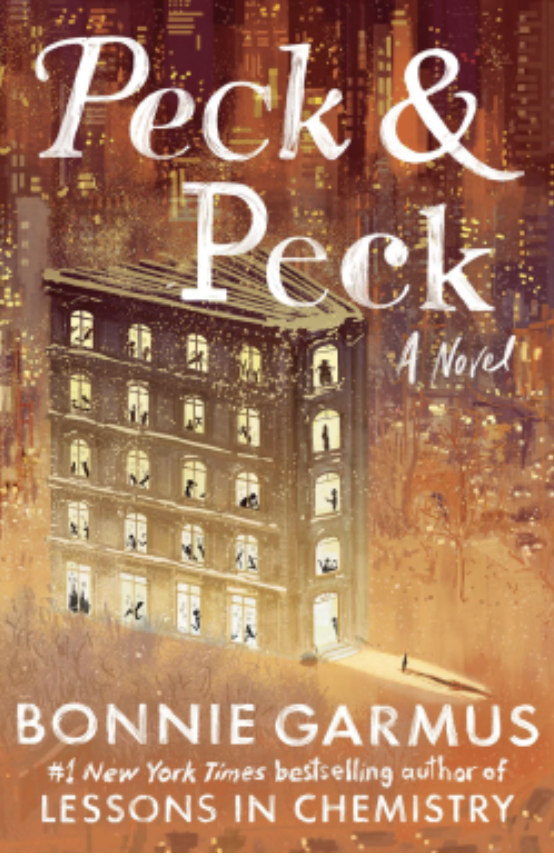
Peck & Peck by Bonnie Garmus (Literary Fiction)

At heart, this is a novel about poetry and how it can change your life — but the poetry theme is tightly inserted into a narrative populated by a madcap scramble of an adventure story replete with good vs evil, multiple layers of deception, the best kind of quirky characters, and lots of personal confusion (and eventual growth :-)) You can read it for the plot, the twisty characters, and / or for the opportunity to do some pretty deep thinking.

Our narrator is Batter — a somewhat timid character who falls hard for Poetry despite experimenting with a wide variety of majors that might have led to more lucrative careers (he does surprisingly well in Accounting). He recognizes that he hasn’t the talent to be a Poet himself, but decides he wants to discover Poets — like Brian Epstein discovered the Beatles. When he heads to the Big Apple after graduation nobody (but himself) is pleased, but through an interesting set of happenstances he lands a (very) low level job at Peck & Peck — the highly illustrious and beyond upscale (also incredibly expensive) Poetry journal. That’s when things start to get interesting.

I’m a character person, and the characters in this book are so very captivating. It took me awhile to warm up to Batter whose timidity and lack of self confidence or direction I found irritating, but I fell in love with his mother immediately. If you’re looking for an Elizabeth Zott type figure, Rainey is it. Rainey is a typeface designer and even if you haven’t a smidgen of interest in the characteristics of typefaces (e.g. common fonts like Arial, Times New Roman, or Palatino or unusual ones such as Impact, Baskerville, Caslon), you might well find her mini contextual lectures on the practical and emotional factors of typeface choice fascinating — I know I did. Dad is the “interesting” kind of historian — one who examines not just what happened in the past, but how the narration shifts with the teller, and how easily we can all be bamboozled. Every one of the editors at Peck & Peck have their own idiosyncratic set of motivations, cringes, hopes, and driving instincts that keep you on your toes if you happen to get bored. And then there is Batter’s “love at first sight” interest… Every character is a real obsessive type — but that’s what makes them interesting (and almost every one of the obsessions is completely obsession-worthy!)

But what about Poetry as a strong theme? I’ve never been a big fan, despite my voracious reading habits. But I perked up when I read one poetry-passionate character toss off the fact that 95% of poetry is boring. Yes! But his thesis is that the very top 1/2% is life changing. This book included excellent pointers to some spectacular poetry and surprisingly I have compiled a set of them and am happily reading, tearing (as in crying, not ripping) up as appropriate.

So — overall fun to read, some very interesting philosophical questions to ponder, a whole lot of tangent topics that were either completely new to me or offered new depths to what I thought I knew already — such as typeface design, slam poetry sessions, and … have you ever heard of heteropaternal superfecundation? Look it up! Reminded me of John Irving books in the way all the weird tangents actually come together in the end to achieve something. A good read.

Quotes:
“Poetry provides answers and despite what my pre-law classes would call an appalling lack of evidence, their answers always seemed right. Or something even more unlikely. Truthful.”

“Awful people succeed because nice people let them. This is the drawback of being nice. Nice people worry that it isn’t nice to take action against awful people because they don’t want to act awful themselves – they don’t want to stoop to that level. But I think nice people have been stooping all along. The worst kind of stooping – because it isn’t stooping, it’s bending over.”

“Poetry is problematic. First, it’s not easy. It forces you to think and sometimes thinking hurts. Also, poetry can make you feel stupid, like you don’t get it. And if you do get it, then it’s only because it just revealed something about yourself that you were hoping to keep hidden.”

“That, in a nutshell, is how the brothers gained new readership: by showing normal, everyday people what poetry was really all about. How it could make them feel; what it could make them think; and why it could change their lives — not just for one night, but for every night thereafter.”

“Dickinson once wrote that hope is a thing with feathers. If that’s true, despair must be a pair of concrete shoes. I know because I wore mine home.”

“The poets I publish have the nerve, the audacity, to face life’s struggles. To wrestle with ugliness, to question prevailing wisdom, to grasp at beauty. And they do it, not by mimicking what’s already been done — not by tilling the same ground, not by planting the same crop, not by sowing the same harvest — but by starting fresh. In a world devoid of poets, do you know what you get? Another knockoff. Another mouthwash.”

“Humans thrive on constant renewal. We require fresh ideas and original thinking to survive, and yet it sometimes feels like the art and necessity of thinking is becoming passe; that the one-size-fits-most, sitcom-rich, knockoff lifestyle is winning. I confess that some days I find the passivity of the human race overwhelming.”

“Since you’re a poetry lover, maybe you’ve heard of this new thing that makes poetry tolerable. It’s called music.”

Thank you to Scribner and NetGalley for providing an advance copy of this book in exchange for my honest review. The book will be published on October 13th, 2027.
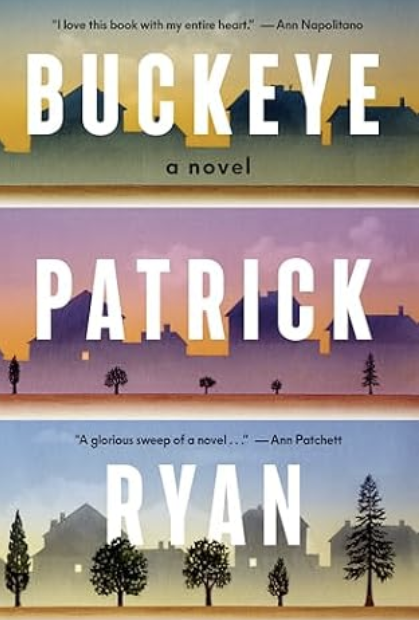
Buckeye By Patrick Ryan (Literary Fiction)

A sweeping, historical, novel that delves into the intimate lives of two couples in the post WWII midwest: Cal Jenkins, prevented from doing his patriotic duty due to a birth defect; his wife Becky, a spiritualist whose life work is helping the living connect to their dearly departed (and never for a fee); Felix Salt, a true gentleman with a deep secret he keeps even from himself; and his wife Margaret, abandoned at birth and deeply craving family.

The Amazon description summarizes with: “Sweeping yet intimate, resplendent with moments of deep emotion and unforgettable characters, Buckeye is a transportive story of love, loyalty, sacrifice, and forgiveness.” That isn’t the way I would have described it — I’ve spent quite a bit of time trying to understand why I didn’t like it, because I really did not!

I can see why I should have liked it: it was written well, contained deep dives on various topics in human interaction such as the “love, loyalty, sacrifice, and forgiveness” mentioned above. And it did utilize meticulously drawn characters to drive the plot. But in truth I often found it a slog to read — and I did not find the characters memorable (or engaging) at all. I particularly had an issue with the way the women were drawn. The two men made sense — I could see how their life experiences made them who they were, and I was attracted to their personal growth throughout the book. But the women did not work for me — especially Margaret whose behavior appeared to be explained away as an oversimplified result of her childhood. I’m trying not to include any spoilers here, but suffice it to say that I do not believe her story would have ended up the way it did, and I was pretty unhappy with the distribution of guilt (i.e. some characters should have felt more guilt than they did, while others felt more than they should have). My gut feeling is that while the book is marketed as an ensemble piece, Felix is the central character — the only one imbued with a “real person” vibe and the only one who gets a “happy ending,” somewhat at the expense of everyone else IMHO. But to each his or her own! You may identify with and applaud the narrative around what may be for you a compelling character. Would love to discuss this more with anyone who has already read it so I don’t have to keep quiet about what bugged me!