
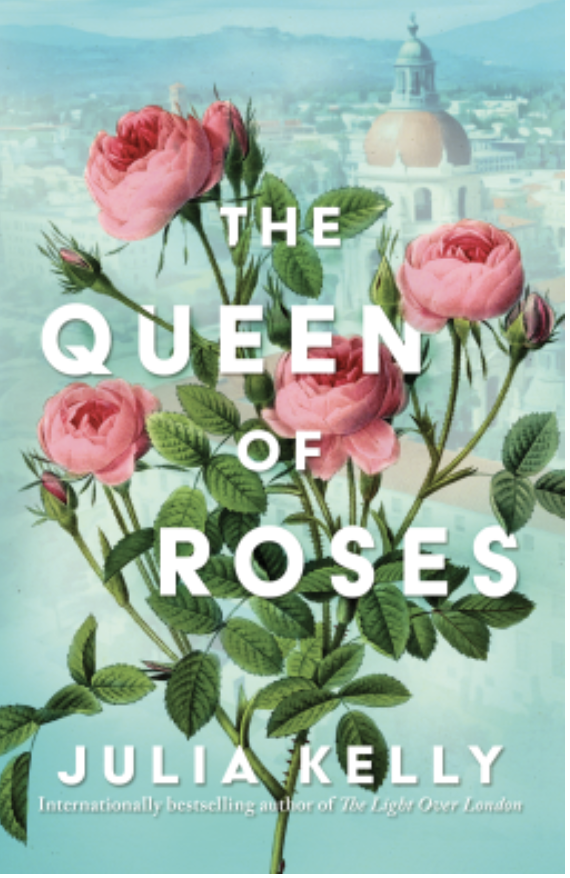
The Queen of Roses by Julia Kelly (Historical Fiction)

.Julia Kelly writes beautiful historical fiction, encompassing story with a personal immersion in the social and physical context of the times. This novel brings to life Pasadena in the early 1900s through dual timelines: one following Adele — an English rose imported from England against her inclination in 1903 — and Theresa — a woman journalist trying to break away from the dead-end (pun intended!) obit desk in 1960. An opportunity to interview a reclusive “old lady” living out of town in a gorgeous rose nursery may be the break she is looking for. Pasadena (as we all know after the recent fire) is fire country, and fire plays a role in both timelines.

I love Kelly’s writing — she’s a “show not tell” writer so all of the detailed and gorgeous prose describing life, surroundings, manners, and society comes naturally as part of the story. There are no long, dreary (to me) descriptions of wainscoting, tableware, or dress tufts that I am forced to skim through, and yet I can picture the houses, the grounds, and the clothing with ease. And the ambiance of the place at that time — the openness, the newness, the literal feel of opportunity and space — are incredibly real. I happened to be reading this while in a nearby section of Los Angeles — definitely a stark contrast! The pace is slow, and yet never boring. Just the right amount of words used to smoothly carry you from start to finish. Never choppy. I forgot that I was reading. Plenty of story with a satisfying conclusion. Gardening — in a way appealing (I think) to even non gardeners.

Very enjoyable.

Thank you to Gallery Books and NetGalley for providing an advance copy of this book in exchange for my honest review. The book was published on October 20th, 2026.

The Last Garden in England by Julia Kelly (Historical Fiction)

A story you can slide right in to, The Last Garden in England brings to life three generations of women whose lives cross the spectacular gardens at Highbury House in Warwickshire. Mixing their voices in a collection of chapters slotted into each season of a single year, we witness the progression of their lives in the contexts of radically different times and accompanying social mores.

In 1907, Edwardian garden designer Venetia Smith designs the gardens. In 1944, recently widowed Diana Symonds is the Lady of Highbury House, now repurposed as a convalescent hospital; Stella Adderton, head cook, is caring for her orphaned nephew; and Elizabeth Pedley is a Land Girl on the adjacent farm. In 2021, Emma Lovett is trying to restore the gardens, struggling to unearth information on their original state.

The writing and story remind me of Kate Morton (I’m a fan) — deep characters and easily absorbed writing with a plot that that is equally character and story driven. I love the way each character makes her way through the constraints of her time period following the dictates of her own values on vocation, family, love, and internal worth. They were all different! Some were naturally maternal, some not; some were pulled towards a life of great achievement (despite difficulties), some not; some were willing to compromise for love, some not. I loved the lack of stereotypes and the matter-of-fact descriptions of social context for women in each time period and the way they got on with it. Included interesting insight into the process of garden design (both creation and restoration).

A real joy to read with that lovely combination that keeps both the heart and the mind engaged.

Thank you to Gallery Books and NetGalley for providing an advance copy of this book in exchange for my honest review. The book will be published on January 12th, 2021.