
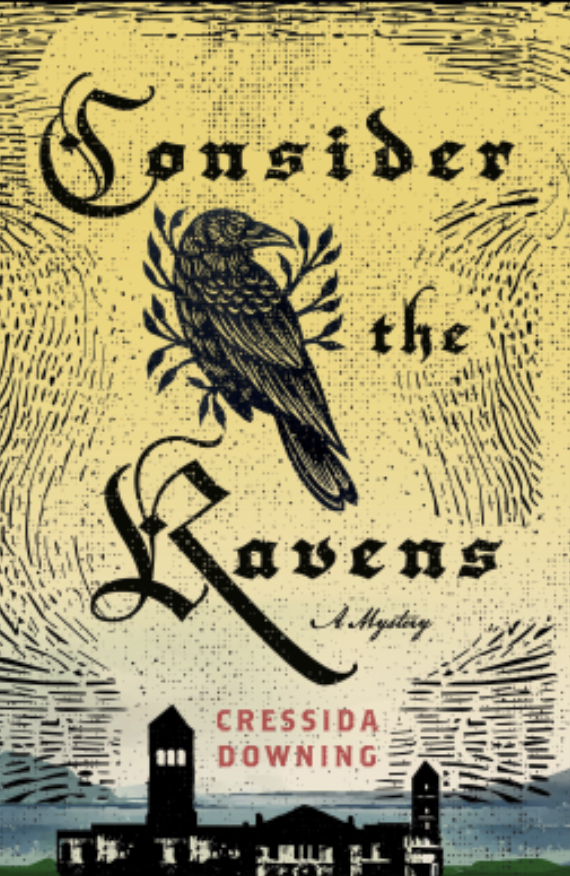
The first in a new mystery series set in the Lindisfarne monastery in 1494. Linnet is a female scribe seeking sanctuary on the island she grew up on, making herself useful through her skills as a scribe. She is fairly friendless when she arrives — only an old fisherman from her childhood and a stray child with her raven can be counted on as somewhat connected — and she has much to hide. When three bodies turn up one by one — two “accidents” and a suicide, she begins to be suspicious but has no one she can trust to turn to.
This book was a real surprise for me — I expected a nice, palate cleansing, historical cozy, but what I got was a fascinating piece of historical fiction with a mystery providing the plot and pacing. I was drawn into the writing, completely forgetting that I was reading a book. I was fully immersed in the (quite foreign) time and place — a monastery on a Holy Isle with a strong interest in producing manuscripts. A woman who is respected by some for her great skill, and shunned by others for being a woman (and a bastard at that!). Each of the characters — the various monks, the Prior, the hellfire breathing Inspector, the locals, and the odd child who seems to be on her own and difficult to boot — all have their own personalities, their own interpretation of a moral code, their own inner turmoils and weaknesses. I liked the tangled knot of the community formed by all the slippery pieces.
I also absolutely loved the details on the process and experiences of scribing, especially as pertained to a woman practicing the craft at the time. The author included a historical note which pointed out that women in the 1400s were often skilled tradespeople and were allowed to practice their crafts (see links to articles about the recent exhibit at the British Library about Medieval Women). I found every bit of the descriptions of penmanship — some of the monks could barely read and were copying shapes rather than letters and content — illumination (illustrating), making inks, making pens from quills, etc. quite fascinating. As she tries to piece together clues from the dead Oswyn’s scraps of paper, Linnet must translate from Latin — I enjoyed the process by which she does that, along with her passing on her knowledge of reading and writing to those interested. I also enjoyed the medieval theology that came out through orations, considerations, and reflections. Something that surprised me — the “sins that cry out for vengeance” that are: Willful murder, oppression of the poor, withholding laborers pay, and sodomy. All drawn from specific bible verses. Plenty to keep the mind busy while simultaneously unraveling the mystery.
From the afterward — sources of information on the lives of Medieval women:
• http://www.bbc.co.uk/news/science-environment-46783610
• https://www.bl.uk/about/press/releases/last-chance-to-see-major-exhibition-that-tells-the-story-of-medieval-women-in-their-own-words
Thank you to Minotaur Books and NetGalley for providing an advance copy of this book in exchange for my honest review. The book will be published on July 20th, 2027, although an earlier edition of the book, from another press, was published this year.

