
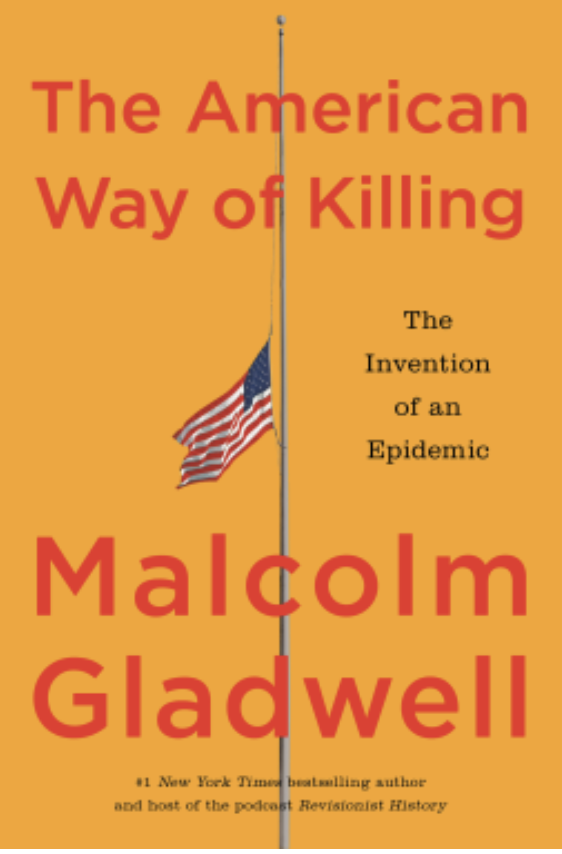
Gladwell’s latest tackles the highly emotional topic of Violence in America — and he tackles it with a shocking amount of anger and aggression aimed at Americans — all 350 million of us. Gladwell’s general approach to his subjects is to (in his words) find interesting anecdotes and interesting research and pair them up. The set of vignettes in this collection do this but in a hostile and often misleading way. Hostile in that he’s clearly angry at Americans (again — all of us) literally and repeatedly calling us stupid, dishonest, “morally reckless,” and pedantic at various points in the narratives. Misleading in that none of his “stories” are comprehensive — some offer partial (but never tested at scale) solutions, many describe efforts and explain why they are a waste of time, a few contradict each other, and several leave out critical aspects of the data that could change the conclusions. I am glad I read this book and I did learn some new and relevant information, but I strongly recommend reading the book critically and doing your own supplemental research to get a fuller picture.
The bits I found interesting: Americans (according to Gladwell) think they are over policed, but in fact we are largely under-policed. A comparison of police forces in L.A. and Berlin (equal populations with L.A. a larger physical area) surprised me. 8,500 police in L.A. vs 18,000 in Berlin. This section included a good description of how a larger police force could prevent more crime and improve community engagement based on interviews with those who had run large police forces (e.g. Boston, L.A.). A dive into a program to teach young men (the victims and perpetrators of the largest segment of gun violence) how to maintain emotional control based on the “realization” that much of gun violence was based on “an exaggerated sense of moral injury leading them to take the law into their on hands.” A few dips into how gun fatality statistics are influenced on the one hand by the amazing abilities of surgeons to save victims who would have died in the past, and on the other hand by the location of trauma centers which are often not close enough to the areas that need them the most. While not productive in any sense, I did learn something from the details of the assault weapons ban — pages and pages of specific weapons banned, an even longer list of those not banned, followed by his point that most homicides were committed with handguns anyway.
The pointless or frustrating bits: Long diatribes about our “absurd” focus on the second amendment and the pedantic nature of the Supreme Court, betraying incomprehension for what the Constitution is and how the Supreme Court is supposed to make decisions (Gladwell is a British-Canadian who has lived in the U.S. since the mid eighties without applying for citizenship so maybe he missed the memo?). Conflating homicides and suicides into single gun violence statistics which give misleading ideas about where the biggest problems are. Some sideways mentions of racism without any cohesive theme — almost as though just throwing it in there.
I’ve read most, if not all, of Gladwell’s books and have enjoyed them. They are called “pop sociology” and I enjoy the surprising tidbits. However, with such a critical topic under discussion, the light-weight nature of the anecdotes coupled with the needlessly hostile tone really didn’t work for me. Read it — but spend some time thinking about what you read and maybe do a little extra research before drawing any conclusions.
There are so many good sources of relevant information out there. Here are a few statistics that I found (and found easily): There is an oft referenced meme on gun friendly states having the highest amount of gun deaths. Using the CDC data at https://www.cdc.gov/nchs/state-stats/deaths/homicide.html, what I found is that by removing the suicides and only looking at homicides, many of the “red” states known to be very gun friendly (Montana, Wyoming, Alaska) jumped down to the middle of the list because almost all (80-90%) of their gun deaths were suicides. In fact, California (very blue!) and Montana (pretty red!) have the exact same number of homicide gun deaths per capita. I also looked up what percentage of firearms in the U.S. were used to cause injury or fatality — according to https://publichealth.jhu.edu/center-for-gun-violence-solutions/data/annual-gun-violence-data, this is 0.003% of all firearms. Lastly, I asked one of the AI engines to give me information on guns used in self-defense and it gave me pointers to several different surveys run by a variety of organizations resulting in a large range (70,000 – 2,500,000) of reported self-defense events, mostly guns used as a deterrant, i.e. without firing a shot. For me this helps to frame why so many people want guns and how few (and concentrated) the use of guns for violence is.
I should mention that I am by no means a “gun nut,” and I’m extremely worried about the level of overall violence in our country — not just inner city gun homicides, but the tendency towards violence with any kind of weapon, the acceptance of politically motivated violence, the excusing of violence committed by the mentally ill, and the violence committed by people who just seem to enjoy it. Some level of gun control is of course required, but it is in no way sufficient. We have a big problem with people and culture — some of Gladwell’s stories point in the right direction, but not nearly enough.
Thank you to Little, Brown and Company and NetGalley for providing an advance copy of this book in exchange for my honest review. The book will be published on September 29th, 2027.

